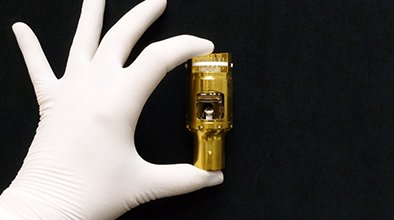
At the heart of all PanScan systems is the remarkably robust PanScan scan head. While designed and optimized for Low Temperature and Magnet fields, it is extremely versatile in numerous demanding settings. Compact, rugged, capable of atomic resolution in or out of high-Tesla environments or temperatures from mK to 400 K. Operates from ambient to UHV. PanScan scanners use industry-standard flag-style sample plates. PanScan offers a wide variety of important practical features, such as 4 electrical contacts on the sample stage (standard); internal temperature sensor; internal sample heater for small localized temperature tweaks; large rear opening in the body to view tip/sample approach; and 4 symmetrical openings around the body for in-situ sample deposition or optical access to the tip/sample junction. Compact and so adaptable – the perfect fit for the Freedom closed cycle cryostats and Freedom Tesla magnet bores or integrated into 3rd party bath cryostats, or dropped in or bolted-on as a multi-functional SPM for homebuilt systems. Let us put a PanScan to work for you today. Specifics - Dedicated STM or STM/qPlus AFM, switchable in vacuum - mK & High Magnetic Field Compatible - Imaging from mK to LT to 400K, in or out of high Tesla magnet fields - Atomic resolution - Ultra-rigid, ultra-stable design - Very low drift - Change tip or sample without disturbing the other - Sample size: 10mm x 10mm (standard), uses typical flat plate sample holder - Able to retract tip and re-approach in same area with high accuracy - Coarse positioning XYZ: 4mm x 4mm x 8mm - Scan range: 5µ x 5 µ XY at RT
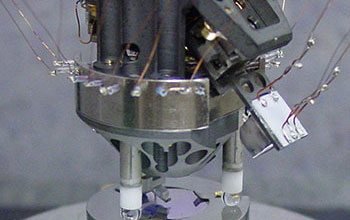
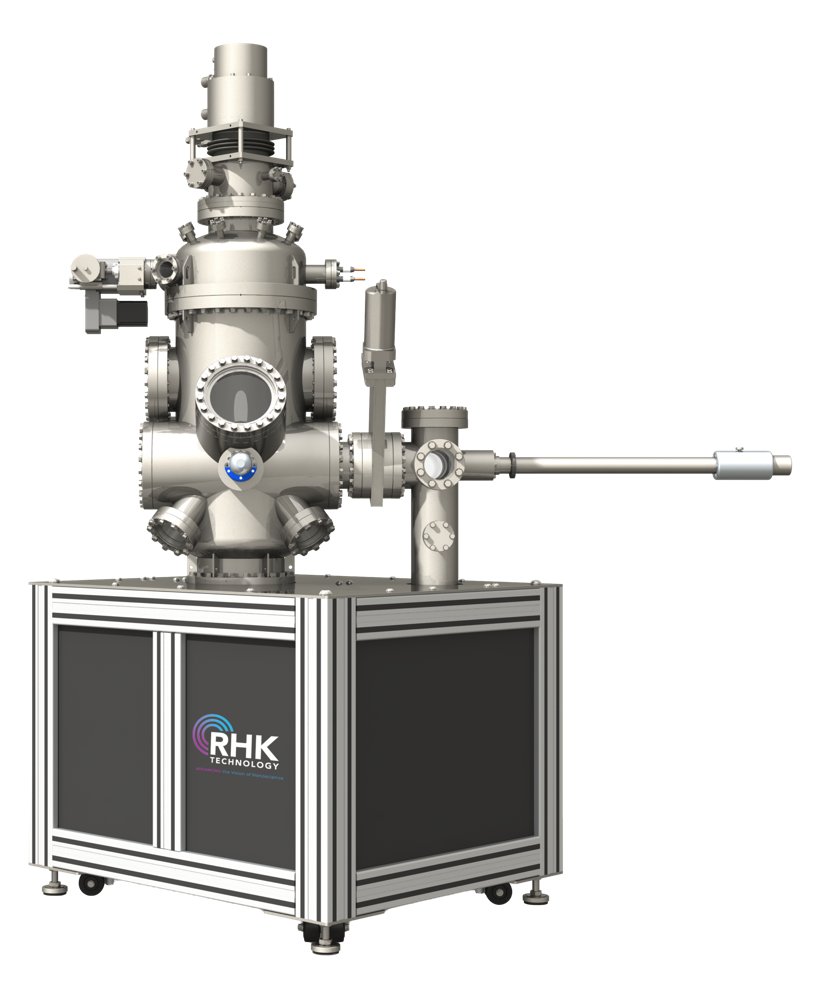
BEETLE FAMILY Beetle UHV VT AFM Overview Performance and versatility using standard cantilevers with the most accurate UHV AFM laser deflection system Based on the field-proven “Johnny Walker” Beetle™ design, RHK’s VT Beetle is the most mechanically and thermally stable of the many variable temperature SPM designs on the market today. Wide VT operation from 25 K (LHe) to 1500 K, the Beetle AFM/STM systems are based on the traditional laser deflection – position sensitive detection (PSD) feedback design. This provides the full range of AFM acquisition modes including; Normal Force, Lateral Force, Non-Contact, Near Contact, Constant Height, CAFM, MFM, simultaneous AFM/STM, and more. The Beetle AFM includes standard commercial cantilever mounts and standard STM tip wire mounts with in vacuum storage and in-situ exchange for easy cantilever and/or tip exchange without breaking the vacuum. The open exchange holders also provide for in-situ thermal and ion beam tip conditioning. Quick Specifications - Straightforward laser path without mirrors or lenses - Intuitive orthogonal laser and PSD alignment - True quantitative friction force measurements - Coarse XY positioning at least 5 mm x 5 mm - Scan range of at least 5 micron x 5 micron XY - Minimum resolution of 0.5Å (X, Y) and 0.1Å (Z) - Thermal drift <1 Å/min - Sample temperatures: from 25 K (LHe) to 1500 K; or 100 K (LN2) to 1500 K - Sample size 10mm diameter Specifics - Inherent Mechanical and Thermal Stability due to small mechanical and thermal loop, inherently stiff and compact Beetle design, and symmetrical geometry. Thermal drift <1 Å/min - Easy day-to-day use without frustration of others’ more complex and less intuitive approach - Simple, direct line of sight laser positioning on cantilever with X and Y motors - Simple, direct line of sight PSD positioning to reflected laser spot with X and Y motors - Simple optical path, without mirrors or lenses - Easy to adjust to center of PSD - True quantitative lateral force (LFM and nanotribilogy) measurements can be made - Optical pathway adjusts on both the cantilever and detector, allowing nulling of both normal and lateral force signals. - Heating samples has no impact on Scan Tube, eliminating danger of affecting its thermal coefficient and causing drift - Beetle design scans more quickly than sample scanners due to fewer restrictions on resonant frequency - Coarse XY positioning at least 5 mm x 5 mm - Scan range of at least 5 micron x 5 micron XY - Minimum resolution of 0.5Å (X, Y) and 0.1Å (Z). - Thermal drift <1 Å/min - Sample temperatures: from 25 K (LHe) to 1500 K; or 100 K (LN2) to 1500 K - Beetle sample holder uniquely provides true and accurate sample temperature measurement via thermocouple in direct contact with sample itself. - Sample temperatures from 25 K to 1500 K on SPM sample stage and on manipulator stages in preparation/analysis chambers - Sample temperature while imaging: 1000 K for AFM (with new Therma AFM), 1000 K for STM - 6 electrical contacts to sample holder (2 for temperature, 2 for heating, 2 for auxiliary use such as BEEM). A single holder conveniently supports all heating and cooling modes – radiative, e-beam, resistive/DC; LN2 and LHe - Sample holders also available for Cleaving; delivering RF signal to sample; and heating in reactive gases via Quartz Bulb or Ceramic Button - Sample size 10mm diameter Documentation Beetle Brochure
CATEGORY
R9plus: Ultimate SPM Control R9plus BUILT for a PURPOSE: Your Research, Your Success When you are pioneering the frontiers of Nanoscience, you can count on RHK’s new R9plus SPM Controller to lead the way. Its remarkable advancements originate from direct user feedback, RHK’s Technical Advisory Board, and our own top scientists. Explore with Confidence With the plus Advantage, no Controller is better equipped or more capable to take on any research challenges you face. History behind R9plus RHK’s original R9 brought great new capabilities and fresh thinking to the SPM field worldwide. It even forced design re-thinking in our competitors’ systems. Although they tried to catch up, they couldn’t match up to R9. Meanwhile, our continuous improvement process evolved R9 well beyond our prior breakthroughs and achievements. With so many new capabilities and ever-improved, ever-expanding firmware, a new model emerged. This is R9plus. While we pledge our continued support for existing R9 units and customers, we proudly announce our new R9 successor: R9plus. With R9plus, RHK sets the standard as the Innovation Leader for SPM Control. Over 1,000 RHK original “Blue Box” Controllers were installed worldwide. Then we revolutionized the field with R9 integrated Controllers. More than 225 R9s are producing published results today. Now, RHK surpasses the market yet again with R9plus. Uniquely integrated into one box, R9plus unites near-limitless flexibility and power with thoughtfully designed single-click simplicity and rock-solid stability. R9plus’s refined and expanded firmware, software, and even further improved analog circuitry give you highest performance and confident command. Only from RHK – The Innovation Leader How did we make the Revolutionary R9plus SPM Controller even better? R9plus: 2nd Generation Refined Electronics, even quieter and faster performance, and uniquely advanced plus-capabilities: - Native 64-Bit Application for greater stability, higher speed operation, and unlimited data arrays for advanced spectroscopy measurements. - New FPGA architecture for greatly enhanced configuration flexibility. - More data channels – now over 60 channels available for advanced measurements. - Data streaming rate 5x faster. High-Speed Scanning 5x faster. - New Analog Circuitry with 4x lower noise. - Improved Lock-In Amplifiers – now increased demodulation bandwidths up to 100 kHz. - Up to 6x Lock-In Amplifiers, 2x PLLs. - Lock-In Amplifiers and PLLs configurable to operate independently or in series. - New KPFM with a click: multi-frequency measurements plus added feedback loop for measuring Contact Potential. - Up to 9 Feedback Loop controllers for multiple probes, KPFM, interferometers, etc. - Multiple Feedback Loops can be connected in parallel or series. - New, Improved Signal Control Module replaces IVP-R9. Programmable output voltage range provides lower noise for high-resolution spectroscopy without limiting total voltage output range. - Dual-Probe Scan Control with dual scan area windows: Enables 1 controller to operate 2 separate SPMs. - Inventor SDK/IHDL: customize routines; exchange data via LabVIEW VIs, MATLAB, Python, etc. - Zoom FFT for thermal resonance peak detection. - PerfectSpec™: Fully customize spectroscopic measurement techniques. Optimize performance for any parameter, e.g., ultimate low noise or high data throughput. - Real-time spectroscopy data slicing can slice through arrays of spectroscopy curves to generate current maps during acquisition. - Non-integer powers of 2 for spec grid: acquire spectroscopic grids of any density, such as 100 x 50 points. - Digital filter bandwidths increased to 0.01 Hz to 100 kHz. Bandwidths can be set to any arbitrary value. - Non-square scans for scanning rectangular images in addition to square images. - Assignable Monitor DACs: DACs 1 – 4 can be linked to output data from any of the 60 internal signals to interface to external equipment. - Independently assignable Low Voltage Scan DACs, now no longer tied to HV scan DACs. - New Probe Drive Interface: programmable output voltage range allows optimal probe drive for resonators with Qs from 1 to 1,000,000. Guided by user feedback, R9plus advances even beyond R9 Success Over 200 shipped
CATEGORY
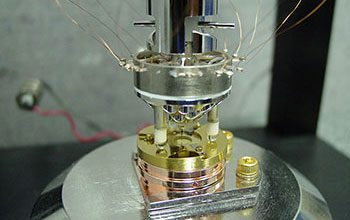
The standard in VT STM with the best stability and lowest noise Overview Based on the field-proven “Johnny Walker” Beetle™ design, RHK’s VT Beetle is the most mechanically and thermally stable of the many variable temperature SPM designs on the market today. Wide VT operation from 25 K (LHe) to 1500 K, the Beetle STM systems have been delivering the highest quality low current imaging for over a decade. Flexible operating modes combined with our low noise, high bandwidth control electronics provide the user with an unparalleled performance STM system package. Our patented tip exchange system provides simple tip exchange along with in-situ tip conditioning on VT systems or with the optional tip heating module. Features - Low Current Imaging – < 1pA at 5kHz bandwidth - High Speed Scanning – 3 sec/frame - Coarse XY positioning at least 5 mm x 5 mm - Scan range of at least 5 micron x 5 micron XY - Minimum resolution of 0.5Å (X, Y) and 0.1Å (Z) - Thermal drift <1 Å/min - Sample temperatures: from 25 K (LHe) to 1500 K; or 100 K (LN2) to 1500 K - Sample size 10mm diameter Specifics - Low Current Imaging – < 1pA at 5kHz bandwidth - High Speed Scanning – 3 sec/frame - Inherent Mechanical and Thermal Stability due to small mechanical and thermal loop, inherently stiff and compact Beetle design, and symmetrical geometry. Thermal drift <1 Å/min - Ideal for spectroscopy and prolonged observation of a particular feature - Heating samples has no impact on Scan Tube, eliminating danger of affecting its thermal coefficient and causing drift - Beetle design scans more quickly than sample scanners due to fewer restrictions on resonant frequency - Coarse XY positioning at least 5 mm x 5 mm - Scan range of at least 5 micron x 5 micron XY - Minimum resolution of 0.5Å (X, Y) and 0.1Å (Z). - Thermal drift <1 Å/min - Sample temperatures: from 25 K (LHe) to 1500 K; or 100 K (LN2) to 1500 K - Beetle sample holder uniquely provides true and accurate sample temperature measurement via thermocouple in direct contact with sample itself. - Sample temperatures from 25 K to 1500 K on SPM sample stage and on manipulator stages in preparation/analysis chambers - Sample temperature while imaging: 1000 K for AFM (with new Therma AFM), 1000 K for STM - 6 electrical contacts to sample holder (2 for temperature, 2 for heating, 2 for auxiliary use such as BEEM). A single holder conveniently supports all heating and cooling modes – radiative, e-beam, resistive/DC; LN2 and LHe - Sample holders also available for Cleaving; delivering RF signal to sample; and heating in reactive gases via Quartz Bulb or Ceramic Button - Sample size 10mm diameter Documentation Beetle Brochure
CATEGORY
Introducing the PanScan Freedom II New Frontiers in Performance and Flexibility Building on the success of the original PanScan Freedom, RHK Technology's latest PanScan Freedom II (PSF II) redefines cryogen-free performance, combining advanced thermal, magnetic, and optical capabilities to a new level in a versatile, compact platform. The original PanScan Freedom was the industry's first cryogen-free SPM and set a standard for mechanical stability and noise resistance. Cutting edge performance was repeatedly achieved in upper floors of buildings and other sub-optimal laboratory environments. The PanScan Freedom II advances this legacy. It delivers 5 K base temperature operation, providing liquid-helium performance with none of the complexity or costs. An integrated 7 T magnet and single cryogen-free cryocooler provides the capabilities of a wet system without the cost or complexity. Unobstructed optical access supports direct light injection/collection and precise probe visualization. An optional sample scanning module allows dual scanning modes—probe-scanning (up to 1.5 μm) and sample-scanning (up to 15 μm x 15 μm)—expanding flexibility for both ultra-fine and large-area imaging. The probe holder has increased the number of electrical contacts from three to ten. This enables measurements utilizing self-sensing cantilevers, thermally actuated cantilevers, Scanning Thermal Microscopy, device-on-probe, and more. The sample holder has increased the number of electrical contacts from four to ten. This enables samples with integrated complex devices, simultaneous SPM and transport measurements, scanning gate measurements, on-sample thermometry, and more. The PanScan Lumin option provides a highly versatile platform for the study of light/matter interactions. The integrated achromatic parabolic mirror allows over 70% of the emitted light from the far-IR to the deep-UV to be collected. The PSF II retains the PanScan Freedom's compact footprint and full compatibility with RHK's R10 Controller. Its unified cryostat design simplifies operation and ensures high uptime. For labs without magnetic field needs or limited space, the original Freedom remains available in 15 K, 8 K, and 5 K versions, all capable of world-class performance in real-world conditions. The PanScan Freedom II represents RHK's continued commitment to advancing the vision of nanoscience. Merging lower temperatures, magnetic versatility, and superior optical access, it delivers unmatched performance within a fully cryogen-free system. PSF II empowers researchers to explore deeper, faster, and farther into the frontiers of quantum and materials science.
CATEGORY
