By Peak Nano
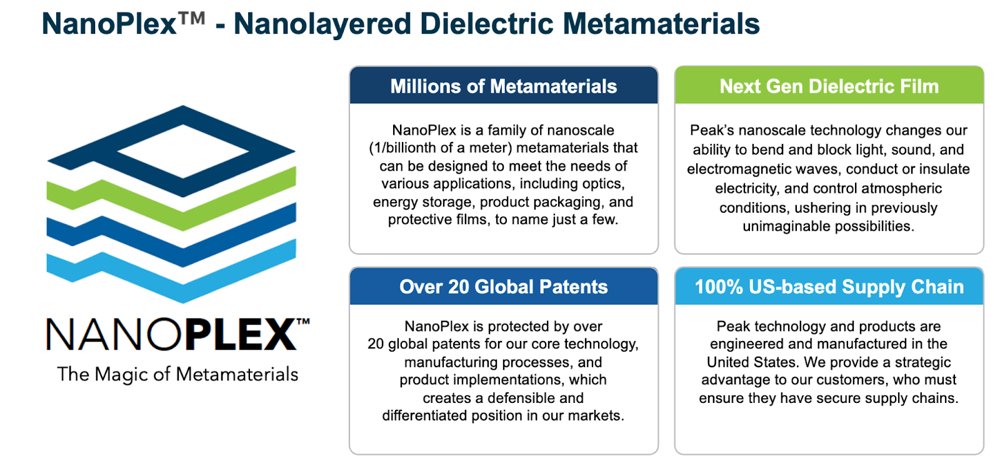
NanoPlex is a family of nanolayered dielectric capacitor films that have been meticulously designed to meet and exceed the demands of the AI-enabled power grid, high-frequency switching, hybrid power factoring, mobile power distribution, and igniting fusion energy systems. Mobile power distribution requires high-voltage power capacitors to integrate and provide predictable power delivery and meet utility grid reliability requirements (voltage stability, phase stability, etc.). NanoPlex-based capacitors can be leveraged for mobile energy deployments to ensure that the power delivered meets the needs of homes, industries, and other energy consumers.
Ultra Energy-Dense Film for Next-Generation Capacitors High-Energy, High-Stability Film Technology Engineered for Demanding Power Systems NanoPlex HDC films are advanced nanolayered dielectric materials that significantly increase the energy storage capacity of capacitor films. Built with Peak’s patented metamaterials and U.S.-based manufacturing, HDC films deliver higher energy density, improved thermal stability, and longer device lifetimes in compact footprints. HDC films are specifically formulated to deliver high energy density in demanding pulse power applications. Best performance is obtained in oil-impregnated film/foil capacitor formats that yield high shot life coupled with significant reduction in device size and footprint. The Next Generation of High-Density Dielectric Films Up to 4x More Energy Storage NanoPlex films enable smaller and lighter capacitors, which reduces space and infrastructure requirements while helping to cut overall capacitor costs. 2x Smaller Capacitor Footprint NanoPlex HDC enables capacitor designs that are 2x smaller, reducing the footprint and overall cost. Higher Thermal Stability (Up to 105°C) NanoPlex’s higher temperature capabilities enable functionality in hotter environments while reducing cooling demands on the system and thus reducing overall system weight and cost. Higher Shot Life Enable 2x times more pulse discharges than pulse power capacitors built to the same capacitance and voltage ratings using other commercial polymer films. U.S.-Engineered, Lab-Tested Backed by 20+ Global Patents, ASTM and JIS-certified performance data. What Is Peak NanoPlex™ HDC? NanoPlex™ HDC Film vs. Conventional Capacitor Films Feature / Property: Conventional Capacitor Film (BOPP / PET) vs NanoPlex HDC Film Dielectric Constant (εᵣ): ~2.2 (BOPP), ~3.3 (PET) vs 3.8 – 4.9 Energy Density: Baseline vs Up to 4x higher energy storage per unit volume Thermal Operating Limit: 85°C typical (BOPP), 105°C with de-rating (PET) vs Up to 105°C without de-rating Footprint / Size Efficiency: Requires more volume to match HDC capacity vs Up to 2x smaller capacitor banks Lifetime at High Temp: Shorter lifespan, early failure in hot environments vs Longer lifespan due to reduced thermal stress Material Composition: Single or few-layer polymers vs Nanolayered metamaterial (up to 4,096 layers) Manufacturing Location: Largely foreign-sourced (China, Europe, India) vs 100% U.S.-based production Supply Chain Security: Exposed to foreign dependency & tariff risk vs Secure, ITAR-compliant, DoD-preferred Applications: General purpose capacitors vs Fusion, EMALS, EV, HVDC, Aerospace Patent Protection: Commodity-grade, limited IP vs 20+ Global Patents Custom Thickness & Metallization: Often fixed grades only vs Available on request Ideal for High-Energy Applications Aircraft EMALS & Directed Energy Systems Mobile Grid Solutions Laser Fusion Reactors & Inertial Confinement Fusion Motor Start Applications NanoPlex™ HDC Film Specifications Property / Method / Units / HDC (4125) / HDC (3125) Dielectric Constant: ASTM D150, 1 kHz, 25ºC: 4.7 / 3.7 Dissipation Factor: ASTM D150, in % at 1 kHz, 25ºC: 1.0 / 0.5 Breakdown Strength @ 25°C Oil submersion method: ASTM D149, V/micron: 790 / 820 Shrinkage MD/TD: JIS K7133, % at 130°C: <0.1/<0.1 / <0.1/<0.1 Shrinkage MD/TD: JIS K7133, % at 150°C: 0.75/0.60 / 1.9/0.65 Tensile Strength, MD/TD: ASTM D638, MPa: 63/57 / 90/75 Young’s Modulus MD/TD: ASTM D638, MPa: 2300/2500 / 2300/2500 Elongation at Break MD/TD: ASTM D638, %: 65/60 / 95/100 Coefficient of Friction (Static): JIS K7125, roll face to air face: 0.45 / 0.45 Coefficient of Friction (Dynamic): JIS K7125, roll face to air face: 0.35 / 0.35 Surface Roughness (Ra): JIS B0601, Microns: 0.03 / 0.03 Density: ASTM D792, g/cc: 1.5 / 1.36 Maximum Temperature: n/a, ° Celsius: 105 / 105 Thickness: n/a, Micron: 8,12 / 8,12 Roll Width: n/a, Millimeters: 620 / 620 Film Length: n/a, Meters: 500-5000 / 500-5000 Metallization, slitting, and other thicknesses available upon request. Based on 8 micron film. Frequently Asked Questions What is NanoPlex™ HDC film and how does it compare to conventional capacitor film like BOPP or PET? NanoPlex HDC is a nanolayered, high dielectric constant capacitor film developed by Peak Nano. It offers up to 4x greater energy storage in the same footprint, withstands higher temperatures (up to 105°C without de-rating), and enables smaller, lighter capacitor designs. Compared to BOPP or PET, HDC delivers superior thermal, electrical, and mechanical performance - especially in demanding environments like fusion energy systems and aerospace power platforms. How does the dielectric constant of NanoPlex™ HDC affect energy storage? The dielectric constant (εᵣ) of NanoPlex HDC ranges from 3.8 to 4.9, compared to ~2.2 for BOPP. A higher dielectric constant directly correlates to greater energy storage capacity per unit volume, meaning capacitors can be made smaller while storing the same, or more, energy. This is critical in space-constrained or thermally demanding applications. What applications benefit most from using NanoPlex™ HDC film? HDC film is ideal for pulsed power, high-voltage DC (HVDC) transmission, laser fusion reactors, military-grade EMALS, motor start solutions, and advanced aerospace power platforms. It excels in environments where thermal endurance, miniaturization, and reliability under stress are top priorities. Is NanoPlex™ HDC film available for sampling or production orders? Yes. Peak Nano is currently scaling high-volume production for commercial availability. Customer samples are available, and custom configurations (e.g., metallization, slitting, thickness) can be discussed to match application-specific capacitor requirements. How is NanoPlex™ HDC manufactured and why is U.S. production important? NanoPlex HDC is 100% manufactured in the United States using patented nanolayered metamaterial technology. This ensures supply chain security, compliance with U.S. defense and energy regulations, and faster delivery cycles. Unlike foreign-sourced BOPP/PET film, HDC provides ITAR-safe, tariff-resistant sourcing that supports national manufacturing resilience. Ready to Evaluate NanoPlex Films? Request a sample kit of NanoPlex HDC for in-house qualification, compatibility testing, and grid-level performance validation.
CATEGORY
High-Temperature Capacitor Films for High-Performance Capacitors What is NanoPlex TM LDF? NanoPlex LDF is a capacitor film designed to outperform conventional BOPP. With a low dissipation factor and stable dielectric behavior up to 135°C, it’s engineered for high-frequency, high-temperature applications like fusion energy systems, EVs, renewables, HVDC, grid, and pulsed-power defense platforms. Easily metallized and wound using existing infrastructure, LDF eliminates the need for major retooling. By extending operational lifetime and thermal reliability, it slashes maintenance costs and enables more compact, efficient system designs. Next Generation Low Dissipation Film - Rated Up to 135 Degrees Celsius: Performs at higher operating temperatures with no derating. - Low Dissipation Factor (DF = 0.00025): Higher thermal thresholds (DF maintained <0.0004 to 15 0°C) - Built for Harsh Duty: Handles thermal and mechanical stress with <1% shrinkage at 130°C. - Drop-In Ready: Metallizable and windable using standard processes. - Up To 5x Longer Lifespan: Longer Capacitor lifecycles, less maintenance cost - U.S.-Engineered, Lab-Tested: Backed by ASTM and JIS-certified performance data. High-Temperature Capacitor Film Engineered for Grid Stability and Extreme Climates LDF is a high-temperature capacitor film engineered to deliver 30–40°C more thermal headroom and dramatically longer service life than conventional materials, enabling reliable power delivery in grid substations, mobile systems, and electronics deployed in the world's most demanding climates. Peak NanoPlex™ LDF vs. Traditional Capacitor Films High-Temperature Performance: Traditional Capacitor Film (BOPP): Performance declines above 85°C | Peak Nano LDF Film: Rated for 135°C operation without derating Dissipation Factor: Traditional Capacitor Film (BOPP): Higher losses under similar conditions | Peak Nano LDF Film: Ultra-low: 0.028% at 25°C, 1kHz (ASTM D150) Breakdown Strength: Traditional Capacitor Film (BOPP): Typically 800 V/µm | Peak Nano LDF Film: 800 V/µm (ASTM D149) Shrinkage Stability: Traditional Capacitor Film (BOPP): Susceptible to dimensional drift above 100°C | Peak Nano LDF Film: Minimal: <1% at 130°C (JIS K7133) Mechanical Strength: Traditional Capacitor Film (BOPP): Lower strength in high-heat cycling | Peak Nano LDF Film: 63 MPa (MD) / 33 MPa (TD) (ASTM D638) Thermal Fatigue Resistance: Traditional Capacitor Film (BOPP): Prone to failure and performance loss over time | Peak Nano LDF Film: Maintains energy delivery under repeated high-duty pulse loads Film Handling: Traditional Capacitor Film (BOPP): Industry standard | Peak Nano LDF Film: Designed to metallize and wind like BOPP Service Life: Traditional Capacitor Film (BOPP): Shorter life, especially at high frequency or temperature | Peak Nano LDF Film: 5x Longer life under thermal and electrical stress Supply Chain: Traditional Capacitor Film (BOPP): ~70% of global supply comes from China | Peak Nano LDF Film: 100% U.S.-based production with allied-sourced materials Commercial Readiness: Traditional Capacitor Film (BOPP): Mature, but aging technology with performance limits | Peak Nano LDF Film: Sample availability in 2025–2026, with production scale-up planned for 2027 Applications - Electric Vehicles - Power Grids - Magnetic Fusion Systems NanoPlex™ LDF 1400 Specifications Dielectric Constant: ASTM D150, 1 kHz, 25ºC, 2.25 Dissipation Factor @ 25ºC: ASTM D150, in % at 1 kHz, 25ºC, 0.03 Dissipation Factor @ 135ºC: ASTM D150, in % at 1 kHz, 25ºC, 0.03 Breakdown Strength @ 25°C "in air" probe/ground plane method: IEC 60243, V/micron, 660 Breakdown Strength @ 25°C Oil submersion method: ASTM D149, V/micron, 790 Breakdown Strength @ 135°C Oil submersion method: ASTM D149, V/micron, 710 Shrinkage MD/TD: JIS K7133, % at 120°C, 5 min., 0.8/<0.1 Shrinkage MD/TD: JIS K7133, % at 150°C, 30 min, 3/0.75 Tensile Strength, MD/TD: ASTM D638, MPa, 160/225 Young’s Modulus MD/TD: ASTM D638, MPa, 2000/320 Elongation at Break MD/TD: ASTM D638, %, 100/44 Coefficient of Friction (Static): JIS K7125, roll face to air face, 0.5 Coefficient of Friction (Dynamic): JIS K7125, roll face to air face, 0.4 Surface Roughness (R a): JIS B0601, Microns, 0.12 Density: ASTM D792, g/cc, 1.5 Maximum Temperature: n/a, ° Celsius, 140 Thickness: n/a, Micron, 3 - 12 Roll Width: n/a, Millimeters, 375, 500 Film Length: n/a, Meters, 500-3000 Based on 6 micron film Frequently Asked Questions: NanoPlex™ LDF Film What makes NanoPlex™ LDF different from traditional BOPP capacitor films? NanoPlex LDF offers a higher operational temperature range - up to 135°C - compared to BOPP’s ~85°C limit. It delivers a similar low dissipation factor (extended to 150°C) while enabling longer device lifetimes, smaller form factors, and more reliable high-temperature performance. Can NanoPlex™ LDF be used in existing capacitor winding and metallizing equipment? Yes. LDF is engineered for compatibility with existing BOPP processing tools. It handles like standard BOPP film, minimizing retooling or requalification requirements for capacitor manufacturers. How does higher temperature stability translate to better performance? Higher thermal stability means capacitors can operate without derating in elevated temperature environments. This results in fewer components, reduced cooling needs, and longer operational life. This is critical for fusion energy, defense systems, and grid modernization. When will NanoPlex™ LDF be commercially available? Samples are now available throughout 2025–2026, with large-volume production planned for 2027 at Peak Nano’s U.S.-based manufacturing facility. Why choose U.S.-manufactured LDF over imported film? More than 70% of BOPP film is sourced from overseas, often with uncertain lead times and geopolitical risk. Peak Nano’s U.S.-based production provides a secure, compliant, and resilient supply chain for critical industries.
CATEGORY
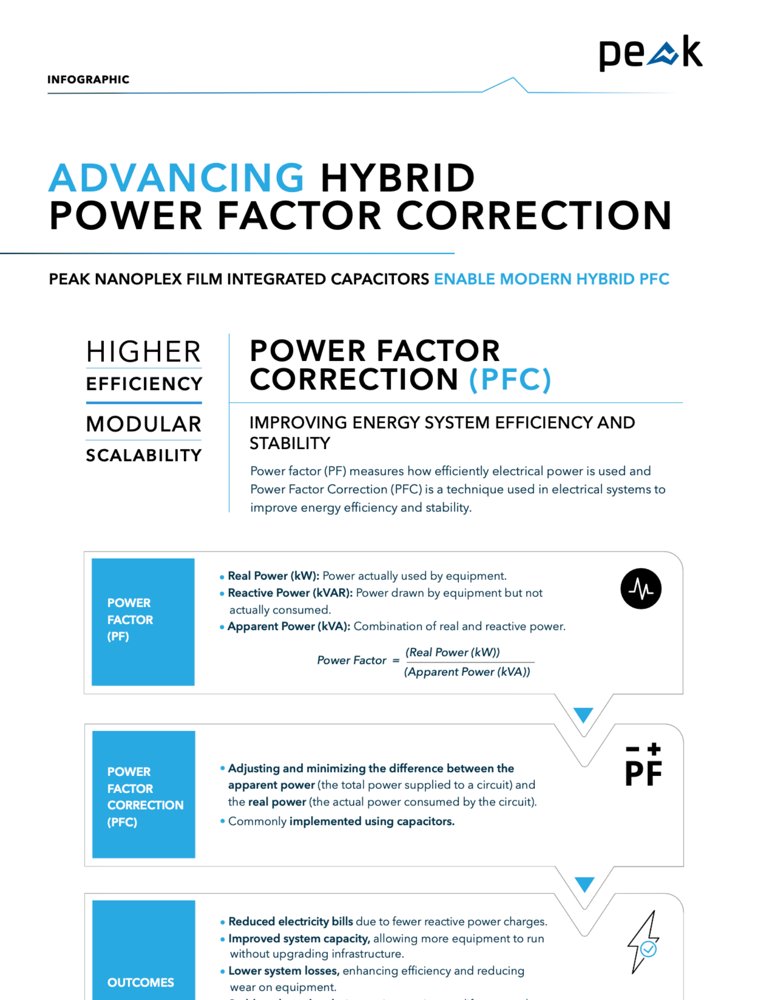
Improved Power Quality, Higher Heat Tolerance, and Longer Lifespan For utilities and operators, NanoPlex means more reliable grids that integrate renewable energy sources smoothly, deliver stable voltage over long HVDC runs, withstand the surges from electrification and AI data centers, and improve grid resiliency while lowering operating costs. NanoPlex HDC films make mobile power lighter, stronger, and more dependable. With 4x higher energy density, NanoPlex™ supports stable voltage and efficient power delivery in environments where reliability matters most. Whether for remote substations, emergency relief, or forward-operating bases, NanoPlex ensures transportable systems stay energized, efficient, and ready on demand. Peak’s NanoPlex films deliver fast, stable, and efficient hybrid power factor correction for today’s volatile grids, addressing the limitations of aging infrastructure. By combining 4x higher energy density, reliable high current performance, and up to 5x longer capacitor life, NanoPlex reduces distortion below 3% while supporting compact, long-lasting systems. Key advantages include: - Faster phase correction to handle renewable energy resource swings - Built-in harmonic protection for sensitive electronics - Improved voltage stability during fluctuations - Reliable performance even in high-heat environments Key advantages include: - Compact, lightweight capacitor banks for faster deployment and mobility - Extended service life to lower replacement needs and reduce downtime - Stable output under high-ripple and variable load conditions - Secure, U.S.-based supply chain for assured availability Peak’s NanoPlex films are purpose-built for the heat, load, and layout demands of today’s substations. With 4x higher energy density, reliable 135°C operation, and 5x longer service life, NanoPlex™ supports underground installations, modular designs, and solid-state integration without sacrificing reliability or performance. Key advantages include: - Stable 135°C performance with self-healing dielectric protection - Compact, lightweight capacitor banks for space-limited environments - Reduced ripple and harmonic distortion for cleaner HVDC/AC output - Proven durability in harsh environments with longer service life NanoPlex films are purpose-built for the heat, pace, and density of modern AI infrastructure. Designed for high-demand, always-on environments, they deliver stable power, reliable thermal tolerance, and 5x longer service life. By reducing cooling and maintenance burdens, NanoPlex™ helps AI data centers maximize uptime and confidently scale as workloads intensify. Key advantages include: - High-density, rapid-discharge energy storage for peak AI power loads - Stable voltage regulation and phase correction to protect sensitive hardware - Reliable operation at 135°C with extended service life to cut downtime - Compact, modular capacitor banks for scalable, resilient infrastructure Ready to Evaluate NanoPlex Films? Request a sample kit of NanoPlex for in-house qualification, compatibility testing, and grid-level performance validation.
CATEGORY

Peak NanoPlex™ capacitor films deliver f aster, stable pulses at high temperatures, with fewer components and longer life for magnetic fusion. NanoPlex LDF is engineered for magnetic fusion systems that demand high-frequency, high-heat, high-performance pulse delivery. With full energy capacity at 135°C and a low-loss, high-stability architecture, LDF capacitors enable faster shot repetition for injection systems, tighter control, and reduced system complexity, without the thermal, space, or maintenance limitations of traditional banks. - Full energy, zero derating under extreme heat and pulse load - Shorter recovery times boost throughput and consistency - Low self-heating reduces fans, cooling systems, and energy waste - Extended duty under high stress cuts downtime and O&M costs Pulse Stability Rapid Charge/Discharge Thermal Management Energy Efficiency Service Life Precision Firing Without Downtime or Derating - During a fusion pulse, capacitor banks must deliver high current through magnetic field coils that confine the plasma. This generates extreme heat. Traditional BOPP films lose performance above 85°C, compromising energy delivery and reducing pulse precision as repetition rates rise. - NanoPlex LDF maintains full energy capacity up to 135°C without derating, handling intense, repeated fusion shots without drifting or degrading -no oversizing or additional cooling systems required. - Fusion teams get stable, precise performance, even under high heat and heavy load, so they can repeat shots more consistently, improve energy yield, and speed up progress toward commercial fusion. Engineered for Repetition, Stable Operation at Scale - As magnetic-fusion systems push toward higher repetition rates, capacitor banks must charge and discharge in rapid succession. Conventional films degrade quickly under this stress, limiting performance and increasing downtime. - NanoPlex LDF features a low-loss architecture that enables up to 4x faster charge and discharge compared to conventional film. This supports more consistent, high-frequency operation without thermal or structural breakdown. - Shorter recovery times between pulses allow fusion teams to run faster shot sequences, boost pulse reliability, and maintain consistent performance, without increasing replacement cycles or maintenance load. NanoPlex™ LDF Capacitors Last Longer in High Temperatures - With each pulse, conventional BOPP capacitors build internal heat. As temperatures rise past 85°C, they begin to lose capacitance, forcing engineers to add fans, heat sinks, or extra capacitors just to stay within safe limits. - NanoPlex LDF capacitors have a 50% lower dissipation factor than conventional film, producing less self-heating during operation. They remain stable at higher temperatures, even under repeated pulsing. - Fusion teams can reduce their cooling systems, save energy, and simplify thermal design, without sacrificing performance. This means more stable operation, fewer components, and better long-term reliability. Stores More Energy Per Capacitor - To meet modern energy demands, conventional films require more capacitors and longer wiring runs. This inflates system size, increases cost, and makes precise pulse delivery harder to manage. - NanoPlex LDF holds full capacitance up to 135°C, allowing fusion teams to use fewer capacitors without sacrificing performance. Systems are designed to stay cooler and more compact. - Fewer components mean easier installation, reduced material costs, and better pulse control. It also simplifies service and opens the door for more scalable, future-ready fusion systems. Longer LifeSpan, Less Downtime - In fusion systems, repeated heat cycles and electrical pulsing cause BOPP-based capacitors to degrade, leading to frequent replacements, more downtime, and higher maintenance costs. - NanoPlex LDF maintains full energy capacity up to 135°C and resists thermal and electrical fatigue, providing stable, long-term performance under sustained pulsed-power operation. - Fusion teams can reduce scheduled outages, keep systems online longer, and lower total O&M costs, extending service life without compromising performance in high-duty environments. NanoPlex™ LDF vs. Traditional BOPP Film for Magnetic Fusion Systems NanoPlex LDF gives magnetic fusion teams a smarter capacitor film option - designed for higher shot rates, higher temperatures, and longer runtimes - all in a smaller, cooler, and more cost-effective package. Capability | Traditional BOPP Film | NanoPlex LDF Film Temperature Stability | Starts derating above 85°C, reducing energy delivery | Operates at full capacitance up to 135°C with no derating Pulse Stability | Drift and degradation at high duty cycles require oversizing | Maintains consistent performance under high repetition and heat Charge/Discharge Speed | Slower cycling under stress; limited support for high-frequency operation | Up to 4x faster charge and discharge; shorter recovery times Thermal Management | Generates more heat; needs additional fans, heat sinks, or capacitors | 50% lower dissipation factor; reduced heat generation and cooling needs Energy Efficiency | Requires more components and longer wiring to meet the same energy goals | Stores more energy with fewer capacitors; supports compact layouts System Footprint | Larger, heavier banks complicate integration and increase system size | Enables capacitor banks that are 50% smaller and 30% lighter Service Life | Frequent replacements; higher O&M and downtime | Lasts up to 5x longer under thermal and electrical stress Cost Efficiency | Higher install cost due to more parts and thermal management components | Cuts BOM costs by up to 60% through fewer parts and simpler design Pulse Consistency | Pulse degradation over time and under heat stress | Tighter control for repeatable, high-energy pulses Scalability | Limited by thermal ceiling and component count | Designed for future-ready, high-rep-rate fusion systems What capacitor films are best suited for high-frequency, high-temperature fusion systems? Suppliers often search for materials that maintain full capacitance at high duty cycles. NanoPlex LDF films, for instance, operate up to 135°C with no derating, making them ideal for magnetic fusion capacitor banks that face rapid cycling and intense heat. How can I reduce the size and cooling requirements of fusion capacitor banks? Fusion suppliers want compact, thermally stable systems. LDF films offer up to 4x higher energy density and 50% less heat loss than BOPP, enabling smaller banks with reduced cooling systems, lowering overall footprint and cost. How does film technology impact pulse precision and stability in magnetic fusion drivers? Pulse stability is critical for confinement accuracy. Advanced films like NanoPlex LDF provide consistent energy delivery under heat and stress, improving synchronization and repeatability during high-frequency operation. What are the lifetime and maintenance advantages of next-generation capacitor films? Suppliers value reliability and uptime. NanoPlex LDF lasts up to 5x longer than conventional films, resisting thermal and electrical fatigue. This reduces maintenance windows and extends overall service life in high-duty environments. Why is domestic capacitor film production important for fusion supply chains? With over 70% of traditional film production located overseas, U.S.-made films like NanoPlex LDF ensure reliable access, shorter lead times, and compliance with national security and Buy American priorities, critical for fusion-scale manufacturing.
CATEGORY
