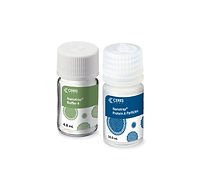
Nanotrap DBS Buffer is a resuspension buffer that extracts protein analytes from Dried Blood Spot substrates (DBS / WBS / VAMS) and is engineered to be compatible with Nanotrap® protein enrichment workflows for LCMS proteomics analysis. Product Features: - Efficient extraction mechanism to easily access proteins from Dried Blood Spot substrates. - Incorporates seamlessly into automated and manual protocols available on our website. Nanotrap DBS Buffer SKU# 10105-20 Kit contents: - Nanotrap® DBS Buffer|1 - 20mL bottle For Research Use Only. Not for use in diagnostic procedures.
Nanotrap® Microbiome Particles are magnetic hydrogel particles designed to capture and concentrate low-abundance microbes (including bacteria, viruses, and fungi) from complex environmental, wastewater, and clinical samples, improving detection sensitivity across downstream workflows. Many labs struggle to detect microbial targets in complex samples such as wastewater, blood, and urine. Low target abundance combined with PCR inhibitors often results in weak signal or false negatives when using standard extraction workflows. Nanotrap® Microbiome Particles address these limitations by physically capturing and concentrating intact microbes prior to extraction, improving recovery and enabling more reliable detection across downstream workflows. Key Advantages: -- Reduce false negatives: Concentration of low-abundance microbes increases detectable signal -- Remove inhibitors: Separation from complex matrices improves PCR and sequencing performance -- Enable detection at low levels: Improves recovery in samples near or below assay limits -- Process larger sample volumes: Efficiently concentrate microbes from mL-scale inputs -- Simplify workflows: Magnetic separation eliminates the need for centrifugation or filtration Extensive Sample Type Compatibility Environmental & Wastewater Samples - Wastewater - Surface waters - Blackwater - Sludge - Airplane lavatory fluid - Food wash Clinical & Biological Samples - Urine - Whole Blood - Sputum - VTM/UTM - Saliva - plasma Capture and concentrate low abundance microbes Nanotrap® particles utilize affinity-based capture to bind and concentrate low-abundance microbes from complex samples, without relying on antibodies, enabling improved reagent stability and consistent performance. Seamless integration with downstream workflows Compatible with qPCR, dPCR, ddPCR, sequencing, immunoassays, and culture-based methods without requiring changes to existing workflows. Consistent performance in complex matrices Demonstrated performance across diverse and inhibitor-rich environmental and clinical sample types. Eliminate centrifugation and filtration steps Streamlines sample preparation by removing the need for centrifugation, filtration, or precipitation-based concentration methods, enabling more consistent recovery. Expert technical support Access dedicated Ceres technical support for guidance on workflow optimization, sample types, and implementation. Comprehensive Pathogen Coverage Nanotrap® Microbiome Particles are designed for broad-spectrum utility across diverse microbial classes, including enveloped and non-enveloped RNA/DNA viruses, and Gram-positive/Gram-negative bacteria. Viral Targets Respiratory: SARS-CoV-2, Influenza A & B, RSV, and Coronaviruses (229E, OC-43). Global Health: Zika, Chikungunya, Dengue, Monkeypox, and Measles morbillivirus. Environmental Markers: Pepper mild mottle virus, Norovirus GII, and Hepatitis A. Bacterial & Parasitic Targets Enteric & Foodborne: E. coli, Salmonella enterica, Campylobacter jejuni, Listeria monocytogenes, and Clostridioides difficile. Clinical/STI: Chlamydia trachomatis, Neisseria gonorrhoeae, and Mycoplasma genitalium. Fungi & Parasites: Candida auris, Cryptosporidium parvum, and Giardia lamblia. Images of Nanotrap Microbiome Particles and Microbe Binding Left to right: Nanotrap Particles under scanning electron microscope (SEM ) Negative-stain transmission electron micrograph (25,000×) of Venezuelan equine encephalitis virus (VEEV) particles (white) captured and bound to Nanotrap Microbiome Particles (black)., Scanning electron microscope image (5,000×) of Yersinia pestis (gram-negative bacteria; yellow) captured and bound to Nanotrap Microbiome Particles (red). For Research Use Only. Not for use in diagnostic procedures.
CATEGORY
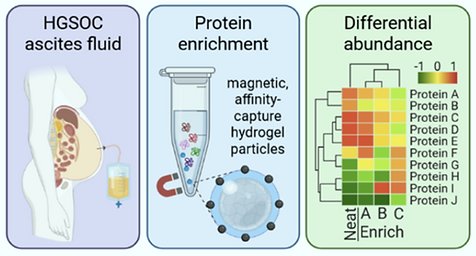
SKU 34XXX This study evaluated the performance of Nanotrap® Protein Enrichment Affinity Kits (PEAK) for mass spectrometry-based proteomic analysis of ascites fluid from patients with high-grade serous ovarian cancer (HGSOC). Because ascites contains abundant plasma proteins that mask low-abundance biomarkers, the authors investigated whether Nanotrap hydrogel particles could improve proteome coverage by selectively enriching low-abundance proteins while excluding high-abundance species. Key Findings Significantly improved proteome depth - Nanotrap enrichment identified more than 2–3× as many proteins as direct (neat) ascites analysis. - Across 10 clinical ascites samples, Nanotrap-enriched workflows identified 3,480–4,000 proteins, compared with 1,505 proteins in unenriched samples. Effective dynamic range compression - Albumin, which represented 74% of the neat ascites proteome, was reduced to approximately 1.5% following enrichment. - The remaining (lower-abundance) proteome was enriched 4.8–7.1-fold, substantially improving detection of potential biomarker candidates. Complementary particle chemistries - Three Nanotrap particle types (A, B, and C) exhibited distinct capture profiles due to differences in affinity chemistry and surface charge. - Multi-particle combinations generally identified more proteins than individual particle types, demonstrating complementary enrichment capabilities. Selective enrichment rather than simple depletion - On average, 61% of quantified proteins were enriched, while 39% were depleted, indicating that Nanotrap particles selectively reshape the detectable proteome through affinity capture and molecular sieving rather than acting solely as an abundant protein depletion method. Reproducible performance - Technical reproducibility remained strong across enrichment methods, with median coefficients of variation between 10–22%. - The AC and ABC particle combinations demonstrated the best balance of proteome coverage and reproducibility for biomarker discovery applications. Implications for Nanotrap Technology This study demonstrates that Nanotrap PEAK substantially enhances proteomic analysis of ascites fluid by: - Increasing protein identifications and proteome depth. - Removing interference from highly abundant plasma proteins. - Enabling detection of lower-abundance proteins that may serve as predictive or prognostic biomarkers. - Providing a scalable, magnetic, and automation-compatible sample preparation workflow suitable for mass spectrometry-based biomarker discovery. The authors conclude that Nanotrap PEAK is a cost-effective, scalable, and reproducible enrichment technology that significantly improves the analytical performance of LC-MS/MS for complex biofluids such as ascites. By compressing the dynamic range and expanding detectable proteome coverage, Nanotrap particles provide a powerful sample preparation approach for ovarian cancer biomarker discovery and other clinical proteomics applications.
CATEGORY
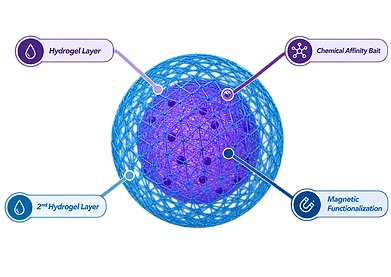
Nanotrap® Particles are hydrogel particles, functionalized with chemical affinity baits that have very high affinities for different classes of analytes, such as proteins, peptides, nucleic acids, microbes, hormones, drugs-of-abuse, and extracellular vesicles. The unique hydrogel structure facilitates rapid exchange with the sample for rapid binding. Nanotrap particles are magnetically functionalized, allowing for easy recovery from the sample. This process can be automated, enabling high-throughput sample processing. The technology platform is well-validated, with over 80 publications and preprints and 14 patents to date. Hydrogel particles facilitate rapid binding and removal of interfering substances, enabling analyte capture, concentration, and purification. Hydrogel particles are highly versatile, with demonstrated functionality across sample types and volumes, ranging from small-volume plasma samples to large-volume wastewater samples. Well-characterized affinity baits capture and concentrate multiple analytes from a type and size of the sample, unlocking access to multiplex and multi-omic testing modalities. Magnetic and automation-ready, ideal for high-volume workflows or point-of-care devices Room temperature stable for 6 years, providing cost-effective durability in a wide range of global settings
CATEGORY
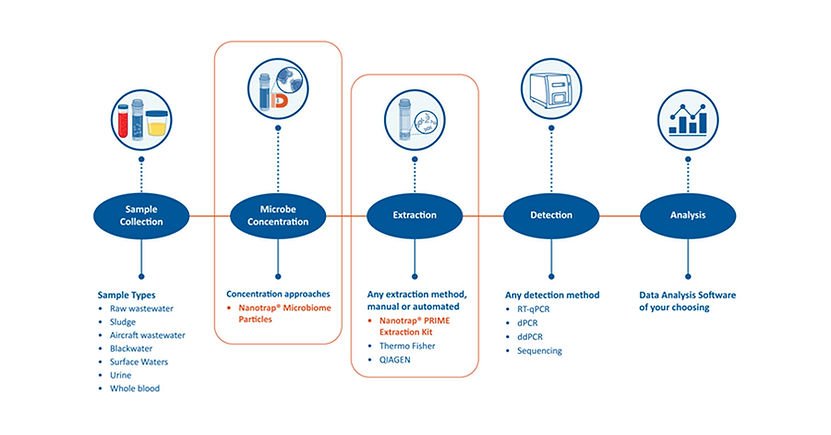
The Nanotrap® PRIME Extraction Kit efficiently extracts nucleic acids from environmental water or urine samples. This process yields a purer sample containing high-quality RNA and/or DNA suitable for downstream analysis. 100% compatible with the Nanotrap® Particle capture and concentration method Designed for workflow flexibility: Supports both automated and manual workflows, allowing seamless integration into existing laboratory processes across environmental monitoring and clinical research applications. Uses the same plate for the entire capture through extraction workflow Expert technical CeresNow support – get answers when you need them with lightning-fast response times. The Nanotrap PRIME Extraction Kit expands Ceres’ portfolio of sample preparation solutions and is designed to deliver higher-quality nucleic acid extraction from concentrated environmental water and urine samples. Paired with Nanotrap® Microbiome Particles, it enables sensitive recovery of low-abundance viruses and bacteria in a single streamlined workflow. Nanotrap PRIME Extraction Kit SKU 11001 Kit contents: - Nanotrap®Buffer 3 (1 - 55 mL bottle) - Nanotrap®Wash 1 (1 - 55 mL bottle) - Nanotrap® Isolate (1 - 2.8 mL bottle) - Nanotrap® Elute (1 - 11 mL bottle) This kit can be used to extract DNA and RNA from 100 environmental samples or 100 urine samples. For Research Use Only. Not for use in diagnostic procedures.
CATEGORY
