By Innovative Scientific Solutions Inc.
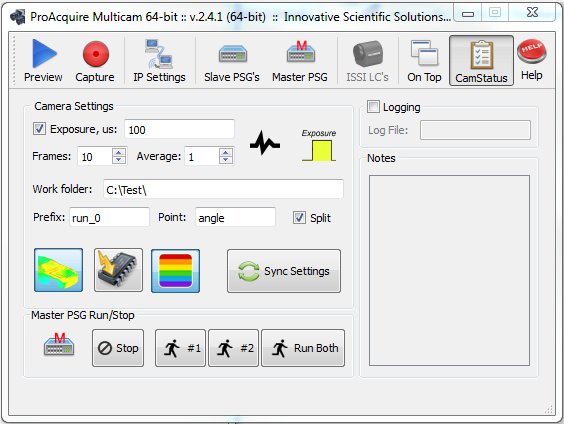
ProAcquire Multi-Camera User Interface For large-scale PSP/TSP systems where an array of cameras and LEDs are utilized, ProAcquire Multi-Camera offers full control of the entire PSP system from a single master computer. The software is installed on the master computer and operates over the local network to control all PSP hardware with the click of a button. Cameras can be synchronized for simultaneous acquisition and data is streamed directly to separate hard drives. For commercial PSP systems where data turnaround time is key, ProAcquire Multi-Camera is a recommended.
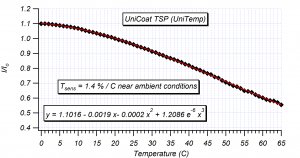
Traditional measurement techniques for acquiring surface temperature distributions on models have utilized embedded arrays of thermocouples and RTD’s. This requires significant construction and setup time while producing data with limited spatial resolution. An alternative approach is to use temperature sensitive paint (TSP) to measure surface temperature. The advantages of temperature sensitive paint include non-intrusive measurements and high spatial resolution when compared to conventional measurement techniques. Much like pressure sensitive paint, image based temperature measurements using TSP are accomplished by coating the model surface with the paint and illuminating the surface with an LED of the appropriate wavelength. The luminescence from the surface is recorded using a CCD camera through a long-pass filter to separate the luminescent signal from the excitation light. The luminescence from the TSP is a function of the local temperature, and therefore, each pixel on the camera acts as a thermocouple. TSP is made up of a luminescent molecule within a polymer binder. Generally, a binder that is impermeable to oxygen is preferred. The basis of the temperature sensitive paint method is the sensitivity of the luminescent molecules to their thermal environment. The luminescent molecule is placed in an excited state by absorption of a photon. The excited molecule deactivates through the emission of a photon. A rise in temperature of the luminescent molecule will increase the probability that the molecule will return to the ground state by a radiationless process, this is known as thermal quenching. The temperature of the painted surface can be measured by detecting the fluorescence intensity of the luminescent paint. To determine this intensity versus temperature relationship, a sample of the TSP is placed in a calibration chamber. The sample is exposed to a series of temperatures and the luminescent intensity of the sample is recorded. For reasons that will be discussed later, each intensity is normalized by the intensity at a reference condition and plotted versus temperature. A plot of the calibration of a typical TSP is shown here. Luminescent intensity distribution is not only a function of the temperature. In fact the luminescence from the painted surface varies with illumination intensity, paint layer thickness, and probe distribution. If we assume that these parameters don’t vary in time however, they can be eliminated by taking the ratio of the image at the test condition or wind-on image to an image taken at a known reference condition or wind-off image. This wind-off to wind-on ratio is often referred to as radiometric TSP.
CATEGORY
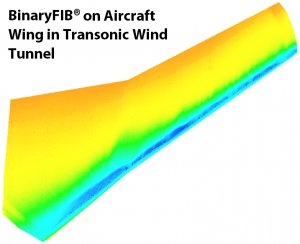
BinaryFIB® pressure sensitive paint is a dual-luminophore, single application PSP formulated to be applied with paint spraying equipment. The binary paint approach involves acquiring data from two distinct luminescent dyes and using these signals to compensate for errors caused by model displacement and deformation as well as temperature. One dye is pressure and temperature sensitive and the other dye is temperature sensitive only. The ratio of the signals from the two dyes allows the temperature sensitive signal to be isolated from the pressure sensitive signal. The temperature sensitivity of the paint can be minimized over a wide range of temperatures and pressures as shown in the calibration below. The paint may be applied to most materials, however a white base coat such as epoxy screen layer or FIB Basecoat™ is recommended. Models constructed of materials that may be attacked by solvents such as plastic or rapid prototyping resin should be coated with a screen layer or FIB Basecoat™. The calibration of BinaryFIB® is very stable, repeatable, and exhibits very little temperature sensitivity. BinaryFIB® is recommended for advanced/professional PSP users who seek high quality data in low-speed environments or where temperature gradients are larger and have a greater impact on the signal-to noise ratio. Specifications - Pressure Sensitivity: 0.6% per kPa - Pressure Range: 0-kPa to 200-kPa - Temperature Sensitivity: 0.03% per °C - Temperature Range: 0°C to 50°C - Response Time: 300 ms - Excitation: 380-nm to 520-nm (400-nm ideal) - Emission: 500-nm to 750-nm - Photo-Degradation Rate: 1% per hour - Shelf Life: 12-months - Filter: 530-nm - ECCN: EAR99 - Available Quantities: 200-ml, 400-ml, 750-ml - Surface coverage is approximately 1 square meter per liter.
CATEGORY
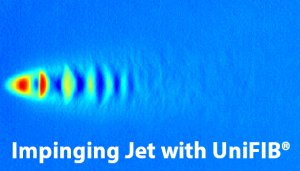
UniFIB® is a bright single-luminophore pressure sensitive paint (PSP) formulated to be applied with paint spraying equipment as a single component PSP optimized for maximum luminescent signal while maintaining high pressure sensitivity and low temperature sensitivity. This paint formulation may be excited effectively from 370-nm to 520-nm, however, 400-nm radiation from LM2X-400 LED modules is recommended. The paint may be applied to most materials, though models constructed of materials that may be attacked by solvents, such as plastic or rapid prototyping resins, should be coated with a base coat such as Screen Layer or FIB Basecoat™. The calibration of UniFIB® is very stable and repeatable thus UniFIB® is recommended for advanced/professional PSP users who seek high-quality data up to transonic flow conditions. Specifications - Pressure Sensitivity: 0.8% per kPa - Pressure Range: 0-kPa to 200-kPa - Temperature Sensitivity: 0.4% per °C - Temperature Range: 0°C to 50°C - Response Time: 300 ms - Excitation: 380-nm to 520-nm (400-nm ideal) - Emission: 620-nm to 750-nm - Photo-Degradation Rate: 1% per hour - Shelf Life: 12-months - Filter: 610-nm - ECCN: EAR99 Available quantities: 200-ml, 400-ml, 750-ml Surface coverage is approximately 1 square meter per liter.
CATEGORY
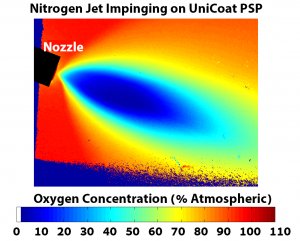
UniCoat is a single-luminophore pressure sensitive paint (PSP) packaged in an aerosol can for ease of application. UniCoat has slightly higher temperature sensitivity and slightly lower pressure sensitivity than UniFIB PSP, but is a simple shake and spray application at a lower cost than other products and is ideal for academic purposes. This single coat application paint may be applied directly to most materials. UniCoat is an effective quantitative PSP well suited for isothermal environments (large metal models and temperature controlled tunnels) or where strong pressure variations are present (transonic and supersonic flows). UniCoat is recommended for introductory PSP users who seek an inexpensive paint for the purpose of developing their PSP capabilities. Specifications - Pressure Sensitivity: 0.5% per kPa - Pressure Range: 1-kPa to 200-kPa - Temperature Sensitivity: 1.3% per °C - Temperature Range: -10°C to 60°C - Response Time: 750 ms - Excitation: 380-nm to 520-nm (400-nm ideal) - Emission: 620-nm to 750-nm - Photo-Degradation Rate: 1% per hour - Shelf Life: 12-months - Filter: 610-nm - ECCN: EAR99 Available in 12-oz Aerosol Spray Can
CATEGORY
