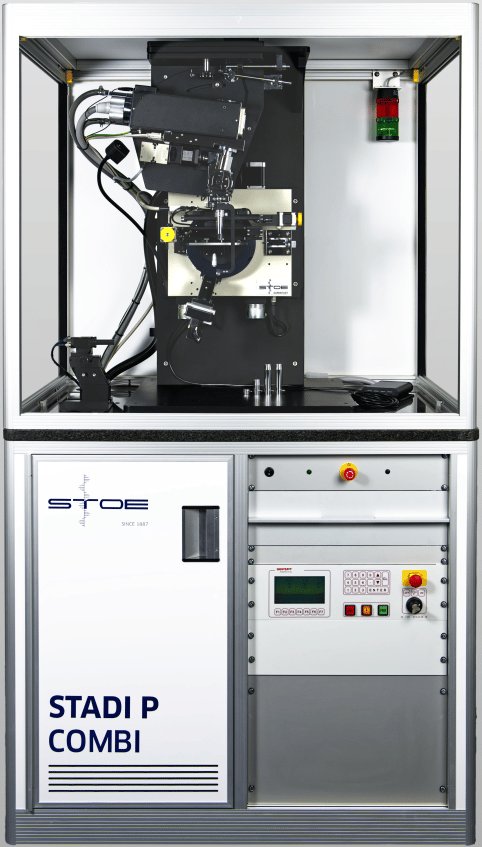
Based on the well-known STADI P, STOE has developed a powder diffractometer for high-throughput and combinatorial measurements in transmission geometry. With its dedicatedly designed sample stage, providing a variable x-y grid for numerous slide-in sample holders, like our 96 sample well plate, the STADI P COMBI offers highest efficiency combined with all the advantages of the STADI P system. - High-throughput analysis for phase identification and similarity checks - 96-fold sample stage - User definable x-y grid - Pure Kα 1 radiation using Co, Cu, Mo or Ag radiation - Transmission geometry Specifications 2θ range 0° up to 140° Goniometer 2 circle Radius of measuring circle 260 mm Radius of focusing circle 160 mm X-ray sources Sealed Tubes: Co, Cu, Mo, Ag Optics Primary monochromator Software WinX pow package Dimensions (Including system cabinet, max.)1100 x 880 x 2050 mm Weight (complete system)650 kg Detectors Silicon strip detector MYTHEN2 R 1K Accessories: x-y stage; Various sample stages
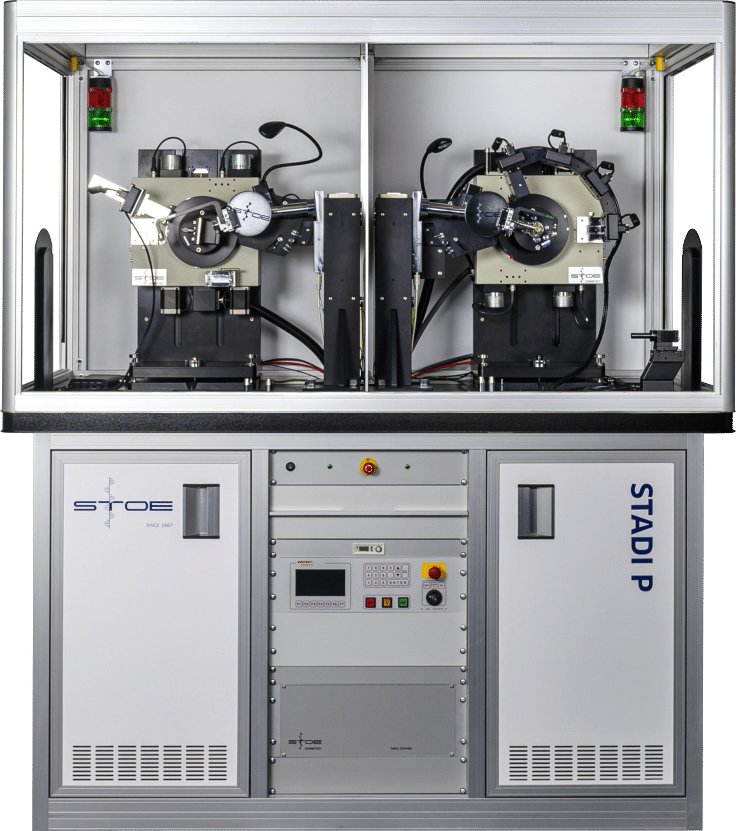
The well-known, high-precision STOE STADI P two circle goniometer is the basis of STOE’s powder diffraction building block system (read more about it here). Vertically or horizontally mounted, the STADI P can be built in Transmission/Debye-Scherrer or Bragg-Brentano geometry. Moreover, two STADI P goniometers, either in the same or different configurations, can be mounted in the same cabinet resulting in two completely independent instruments. However, the two goniometers can also share one source. - Various single-photon-counting X-ray detectors - Pure Kα 1 radiation using Co, Cu, Mo and Ag sources - The ultimate platform for laboratory PDF calculations using Ag Kα 1 data - Transmission/Debye-Scherrer or Bragg-Brentano mode - Ideally suited for the analysis of air/moisture-sensitive and microsamples - A range of high- and low-temperature attachments available ADVANTAGES OF TRANSMISSION-/ DEBYE-SCHERRER GEOMETRY - Same sample volume in the beam over the full 2θ scale - Reliable intensities with no necessity for further mathematical corrections - No line broadening for weak absorbers - No height displacement - Real micro-sampling possible - Lesser effects of preferred orientation specifications 2θ range 0° up to 140° 2θ Goniometer 2 circles Radius of measuring circle 260 mm Radius of focusing circle 130 mm X-ray sources Sealed Tubes: Co, Cu, Mo, Ag Optics Primary monochromator Software WinX POW package Dimensions (Including system cabinet, max.) 1800 x 880 x 2050 mm Weight (complete system) 780 – 940 kg Detectors Silicon strip detector MYTHEN2 R 1K/2K/3K/4K Accessories • High- and low-temperature attachments for reflection and capillary samples • Reaction chamber for capillary samples • Various sample stages • Various sample changers The STADI P can be set up by itself or as a dual setup with two different geometries on the independent goniometers. The horizontal STADI P set up with a capillary sample holder. The horizontal STADI P set up with STOE's transmission sample holder. For ultra fast measurements of e.g. unstable samples STOE offers an installation with up to four MYTHEN detectors. With four MYTHEN detectors a single exposure will cover 0 - 73° in 2θ. (See the respective AppNote) STADi P for pdf data collection As the demand for materials with lower degrees of order continues to rise, the significance of Pair Distribution Function (PDF) measurements is growing steadily. To measure best possible data for PDF interpretation, the STADI P can be installed with Ag Kα 1 radiation and expanded with a PDF collimator, a MYTHEN2 4K detector and optionally air scattering shields, without any loss in diffraction data quality. This direct comparison of PDF data measured on the ionic liquid hmimPF 6 shows how excellent our instrument performs versus a synchrotron. PDF data is preferably collected in Debye-Scherrer geometry, which is beneficial for air sensitive samples. With the MYTHEN2 4K detector in one-step mode you can measure up to 144° 2θ (2x 27° simultaneously, see the respective AppNote) in shortest time. Shields can optionally be set on the detectors to reduce additional effects of air scattering. For PDF measurements we offer a special collimator to reduce additional background signal at high angles.
CATEGORY

The STOE Powder Diffraction Software Package WinXpow is a state-of-the-art Windows application. It is extremely user-friendly, easy to use, yet flexible and powerful. One computer can simultaneously control two diffractometers and the measurement results can be easily incorporated into other standard Windows applications. The software comes as complete package for data collection and evaluation. FEATURES - Instrument configuration - Diffractometer control / data collection / detector calibration - Graphics incl. peak search, smoothing, background subtraction - 3D graphics - Raw data handling with import/export of data in various formats - Profile fitting - Indexing and lattice constants refinement - Theoretical pattern generation - Size/strain analysis - Crystallinity analysis - Retained Austenite Analysis - Optional CFR21 part 11 compliant GMP package available DATA ACQUISITION Diffractometer control / Temperature control - Versatile and intuitive interface to the STADI P diffractometer series. Easy access and control of the diffractometer and the attached equipment - Supports a wide range of sample configurations like Transmission, Debye-Scherrer and Reflection - For 2θ/ω, θ/2θ, θ and ω scans - Automated temperature scans with various low and high temperature devices - Measurements with sample changers can be performed directly, or executed through external programs via batch-files - Fully automated calibration: zero-point correction within a few minutes Raw data handling - Data reduction tools comprising background editing, absorption, dead time as well as angle correction and, if necessary, Kα 2 stripping - Complete files or selected ranges may be merged, added or subtracted - Easy conversion of the STOE raw data format into other data formats, i.e., for importing in common Rietveld programs Presentation 2D-Graphics - Powerful graphics program for visualization and presentation of collected data - Visualization of a variety of different data sets like measured data, peak data or data imported from ICDD databases - Basic data evaluation like peak search or background editing - All data sets are very easily arranged or labeled, with different axis scales, colors, etc. 3D-Graphics - Easily accessible 3D-Graphics visualization programm - Flexible choice of perspective, scaling and labelling option of a 'top-down' view on a set of data curves (Guinier-plot) EVALUATION SystEval for Indexing / Cell refinement / Extinction Symbols - As pattern indexing and space group determination is often the rate limiting step in structure determination from powder data, WinXpow, with SystEval, offers a powerful tool for peak searching, indexing with three different well-known algorithms, cell refinement and determination of extinction symbols - All performed with full pattern refinement - Offers either a direct step by step guided way through the evaluation process, where most parameters are chosen by the program, or the expert mode, where the user has access to nearly all parameters of the algorithms - Profile fitting and indexing also available as stand-alone modules Size-Strain / Crystallinity - Evaluation of size/strain measurements - Determination of the state of crystallinity theoretical pattern - Calculation of a theoretical pattern from given metric and atomic positions - Easy import from CIF files Optional modules Search-Match - Based on the ICDD PDF databases, phase analysis from observed powder patterns is combined with convenient database browsing - A powerful search and match algorithm performs searches for phases of given chemical composition, mineral names or other criteria - Semi quantitative results are calculated from the phases' tabulated I/I cor values - The database can be easily enhanced with own phases Search/Match2 - Direct import of measured.raw files Into the program - Import of single or multi range files as well as series from repetition or non-ambient measurements - 2D or 3D data can be visualized with a powerful new graphics chart - One-click solution for an entire phase analysis using the ICDD database, the public COD database or your own database - Expert mode enables conducting each step of the phase analysis manually using own experience and additional knowledge about the phases - A powerful Bayesian algorithm searches the entire databases in fractions of seconds and ranks all possible phases by probability - Plausibility of results can easily be checked by performing a full pattern fitting - Projects, measurement files and databases can be saved in an SQL database, accessible even from other PCs within the network or shareable as a file with other people using Search/Match2 Combinatorial and high-throughput analysis - High throughput analysis module allows phase identification, similarity checks and intensity analysis-performed on free grid of up to 96 sample wells - Optimized graphical representation of results by easy adjustment of parameters for each analysis Reflectometry - The module Layer allows evaluation of thickness, density and roughness from reflectometry scans using an optimized least squares approach - For samples of unknown composition or with unknown layers, the simulation of theoretical patterns is the first step towards identification
CATEGORY
The excellent and comprehensive software package STOE X-Area has been designed to drive the latest STOE single-crystal diffractometers such as the STADIVARI (equipped with – for example – one or two microfocus sources and a rapid state-of-the-art hybrid photon counting detector), as well as the IPDS II/2T (containing well proven image-plate detectors). Moreover, STOE X-Area offers planning and performing of accurate measurements, precise frame evaluation, data analyses as well as sophisticated corrections of intensity-data sets and many more features in order to obtain highest-possible data quality. FEATURES - Superior data quality, unlimited number of reflections in lattice parameter refinement - Two indexing methods available: either graphics-supported or automated - Use of elliptical reflection profiles and Kα 1/2-splitting option for integration process - Graphical tools for the analysis of intensity-data quality - Using the well-designed GUI during measurement and data processing offers better control of the instrument and easier analysis of the measured data - High flexibility due to dynamic memory management - Full integration of STOE’s FaceitVideo DATA ACQUISITION Instrument Control / Measurement / Run Optimizer - Intuitive interface to the diffractometer,offering direct access to all functions - Easy centering of the sample with the aid of the integrated FaceitVideo function - Automated data collection is started with just a few clicks in the measurement program - Frames with 32 bits per pixel allow an extensive dynamic range and thus high data accuracy - User-friendly GUI optimizes the run strategy(e.g., in terms of high data completeness according to the crystal system and orientation), allowing faster and more dedicated data collection - Now including the “End-Date Wizard” to help you find measurement parameters that not only result in highest data quality, but also the most efficient use of your time Frame Graphics - X-Area offers a comprehensive graphics program for the inspection of collected frames - Interactive display options provide an easy-to-use way for checking the quality of the crystal to be investigated, e.g., unexpected splitting of reflections can easily be examined - Diffraction patterns can be checked for anomalous effects, such as diffuse scattering IMAGE PROCESSING Index / Cell / Refine - Peak-finding routine scans frames rapidly in multi-processing mode - Resulting peaks can be indexed either automatically or based on a robust graphics method - Unit-cell parameters are refined according to the crystal system - Unlimited number of peaks for the refinement Integration - Use of elliptical reflection profiles and Kα 1/2-splitting option for integration process - Automated optimization of integration parameters - Self-acting detection of reflection overlap - Graphical control over the integration process - Masking of user-specified detector areas possible - Support of high-pressure cells by automatically calculated shading masks - SHELX-compatible intensity data file by default - XD-compatible file as an option Integrate3D - Integration based on ab-initio instead of learned profiles - Therefore automatically adapting the integration box on each frame according to shape and intensity of the reflection - Improved I/σ(I) especially for weak data - Fully automatic: little user intervention needed - Precise manual data treatment settings available - Fully integrated in X-Area DATA ANALYSIS Data Analysis - E-statistics plot to visually discern centric from acentric structures - Analyzer for convenient determination of the correct Laue group - Automated space-group determination - Display of peaks in reciprocal-space viewer - Reciprocal space reconstruction to inspect difficult diffraction patterns - Transformation of frame pixels into “powder diagrams” CORRECTIONS Corrections - Fully automated LP and air-absorption correction - Crystal-dependent absorption correction (numerical correction, or intensity scaling based on spherical harmonics in conjunction with symmetry-related reflections) - Automated version of STOE’s X-Shape - Inter-frame scaling, based on polynomials - Correction for crystal decomposition - Rejection of outliers CHALLENGING Structures Multi-Domain Systems - Semi-automated indexing of peaks from the individual domains - Simultaneous integration of intensities from up to eight individuals, full graphics control - Intensity scaling based on sets of symmetry related reflections Modulated Structures - Evaluation of the main lattice - Determination and refinement of up to 3 q vectors - Integration of main reflections as well as satellites - Ability to process patterns from multi-domain crystals being modulated
CATEGORY
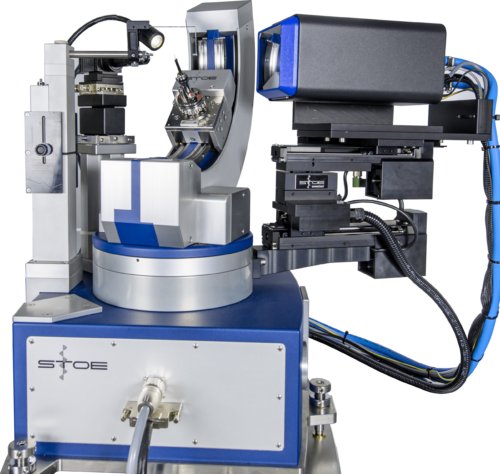
Being conceptualized to offer a wide scope of applications, the STOE STADIVARI can be set up vertically as well as horizontally. It can be used for single crystal as well as powder diffraction, with the open Eulerian cradle offering enough space for high pressure cells, high- or low-temperature devices or other accessories. In the dual beam setup, all combinations of tubes and microfocus BDS are possible: two sealed tubes, one sealed tube and one microfocus BDS or two microfocus BDS. Moreover, the STADIVARI is fully integrated in the well-established STOE X-AREA software package. Flexible goniometer (Eulerian cradle and various fixed chi setups) Sphere of confusion of less than 0.005 mm radius Different source solutions (Standard sealed tubes, Microfocus sources, MetalJet or synchroton beam) Ultrafast hybrid pixel detector (full EIGER and PILATUS detector range) Various non-ambient attachments (high and low temperature, high pressure) Specifications Sphere of confusion less than 0.005 mm in radius Goniometer (utilized angular regions)2θ: 240° / ω: 205° / χ: 90° / φ: 360° Detector distance 40 – 140 mm (automatically set) X-ray sources Standard sealed tubes (Ag, Mo, Cu), Microfocus sources (Ag, Mo, Cu), Excillum MetalJet or synchroton Dimensions (Including system cabinet, max.)1680 x 1150 x 1900 mm Weight (complete system)760 kg DETECTOR SPECIFICATIONS EIGER2 1M CdTe Sensor technology Hybrid pixel counting Sensor material CdTe Sensor thickness 750 µm Pixel size (W x H)75 µm x 75 µm = 5625 µm 2 Number of modules (W x H)1 x 2 = 2 Pixel array format (W x H)1028 pixels x 1062 pixels = 1 091 736 pixels Active area (W x H)77.1 mm x 79.65 mm = 6141.015 mm 2 Dynamic range 32 bit Maximum count rate 9.8 × 10 8 photons/s/mm 2 Energy range 8 keV to 25 keV Readout time continuous readout with 100 ns dead time Maximum frame rate 100 Hz Cooling Water cooled The STADIVARI can support one or two X-ray sources of choice and a plethora of accessories without interfering with its sphere of confusion or its collision map. The eulerian cradle offers highest precision for the goniometer positions even with heavy accessories and at a Χ angle of -90°. For special applications, e.g., at a Synchrotron, the STADIVARI can be mounted vertically.
CATEGORY
