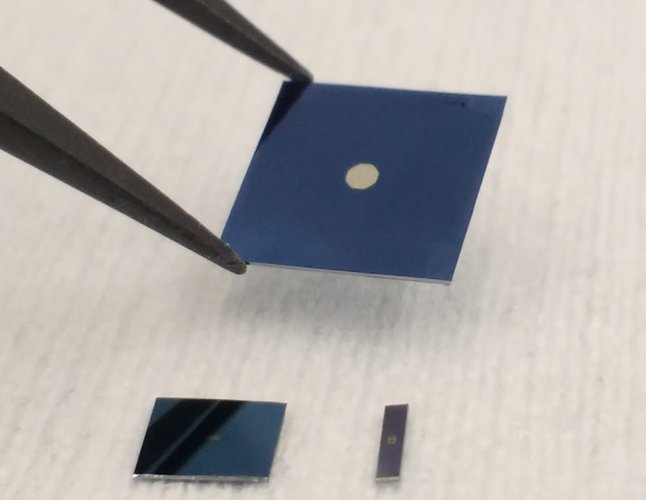
Our custom XY stage allows micro-scale alignment of a central stop and zone plate and also allows for a possible blast-shield to be mounted. The outer dimensions of the XY stage are 19 mm wide x 19 mm tall x 5.1 mm deep and is made of lightweight aluminum. Threaded M2 screw holes are provided for straightforward attachment to any existing experimental setups.
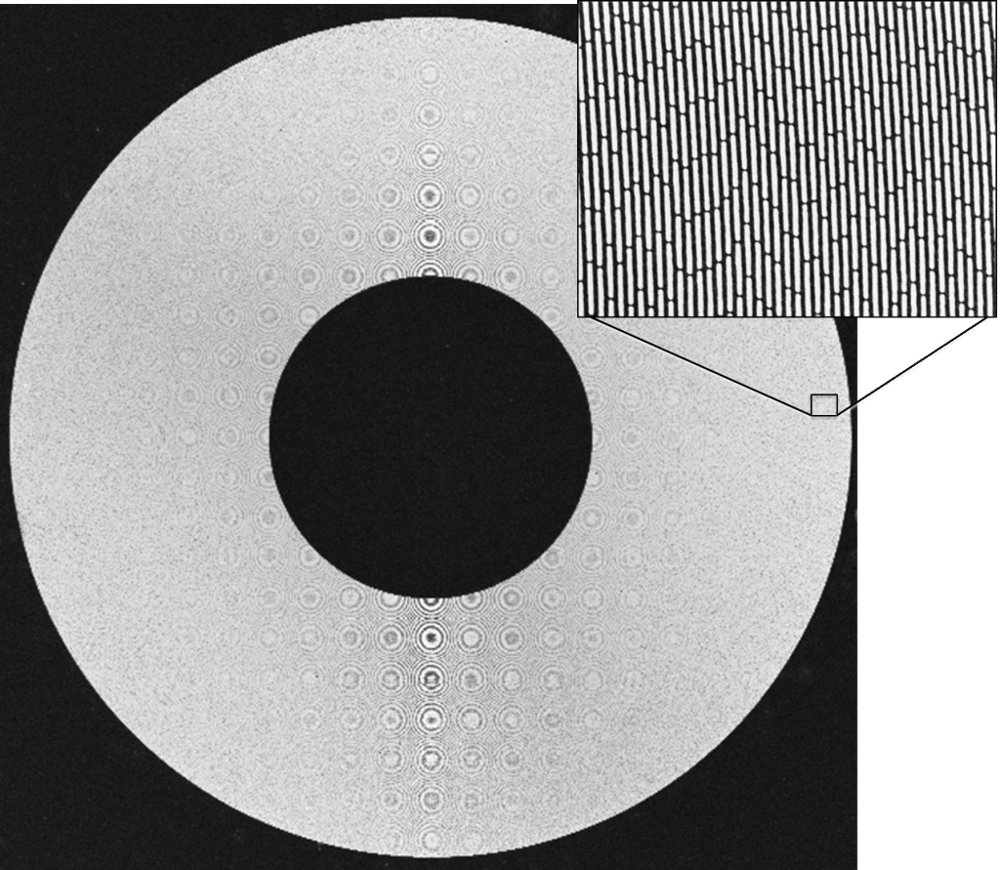
Fresnel zone plates have become indispensable for focusing and imaging in both the soft X-ray (0.1–5 keV) and extreme ultraviolet (EUV, 10–120 eV) regimes. Traditional refractive lenses, made out of materials, such as glass, are transparent to X-rays, making focusing difficult. For EUV, most materials absorb too much light, also making it difficult to focus light. To overcome these challenges with refractive optics, zone plate optics use diffraction to focus light, opening up applications in X-Ray and EUV optics for nanoscale imaging. By patterning concentric opaque/transparent rings with radii defined by the Fresnel condition rₙ = √(nλ f + (nλ)²/4) each zone plate brings radiation of wavelength λ into constructive interference at a focal length f. Where zones switch from opaque to transparent at radii, rn, with n being the nth zone. For EUV and X-ray applications, Applied Nanotools offers binary and blazed zone plates with outermost zone widths down to 12 nm, enabling sub-20 nm focal spots with diffraction efficiencies of 10–30%. Many of the properties can be calculated to determine the efficiency of focusing with our online calculator at www.appliednt.com/zpcalc. X-ray and EUV Zone Plate Optics can be as small in diameter as a human hair (~100-2000 µm typical diameters) made out of thousands of rings. The periodic circles are an artifact of imaging and are not real. These optics are generally made using electron beam lithography, which allows patterning of structure to below 10 nm. As a direct-write process, rings are patterned in an polymer or other material, and electroplated with metals such as nickel, platinum or gold, or etched, like ruthenium, tungsten, or silicon nitride. By fabricating them on a thin membrane, X-rays or EUV light can pass through a substrate, with the zone plate focusing the X-ray light for imaging. Looking ahead, multilayer and stacked zone-plate architectures promise even higher efficiency and finer resolution. Blazed “phased” zone plates can redirect 40% of incident EUV into the focus. This is a new capability of Applied Nanotools, achieving 40% efficiency at 8 keV. As nanotomography, ptychography and table‐top HHG sources continue to mature, zone plates will remain important optics for pushing nanoscale imaging and spectroscopic studies across materials science, life sciences, and semiconductor metrology. Applications include high-resolution imaging of materials and biological samples an fluorescence Microscopy, where zone plates are used for high-resolution imaging of small biological structures with fluorescence emissions. Work in battery research, using zone plates, has further improved battery technology, and will continue to provide improvements to that technology. There are thousands of applications where zone plate optics are used for imaging all types of samples at the nanoscale, which will lead to many new discoveries.
CATEGORY
X-Rays above 5-10 keV transition from tender to hard X-Rays where they are better able to penetrate through samples to give better imaging. Hard X-ray Fresnel zone plates require high aspect ratio features to offer sufficient efficiency and resolution for energies above 5 keV. Our current optics give ultra-high resolution for sub 25 nm – 100 nm imaging depending on the required energy. Stacking of hard X-rays (either through double processing or chip alignment) can significantly increase the efficiency of our devices. A range of zone plate options for hard X-Rays are available for specific requirements. (Custom Designs Available) Device | Outer Zone Half-Pitch ΔR n (nm) | Thickness (µm) | Outer Diameter (µm) | ( of zones) E/ΔE Limit | Energy Range (keV) HZP-50-25nm | 25 | 0.65 | 50 | 500 | 1.5 to 10 HZP-75-25nm | 75 | 750 HZP‑100um‑42.5nm | 42.5 | 0.8 | 100 | 588 | 2 to 12 HZP‑85um‑50nm | 50 | 0.9 | 85 | 425 | 2 to 12 HZPSC/HZPX‑85um‑50nm | 1.5 | 5.5 to 20 HZP‑180um‑50nm | 0.9 | 180 | 900 | 2 to 12 HZP‑550um‑50nm | 0.9 | 550 | 2750 | 2 to 12 HZPSC/HZPX‑550um‑50nm | 1.5 | 5.5 to 20 HZP-400um-100nm | 100 | 1.8 | 400 | 1000 | 2.5 to 8 HZPSC/HZPX‑400um‑100nm | 2.5 | 8 to 30 HZP‑400um‑120nm | 120 | 2.0 | 400 | 834 | 5 to 25 HZPSC/HZPX‑400um‑120nm | 2.6 | 8 to 30 HZP‑750um‑200nm | 200 | 2.2 | 750 | 938 | 7 to 20 HZPSC/HZPX‑750um‑200nm | 200 | 3.6 | 12 to 50 For estimated efficiency of zone plate, please see generated graphs below or download our zone plate software. All zone plate diameters can be customized for specific setups. Standard frame sizes are 5 mm x 5 mm with SiC or SiN membranes (1000 nm). HZP - Standard Binary Zone Plate HZPSC - Staircase Zone Plate HZPX - 2x Thickness, similar to the staircase, but binary design.
CATEGORY
Extreme ultraviolet (EUV) diffractive optics below 120 eV (10-25 nm) are used in applications with EUV lithography, synchrotron microscopes and with high-harmonic generation lab systems. Our products include free-standing resolution/calibration standards, zone plates (blazed and binary), gratings and many other materials. Diffractive optics with ruthienmu A range of zone plate options for soft/tender X-Rays are available for specific requirements. (Custom Designs Available) Device | Outer Zone Half-pitch ΔR n (nm) | Thickness (nm) | Outer Diameter (µm) | ( of zones) E/ΔE Limit | ~ Focal Length(µm) EUVZP‑200um‑20nm | 20 | 55 | 200 | 2433 | 297 EUVZP‑300um‑20nm | 20 | 55 | 300 | 3649 | 445 EUVZP‑350um‑20nm | 20 | 55 | 200 | 2797 | 868 EUVZP‑200um‑30nm | 30 | 55 | 200 | 1646 | 445 EUVZP‑300um‑30nm | 30 | 55 | 300 | 2469 | 668 EUVZP‑350um‑30nm | 30 | 55 | 350 | 2881 | 779 EUVBZP‑200um‑60nm | 60 | 38+38 | 200 | 831 | 890 EUVBZP‑300um‑60nm | 60 | 38+38 | 300 | 1246 | 1335 EUVBZP‑500um‑60nm | 60 | 38+38 | 500 | 2077 | 2225 EUVZP (Binary zone plate) EUVBZP (Blazed (L=3) zone plate) For estimated efficiency of zone plate, please see our online calculator at www.appliednt.com/zpcalc
CATEGORY
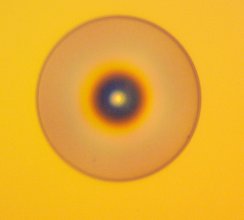
We offer a range of different materials, all chosen to provide the maximum resolution and efficiency for different energies. We currently offer as different materials for zone plates: Au, Cu, Mo, Ni, W, Pt, and free-standing silicon nitride. To compare the different materials, see our zone plate calculator at www.appliednt.com/zpcalc Copper zone plate with 250 µm diameter and 80 nm outer zones SEM image of copper zone plate with 250 µm diameter and 25 nm outer zones
CATEGORY
