This system is designed to be 100% reactive with no need for solvent. Our proprietary blend is <30 cP, but can also be tailored to a variety of viscosities for several dispense techniques, including ink-jetting and traditional jet-dispensing. After a brief thermal cure, it polymerizes and solidifies to a thermoset in place. On its own, the polymer is capable of UL-94 V-0 rating. Its dielectric constant and low loss are comparable to PTFE, but its low viscosity may provide processing advantages.
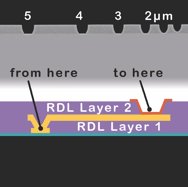
Redistribution is a process that utilizes photo-patternable dielectrics to encapsulate electrically conductive relocation traces. Polynorbornenes are finding their advantage in an industry moving toward smaller features and lower cure temperatures (170-200 ̊C). PDM-5013 has an inherently high Tg from its rigid polycyclic olefin backbone. Unlike its competition, it doesn’t need a high cure temperature to increase the Tg. This low cure temperature, balance of strength (100 MPa) and elongation beyond 40% makes it an attractive candidate for next-generation technologies.
CATEGORY
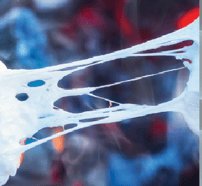
This polymer is specially formulated to combine adhesion and photo-patternability. After spin-coating onto a wafer or other preferred substrate, it undergoes i-line photolithography. Once features are defined by developing in tetramethylammonium hydroxide (TMAH), the wafer can be baked, diced and subject to thermo-compressive bonding (140 ̊C/sec). After a no-outgassing low temperature (175 ̊C) cure, a high strength bond is created between substrates, which can endure wire-bonding or solder reflow temperatures (4MPa at 260 ̊C).
CATEGORY
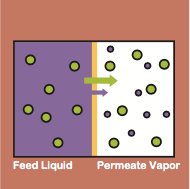
Typical polymer solutions are Newtonian fluids meaning that viscosity is linearly proportional to shear rate. In the case of PDM-5055, when the shear stress is removed, viscosity increases dramatically. This behavior is known as thixotropy. Most commonly, thixotropy can be observed in a stubborn bottle of ketchup. However, this behavior can be practically utilized in thread adhesives, paint and solder pastes. In all cases, when the shear forces are removed, the material has a tendency to stay put.
CATEGORY
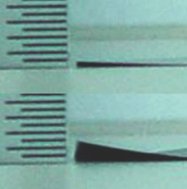
Packaging stress can add up, and PDM-5022 has been utilized to minimize stresses caused by polymer coatings. Typical materials, like polyimide, have a high modulus and cure temperature, causing it to shrink during cure. This is counter-productive to low wafer stress. By employing a non-shrinking, low cure temperature (180 ̊C) mechanism in combination with a low modulus (1.2 GPa), PDM-5022 was designed to reduce wafer curvature (15 μm; 7 MPa stress). This helps to reduce overall package stress.
CATEGORY
