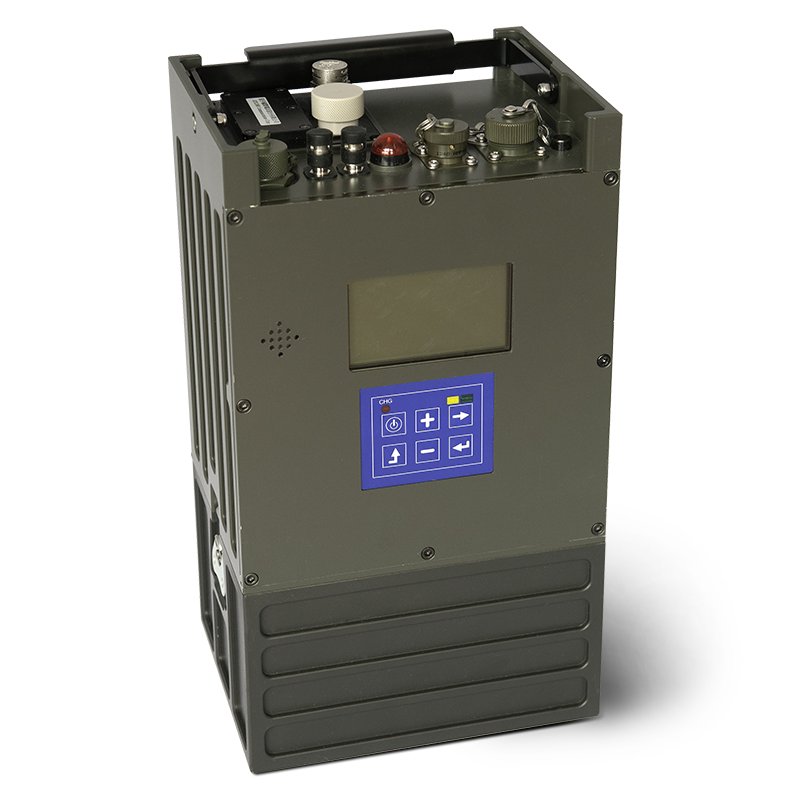
The 21st century soldier needs modern defenses against all threats, both visible and invisible. OwlSens-C provides this capability with rapid airborne threat detection of conventional Chemical Warfare Agents (CWAs) and high-threat Toxic Industrial Chemicals (TICs). - Man portable - Improved sensitivity - Large detection library - Reprogrammable Incorporating Owlstone’s unique chemical detection technology, the system offers the flexibility to provide both rapid alarms and improved sensitivity. OwlSense-C can be trained to respond to a broad range of chemical threats beyond just traditional CWAs and priority TICs. The system has been evaluated against a range of environmental test standards outlined in MIL-STD-810G. OwlSens-C —Delivering Chemical Detection Capability to the 21st Century Soldier Rapid airborne threat detection is a critical requirement in all Army, Navy, and Air Force operations. In addition to detecting conventional Chemical Warfare Agents (CWAs), OwlSens-C provides capability against a wide range of high-threat Toxic Industrial Chemicals (TICs) at concentrations well below IDLH specifications. - Sensitivity: Typical sensitivity at part per billion detection levels combined with inlet control for high dynamic range - Selectivity: The technology has double the analytical window of conventional ion mobility based systems - Software: Chemical detection library covers both conventional CWAs and high-threat TICs. The database can be readily expanded to detect new and evolving threats - Integration: Easy integration of other sensor data and control of third party systems - Remote Monitoring: Network and wireless connectivity for remote monitoring and operation - Man Portable: Ergonomic carry handle for man portability. Options available for vehicle mount and fixed site - Easy to Use: Operable by non-specialists with less than one hour's training. - No Hazardous Materials: System uses a non-radioactive (non-RAD) ionization source. OwlSens-C's Technical Specifications OwlSens-C is the first-of-its-kind next-generation broadband chemical detector — capable of detecting more hazardous chemicals at ultra-trace levels than any other single detector. - Technology: Rapid Thermal Ion Modulation Spectrometry - Ionization Source: Patent-pending non-radioactive source - Dimensions: 15.7 × 23.6 × 8.3″ = 40 × 21 × 21cm - Weight: 12 lbs = 5 kg - Mounting: Wall mount (bracket included) - Housing: Rust-resistant stainless steel - Ambient Temperature: -30 to 40℃ - Operating Humidity: 0 to 95%RH (non-condensing) - Scrubber life: 3 months - Power Requirements: 13A, 120–240V AC, 50–60Hz - Comms interface: TCP/IP (Ethernet) - Dry contacts relay: 3A, 240V AC (50-60Hz) / 48V DC - Electrical compliance: EN61010/UL61010, EN61326 + EN61000
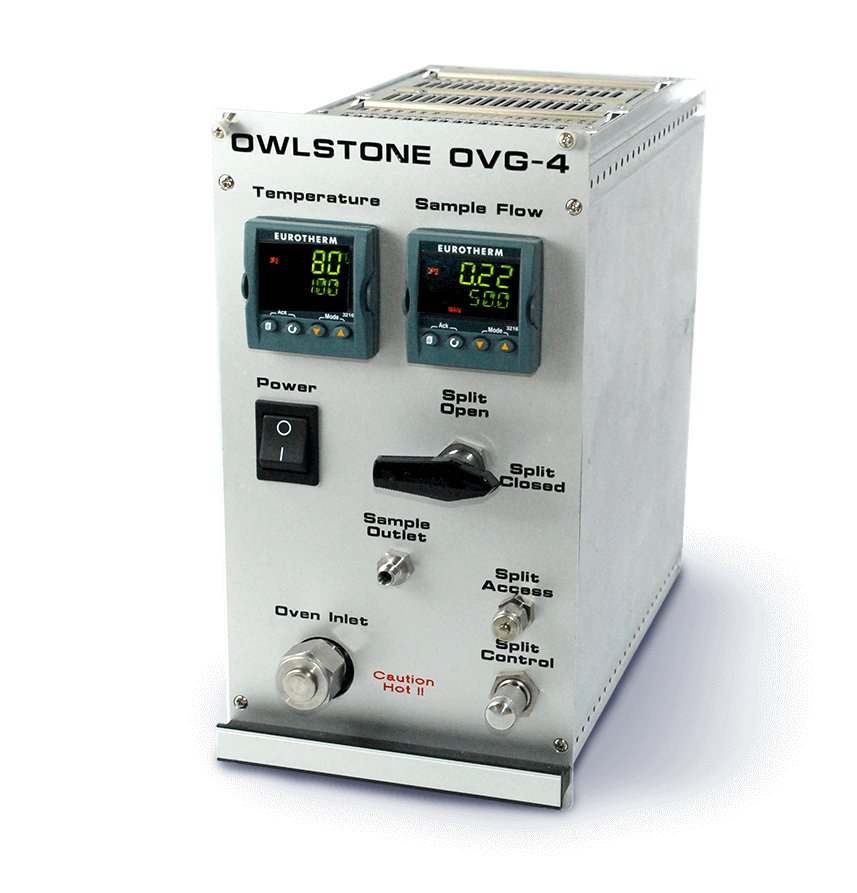
The Owlstone Calibration Gas Generator (OVG-4) is a compact, cost-effective calibration gas system, which can generate NIST traceable, precise, repeatable, and accurate concentrations of chemicals and calibration gas standards. - Industrial and scientific vapor generation for all types of gas sensor calibration. - Cost savings by replacing multiple, costly gas cylinders - Small quantities of target chemicals reduce the risk of dangerous exposure - Fast and easy sample replacement removes the dangers associated with high-pressure cylinders Designed for calibration of industrial and scientific gas sensors, the OVG-4 incorporates permeation tube technology and can replace multiple gas cylinders. This results in significant cost and space savings as well as elimination of dangers associated with cylinders. The ability to generate arbitrarily complex gas mixtures makes the OVG-4 Calibration Gas Generator suitable for a broad range of applications from calibration of explosive detectors in military and homeland defense to testing personal monitors in industrial health and safety applications. OVG-4 Benefits - Industrial and scientific vapor generation for all types of gas sensor calibration - Cost savings by replacing multiple, costly gas cylinders - Small quantities of target chemicals reduce the risk of dangerous exposure - Fast and easy sample replacement removes the dangers associated with high-pressure cylinders - Accuracy and precision even at very low concentrations with superior long-term stability and repeatability - Portable with compact footprint for significant laboratory space savings - Reduce setup time and generate blended gas mixtures rapidly - Adjust concentrations from parts-per-billion to parts-per-million levels - Interface with the Owlstone Humidity Generator (OHG) for realistic environmental testing What's Wrong with Cylinders? - Not suitable for many compounds, e.g., corrosives, explosives, etc. - Hazards in high concentrations and high pressures - Cylinder and regulator costs quickly escalate with multiple analytes Benefits of Permeation Tubes - Excellent stability for up to two years of continuous use - Traceable to NIST standards - Safety – tubes contain only a very small quantity of analyte and operate at low pressure How to Calibrate Gas Sensors with OVG-4 1. Individual permeation tubes are filled with the analyte to calibrate and test instruments, gas analyzers, and sensors (e.g., FTIR, GC). 2. The permeation tube is placed in the OVG-4, which generates a traceable gas standard for testing and calibration. 3. That's it. You are now ready to test your sensors/instruments against traceable, precise, and repeatable gas standards. - Reliable — Accuracy and precision even at very low concentrations with superior long-term stability and repeatability - Economical — Cost savings by replacing multiple, costly gas cylinders - Safe — Small quantities of target chemicals reduce the risk of dangerous exposure - Simple to Use — Fast and easy sample replacement removes dangers associated with high-pressure cylinders - Space Saving — Compact footprint for significant laboratory space savings - Traceable — Owlstone permeation tubes are traceable to NIST standards, and are supplied with their own calibration certificates Specs OVG-4's Technical Specifications Designed for calibration of industrial and scientific gas sensors, the OVG-4 incorporates permeation tube technology and can replace multiple gas cylinders. - Technology: Permeation tubes - Available analytes: 500 including VOCs, environmental gases, explosive and CW agents, and simulants - Computer communications: RS-485 optional - Dimensions: H 262 mm, W 142 mm, D 260 mm - Exhaust connection: ⅛” Swagelok tube - Exhaust flow range: 0 ml/min to 3000 ml/min - Exhaust pressure: <30 psi - Inlet air: Regulated air/nitrogen. Free from impurities, -35°C dew point - Inlet connection: ¼” Swagelok quick connect - Inlet pressure: 40 psi - Output concentrations: parts per trillion to parts per thousand - Power supply – inlet: 100–240V AC - Oven Diameter: 40mm - Sample Outlet connection: ⅛” Swagelok compression fittings - Oven Temperature: 30–100°C ±0.1°C in 0.1°C increments - Sample Outlet flow range: 20–250 ml/min
CATEGORY
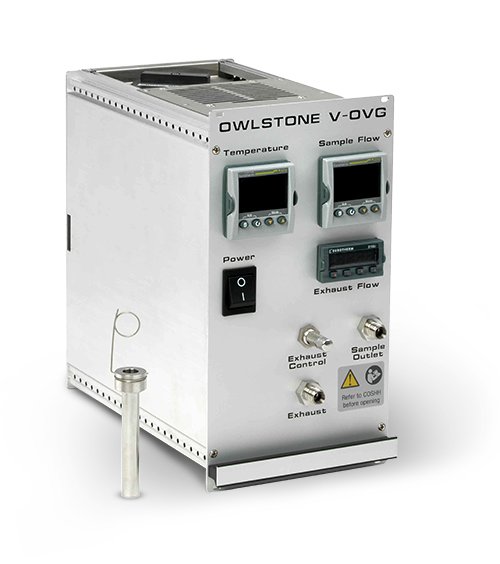
The Vertical Owlstone Vapor Generator (V-OVG) builds on Owlstone's proven OVG technology. - More versatile–a bigger, vertical oven that holds up to 6 standard permeation tubes - Easier to use–digital split flow meter readout - Suitable for multiple permeation sources - Easy–access top entry oven - Optional RS-485 connection Owlstone Vapor Generators are compact, cost-effective calibration gas systems, which can generate NIST traceable, precise, repeatable, and accurate concentrations of chemicals and calibration gas standards. The V-OVG is a versatile platform for the calibration of industrial and scientific gas sensors. Using permeation tube technology, a V-OVG system can replace multiple gas cylinders resulting in significant cost and space savings. The new V-OVG sample oven is 16 times the volume of the OVG-4 model. This larger oven allows gas standards to be produced from multiple and non-standard geometry permeation sources. The V-OVG also features an improved split flow meter with a digital readout and a RS-485 communications module for computer control. - V-OVG's vertical oven holds up to 6 permeation tubes - Wafer device/diffusion tube - Digital control of permeation oven temperature, sample flow, and split flow enables fully automated generation of calibration gases - Easily add parallel channels - Vertical loading, large-bore oven for multiple permeation tubes and diffusion tubes. V-OVG and OVG-4 The three principal differences between the calibration gas generators are listed below. V-OVG has: - Vertical oven compatible with diffusion tubes - Large-bore oven can hold up to 6 permeation tubes simultaneously - Digital control of split flow and sample flow - Reliable: Accuracy and precision even at very low concentrations with superior long-term stability and repeatability - Economical: Cost savings by replacing multiple, costly gas cylinders - Safe: Small quantities of target chemicals reduce the risk of dangerous exposure - Simple to Use: Fast and easy sample replacement removes dangers associated with high-pressure cylinders - Space Saving: Compact footprint for significant laboratory space savings - Traceable: Owlstone permeation tubes are traceable to NIST standards, and are supplied with their own calibration certificates Specs V-OVG's Technical Specifications Owlstone Vapor Generators are compact, cost-effective calibration gas systems, which can generate NIST traceable, precise, repeatable, and accurate concentrations of chemicals and calibration gas standards. - Technology: Permeation and diffusion tubes - Available analytes: 500 including VOCs, environmental gases, explosive and CW agents, and stimulants - Computer communications: RS-485 optional - Dimensions: H 262 mm, W 142 mm, D 260 mm - Exhaust connection: ¼" Swagelok tube - Exhaust flow range: 0 ml/min to 3000 ml/min - Exhaust pressure: <30 psi - Inlet air: Regulated air/nitrogen. Free from impurities, -35°C dew point - Inlet connection: ¼" Swagelok quick connect - Inlet pressure: 40 psi - Output concentrations: parts per trillion to parts per thousand - Oven Diameter: 40mm - Oven Temperature: 30–100°C ±0.1°C in 0.1°C increments - Power supply – inlet: 100–240V AC - Sample Outlet connection: ⅛" Swagelok compression fittings - Sample Outlet flow range: 20–250 ml/min
CATEGORY
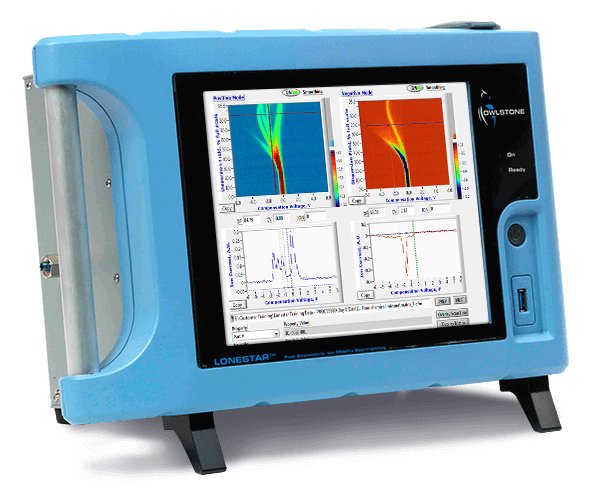
Lonestar is a programmable chemical analyzer used at the point of need by non-specialist operators. - Ability to screen and quantify VOCs in solid, liquid and gas samples - Sensitivity in the low ppb for many VOCs - Flexibility to "train" the instrument for a broad range of processes Incorporating Owlstone’s proprietary technology, the instrument offers the flexibility to provide both rapid alerts and detailed sample analysis. It can be trained to respond to a broad range of chemical scenarios and can be easily integrated with other sensors and third-party systems to provide a complete monitoring solution. As a result, Lonestar is suitable for a broad variety of applications ranging from online/at line process monitoring to lab-based R&D. - Flexible: Flexibility to "train" the instrument for a broad range of processes - Sensitivity: Sensitivity at ppm/ppb detection levels - Real-time: Real-time, online monitoring for rapid identification of VOCs - Portable: Portable with a compact footprint - Ease of use: Easily operated by non-specialist - Software: Powerful custom software for data visualization, real-time control, and offline analysis - Integration: Easy integration of other sensor data and control of third-party systems - Remote Monitoring: Network and wireless connectivity for remote monitoring and operation Specs Lonestar's Technical Specifications - Technology: Field Asymmetric Ion Mobility Spectrometry - Detection mode: Positive and negative ions - Sample input: Ambient, Headspace - Inlet / Outlet: 1/8 Swagelok compression fittings - Analyte range: Volatile Organic Compounds - Dynamic range: User adjustable inlet dilution for ppb - % - Instrumental air: Integrated and easy to replace - Max heater temp: 70°C - Humidity Range: 0% - 95% - Instrument Sensors: Temperature, humidity, flow and pressure - Inputs: Built-in tracker ball - Output: Real-time chemical spectra and stored data - Computer: Built-in PC running Windows XP - Memory: 4gb internal - Comms: USB, RJ45 - Software: Custom online control software - AC Inputs: 120/240V AC - Dimensions: 383 x 262 x 195 mm - Weight: 7.8kg For information regarding pricing and availability get in touch with our team
CATEGORY
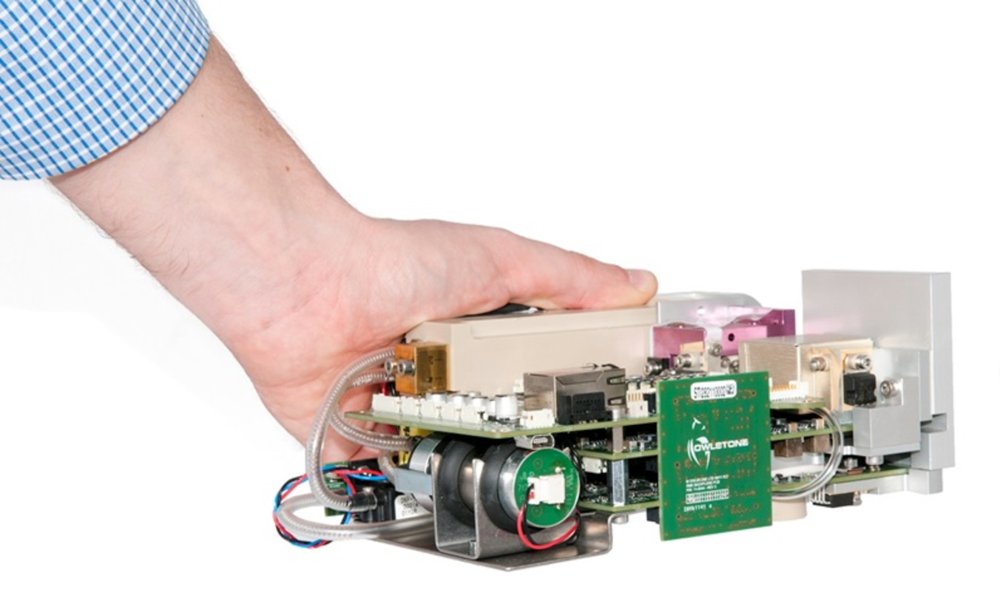
Owlstone's Next Generation Chemical Detector (NGCD) was funded by the U.S. military. It integrates the Owlstone technology into a handheld form factor while maintaining all of the technology's key benefits. - Handheld and lightweight - Extreme sensitivity - Extended CWA and TIC detection libraries - Reprogrammable Incorporating Owlstone's proprietary technology, the instrument offers the flexibility to provide both rapid alerts and extended-duration hazard monitoring. It can be trained to respond to a broad range of chemical hazard scenarios and can be easily integrated with other sensors (e.g., RAD & BIO) and third-party systems. In particular, the NGCD detection database has been expanded to include an extensive range of Toxic Industrial Chemicals (TICs). Broadband Detection: Detection and identification of conventional CWAs, emerging threats and an extensive range of TICs Sensitivity: Sensitivity at parts-per-billion detection levels combined with inlet control for a high dynamic range Response Time: 30 second alarm times for a majority of conventional CWAs and high-threat TICs at 10 minute critical Military Exposure Levels (MELs) Handheld: Less than 1 kg (2.2 lbs). Options available for vehicle mounted fixed site Ease of Use: Operable by non-specialists with less than one hour's training Advanced User Software: Intuitive laptop-based user interface available for data review Flexible: Mode selection: user can switch between rapid response (high threat condition) and monitoring mode (lower threat, contamination avoidance condition). More than 4 hours data logging capability No Hazardous Materials: System uses a non-radioactive (non-RAD) ionization source
CATEGORY
