
By Quandela
Cutting-edge platform tailored to your needs. Our comprehensive, accessible platform to discover, learn, test, and develop advanced quantum solutions.
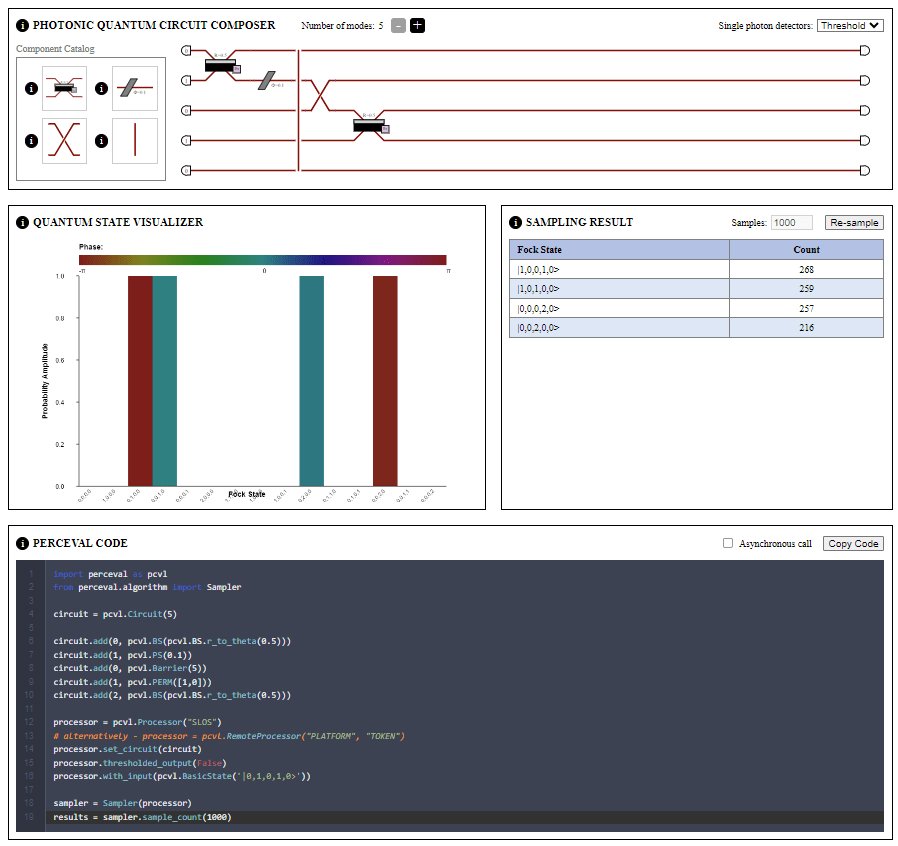
Open-source framework for photonic quantum programming. Bridging Theory and Practice in Photonic Quantum Computing Perceval is Quandela's open-source quantum programming framework, specifically designed for photonic quantum computing. It offers: - Intuitive Python-based interface for photonic quantum circuit design - Advanced simulation capabilities for photonic qubits - Seamless integration with Quandela's photonic quantum hardware - Full support of discrete-variable quantum computing models - Optimized performance for photonic quantum algorithms Perceval serves as the central programming interface across Quandela's quantum computing solutions, bridging the gap between theoretical quantum algorithms and practical implementation on photonic hardware. Whether you're a researcher, developer, or industry professional, Perceval offers unique advantages for your quantum computing endeavors. Why choose Perceval? - Hardware-Software Synergy: Unparalleled integration with Quandela's photonic quantum processors - Quantum-Classical Hybrid Algorithms: Efficient implementation of algorithms leveraging both quantum and classical resources - Seamlessly transition from simulation to hardware execution on Quandela Cloud - Active user community: join the community to request some guidance or contribute to new algorithms or to Perceval codebase - Follow classes on Training Center and become certified Perceval expert 01 Simulation Access powerful backends to simulate quantum algorithms on photonic circuits. Numerically and symbolically, Perceval is optimized to run on a local desktop, with several extensions for HPC clusters. 02 Design Design algorithms and complex linear optics circuits through a large collection of predefined components. A collection of known algorithms are available and presented as tutorials. 03 Experimentation Run experiments to fine-tune algorithms, compare with experimental data, and reproduce published articles in few lines of code. 04 Framework Unique framework fully dedicated to linear optics and photonic quantum computing. 05 Flexible Evolve from performing local or cloud-hosted simulations to running code on photonic chips within the same framework. 06 Exploration Open Source Project, and modular architecture welcoming contributions from the community. Getting started Ready to start your photonic quantum computing journey? Explore these resources: Getting Started with Perceval Applications, Tutorials, and Demonstrations Practice Perceval on Quandela Cloud Join the community Github Repository
CATEGORY
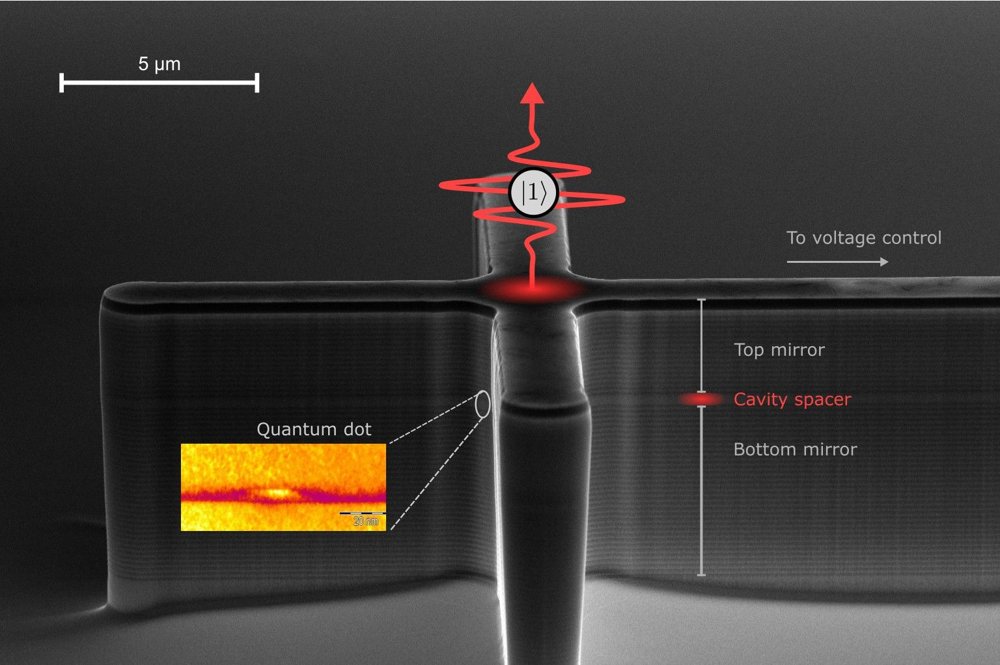
Quantum dots are at the heart of Quandela's groundbreaking single-photon technology. These tiny semiconductor structures, often called "artificial atoms," are the key to producing high- quality, on-demand single photons. How quantum dots work: - Electron confinement: Quantum dots trap electrons in a nanoscale space, creating discrete energy levels similar to those in atoms. - Excitation: A short laser pulse excites an electron to a higher energy state. - Relaxation and emission: As the electron returns to its ground state, it releases a single photon with precise properties. - Directed output: Advanced cavity designs ensure the photon is emitted in a specific direction for easy collection. Advantages of Quandela's quantum dot technology: - Deterministic emission: Quantum dots can produce single photons on-demand when and as they are needed. - High purity: Unlike other methods, the probability of emitting multiple photons at once is extremely low, ensuring true single-photon states. - Indistinguishability: Photons produced by the same quantum dot are nearly identical which is crucial for quantum interference effects. - Brightness: A high percentage of generated photons can be collected, boosting overall efficiency. - Scalability: The solid-state nature of quantum dots allows for miniaturization of the single-photon sources enabling integration of a large number of devices. By precisely controlling the quantum dot environment and leveraging the Purcell effect in specially designed optical cavities, Quandela achieves unparalleled performance in single- photon generation. This technology opens the door to practical, large-scale photonic quantum computing and other cutting-edge quantum applications. Quandela's innovative approach to creating ready-to-use single photon sources involves a precise and sophisticated fabrication process: - Quantum Dot Growth: We begin by growing semiconductor quantum dots using advanced epitaxial techniques. These nanoscale structures are carefully engineered to emit photons at specific wavelengths. - Micropillar Fabrication: A key innovation is our method of deterministically placing quantum dots at the center of microscopic pillars. These pillars, made from alternating layers of semiconductors, act as optical cavities that enhance photon emission and collection. - Cavity Optimization: The micropillar's dimensions and material composition are finely tuned to create a highly efficient optical cavity. This design leverages the Purcell effect to boost photon emission into a preferred direction. - Electrical Contacts: We integrate electrical contacts into the structure, allowing precise control over the quantum dot's emission properties through applied voltages. - Fiber Coupling: Finally, we permanently attach (or "pig-tail") an optical fiber to each high-performance micropillar device. This creates a robust, alignment-free interface between the quantum dot source and standard fiber optic systems. The result is a compact, efficient, and ready-to-use single photon source that can be easily integrated into quantum photonic systems or experiments. This unique fabrication process enables Quandela to produce high-performance single photon sources at scale, paving the way for practical quantum photonic technologies.
CATEGORY
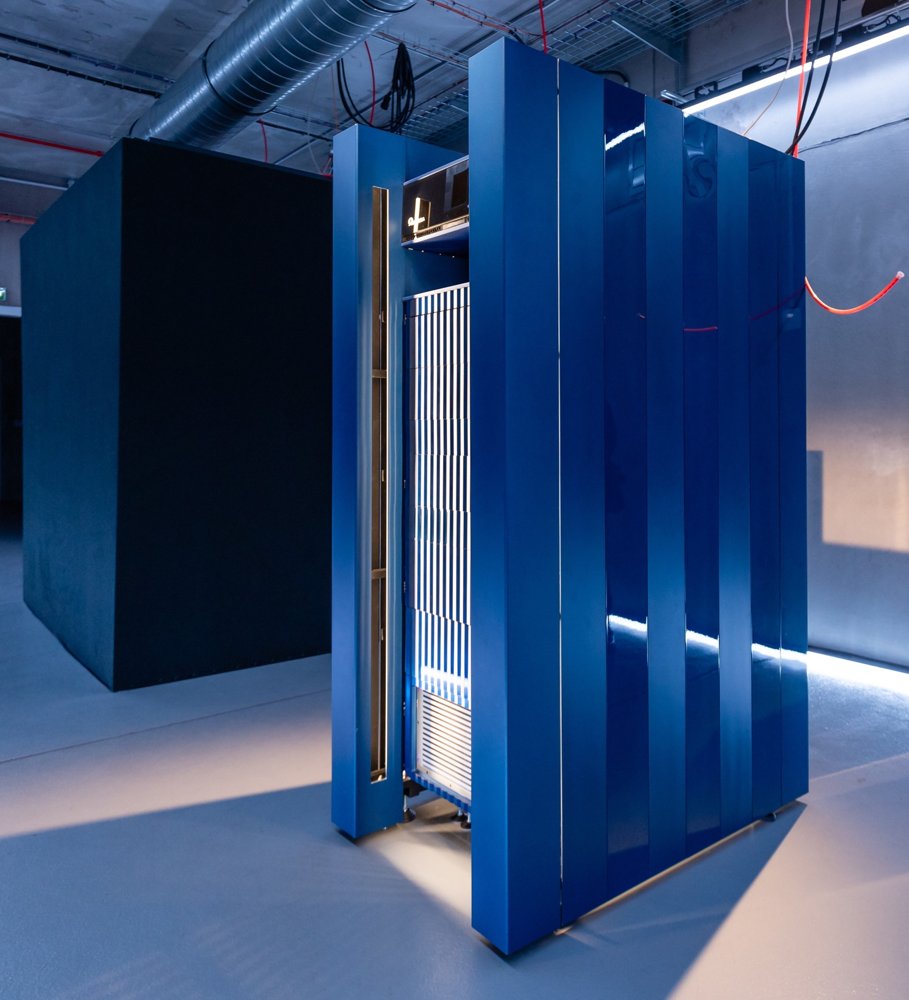
Reinforced security through true quantum randomness. Entropy harnesses the fundamental unpredictability of quantum mechanics to deliver the strongest encryption foundation available today. Our quantum random number generator provides true randomness that cannot be predicted, manipulated, or replicated – even by quantum computers. How does Entropy work? 1 Generate Entropy creates true randomness by measuring quantum entanglement between Bell pairs. This process leverages the inherent uncertainty in quantum measurements to produce numbers that are fundamentally unpredictable – not just diffcult to predict 2 Certify Each quantum random number produced by Entropy is validated through Bell tests – the same quantum verifcation method recognized by the 2022 Nobel Prize in Physics. This ensures cryptographic-grade randomness that meets the highest security standards. 3 Implement Entropy integrates seamlessly with your existing security infrastructure without requiring specialized hardware or cloud connections. Our software-based approach makes quantum-safe encryption accessible to organizations of all sizes. Technical Specifications Entropy: Bell State Generation Rate 100 kbps; Verification Method Bell Test Quantum Validation (CHSH 2.2); API Compatibility Compatible with any datacenter; Unit Dimensions (cm) 60 x 80 x 180; Weight 80 kg Entropy++: Bell State Generation Rate 200 kbps; Verification Method Bell Test Quantum Validation (CHSH 2.2); API Compatibility Compatible with any datacenter; Unit Dimensions (cm) 60 x 80 x 180; Weight 90 kg Entropy Module installed in OVHCloud datacenters in France Why Quantum Randomness matters Traditional random number generator solutions rely on deterministic algorithms or physical processes that can be vulnerable to prediction or manipulation. The applications of quantum random number generators span across industries where security cannot be compromised: - Financial Services: Protect transactions and sensitive customer data - Healthcare: Secure patient records and medical research - Government: Safeguard classifed information and critical infrastructure - Telecommunications: Ensure private communications remain private - Research: Enhance the accuracy of Monte Carlo simulations and scientifc modeling Entropy Advantages Quantum-Certifed Security Unlike conventional solutions, our quantum random number generator leverages quantum entanglement for randomness that cannot be predicted or manipulated. Entropy delivers quantum random number sequences at industry-leading speeds while maintaining the highest quality standards. Future-Proof Protection As quantum computing advances threaten traditional encryption, Entropy provides the foundation for quantum-resistant cryptography. Implement quantum-safe encryption today without complex infrastructure changes. Seamless Integration Our random number generator provides drop-in replacement for existing entropy sources with minimal confguration. Entropy serves as a reliable entropy source for cryptography applications across your organization. Verifed Performance Entropy’s QRNG (quantum random number generator) technology has been validated through rigorous testing and certifcation. Our solution meets and exceeds industry standards for randomness quality and security. Applications Financial Services Secure transactions worth billions with Entropy. The benefts of quantum random number generation include protection against both current and future threats to fnancial data. Government & Defense Entropy provides the foundation for implementing quantum-resistant cryptography across critical systems. Our enterprise quantum security solutions meet the stringent requirements of government agencies. Healthcare & Hospitals Protect sensitive patient data and research with quantum-level security. Quantum random number generation in cybersecurity represents a paradigm shift in healthcare data protection.
CATEGORY
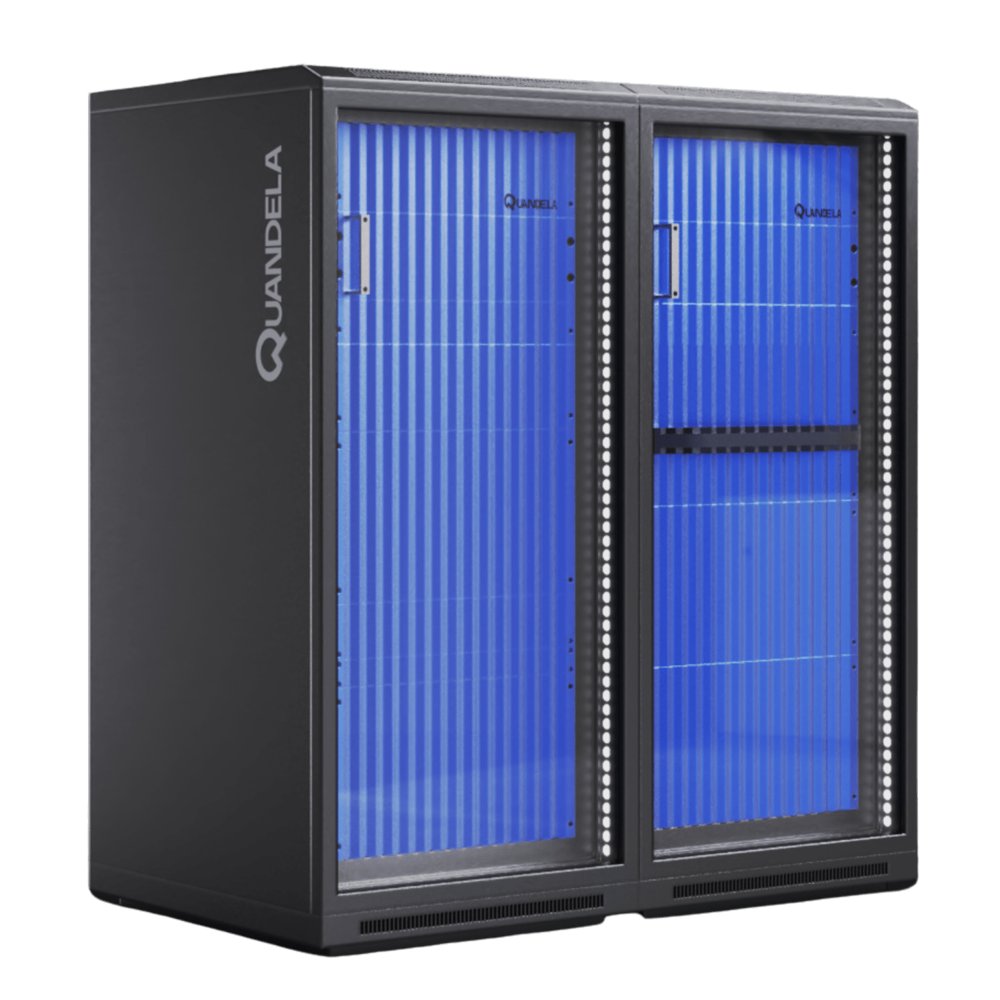
Exploring Ascella, the Single-Photon Quantum Computing Prototype Quandela announces the launch of Ascella, the first functional Photonic Quantum computer. This is a key milestone for Quandela. Ascella is a quantum computer that uses a highly efficient quantum dot single photon source, which functions much like a miniature box that produces single photons on-demand which then go into its universal interferometer to perform the computation and subsequently are detected at the output for processing. At its core, Ascella is a unique piece of technology that uses light to perform complex calculations. Its hardware is made up of several key components. Firstly, there is the single-photon source which produces the photons on demand. This source emits photons into a fiber which then sends the photons on their journey through the system. The system contains a device called a demultiplexer, which is responsible for splitting the stream of photons into separate streams. So it feeds the chip 6 photons that arrive at the same time. Secondly there is the unitary matrix in the universal interferometer which determines the evolution of the photons and finally detectors (SNSPD) at the outputs. Ascella is available directly in the cloud. Technical Specifications Product Line / QPU MOSAIQ-6 Technology Digital Quantum Computer Modality Photonic Topology All-to-all connectivity modes 12 QOPS 144 Photonic chip design Universal System Software MosaiqOS Cooling system Air-cooled Programming environment(s) (Client software) Perceval, Qiskit, myQLM, Quandela Quantum Toolbox SDK (99.6 ± 0.1)% 1-qubit gate fidelity (99.0 ± 0.8)% 2-qubit gate fidelity 99% Read-out fidelity 6 fully entangled qubits Entanglement capability 3 kW Power consumption (in main system) APPLICATIONS Simulation of Properties of Large Molecules Predicting Loan Defaulters Stress Simulation of Large Mechanical Constructions
CATEGORY
