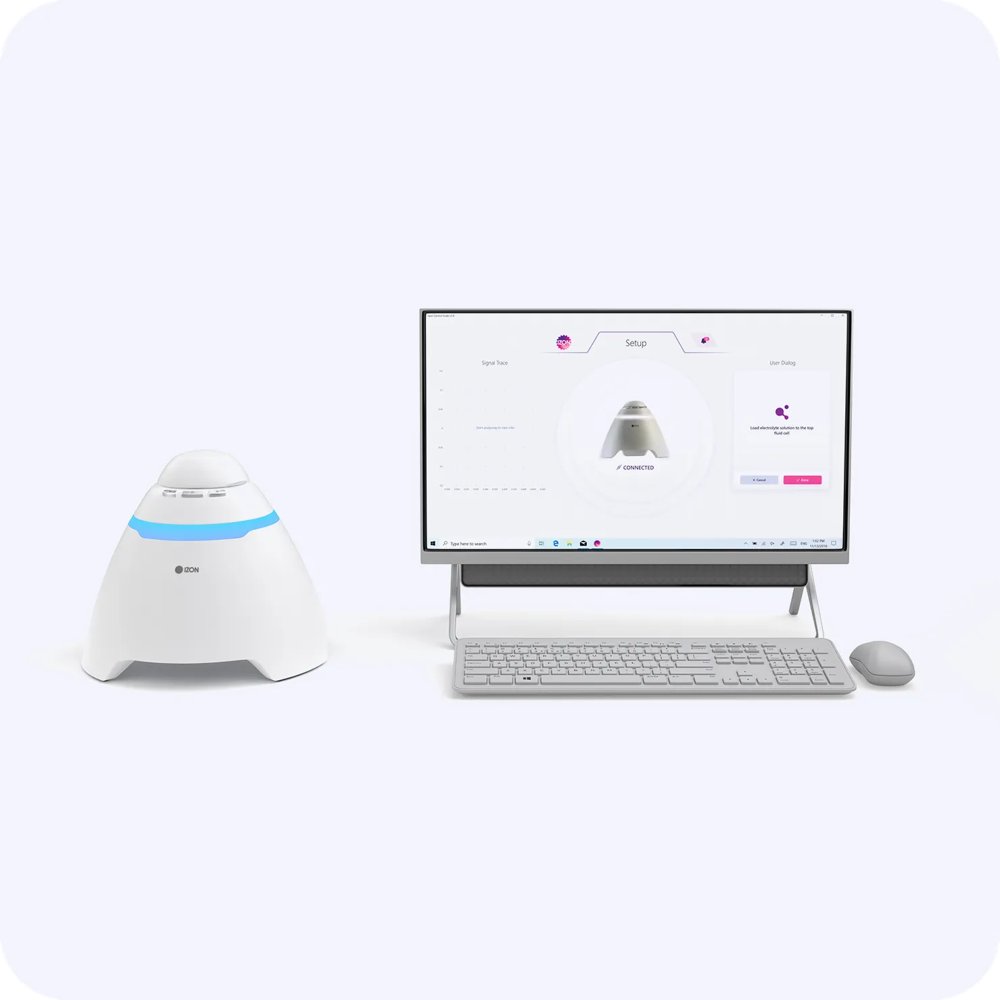
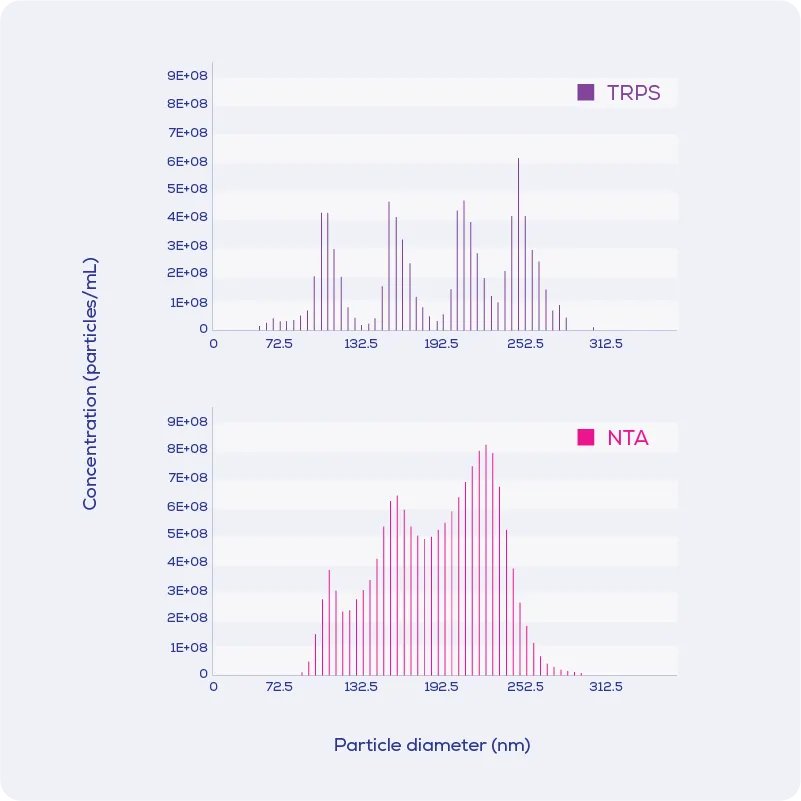
Using Tunable Resistive Pulse Sensing (TRPS), the Exoid measures nanoparticles one-by-one as they pass through a tunable nanopore, allowing you to obtain measurements of particle size and concentration, or particle size and zeta potential, on a single-particle basis. Unlike ensemble techniques, where larger particles can skew size measurements, the Exoid provides insightful, high-resolution measurements that allow you to detect important differences in particle size distribution. The Exoid is capable of measuring polydisperse samples over a wide size distribution, at a high resolution. This allows you to identify subpopulations within your sample and obtain an accurate measure of the overall concentration and number-based particle size distribution. Tunable Resistive Pulse Sensing (TRPS) measurements have in-built requirements which ensure a standardised approach to measurement: Traceable calibration - Measurements are calibrated using Izon standards characterised against NIST particles, ensuring reproducible and comparable results. Real-time system feedback - Live monitoring of current and noise helps maintain stable, high-quality measurements. Buffer control checks - Running a particle-free buffer confirms that detected events represent true particles in the sample. EV-ready workflow - Pair with qEV isolation to support consistent, standardised EV characterisation. The Exoid enables detailed, single-particle analysis across a broad range of nanoparticle types. Measure particle size and concentration from 40 nm to 11 µm, and size and zeta potential from 40 nm to 2,000 nm, using interchangeable nanopores to match your sample. Its wide dynamic range and tunable measurement conditions make it well suited to complex or heterogeneous samples, including extracellular vesicles, lipid nanoparticles, virus-like particles, and other biological or synthetic nanoparticles. For researchers who require flexibility and depth of insight across diverse particle systems, the Exoid remains a trusted and versatile platform. Over the years, TRPS instruments have evolved significantly, improving usability and workflow compared with earlier generations. That said, the Exoid remains a hands-on platform. Users adjust measurement conditions and occasionally troubleshoot to maintain optimal performance, particularly when working with complex samples. With training and experience, this level of control becomes a strength, enabling detailed analysis across a wide range of particle types. Izon provides training and ongoing support to help users get the most from the system. As particle size decreases, measurement becomes more technically demanding. Smaller particles require tighter control of conditions, careful calibration, and greater user skill to obtain reliable data. The Exoid is designed to deliver precise, repeatable single-particle measurements across a wide size range, including challenging sub-100 nm particles. Achieving optimal results requires good sample preparation and active user oversight. For experienced users who value flexibility and control, this involvement enables robust, defensible data, particularly at the smallest sizes. Specifications of the Exoid TRPS Measurement System Analysis range: 40 nm to 11 µm Compatible electrolyte solutions: Include PBS, HEPES, MES and KCI Footprint: 300 x 300 mm Concentration range: 1E5 to 1E11 particles/mL (size-dependent) Weight: 10.8 kg Height: 250 mm Purchase price $47.5K Lease $4.5K / month
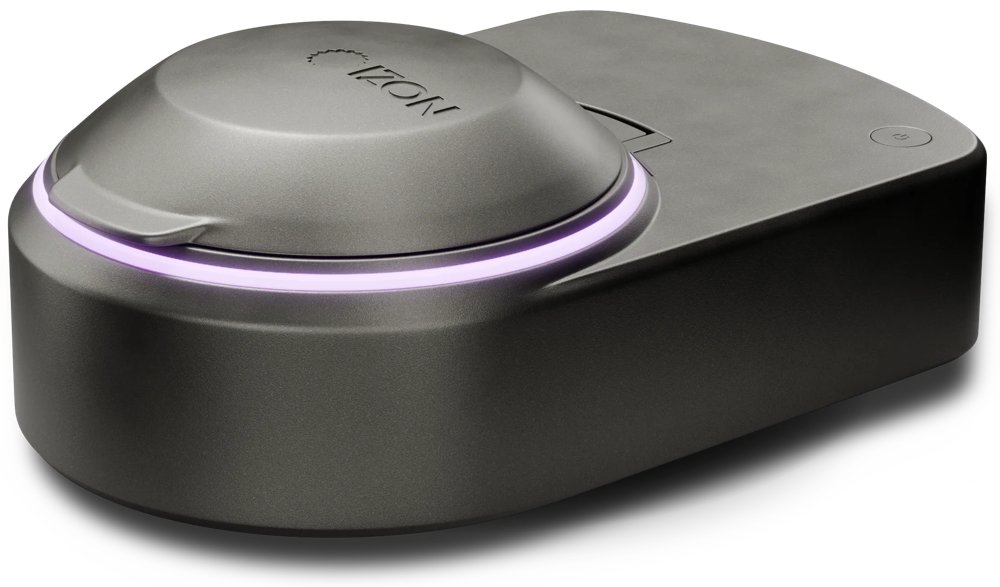
A New Era in Nanoparticle Characterisation High-Resolution Nanoparticle Measurement, Made Simple The Pulsoid is Izon’s brand-new nanoparticle measurement system, delivering high-resolution, single-particle insight through a faster, more intuitive workflow. Powered by Nanopore Pulse Sensing (NPS), the Pulsoid removes the traditional trade-off between measurement performance and usability, making direct measurement of particle size, concentration, and zeta potential more accessible. See What Ensemble Methods Miss Ensemble techniques report averages - but important differences between particles can be hidden beneath them. The Pulsoid provides particle-by-particle insights, allowing you to explore distributions, heterogeneity, and subtle population differences that may otherwise go undetected. Exceptionally Accurate Size Measurement Access high-resolution measurements of size and concentration, with TEM-level size accuracy¹. The precision and consistency of solid-state nanopores enable accurate measurement of small particles from 40 nm and above. Size accuracy is exceptionally high, demonstrated by 99.7% agreement with TEM for NIST-traceable polystyrene standards. Single-particle analysis ensures the Pulsoid maintains accuracy even when analysing polydisperse samples. High-Throughput, Easy to Learn A solid-state silicon nanopore housed in an easy-to-clean fluid cell reduces handling, maintenance, and calibration between runs. The result is faster workflows and higher throughput. With a simplified setup and fewer opportunities for user error, the Pulsoid requires only a fraction of the setup time of the Exoid and delivers around double 2 the throughput. It also offers a significantly lower learning curve and more consistent results across users. True Particle-Count–Based Concentration Measurement The Pulsoid measures concentration by directly counting individual particles, delivering a linear response across a wide concentration range of 10⁹ to 10¹² particles per mL. This ensures measured changes reflect real differences in particle number, not artefacts, making the Pulsoid well suited to formulation work, process monitoring, and comparability studies. Direct, Single-Particle Zeta Potential The Pulsoid measures particle size and zeta potential simultaneously on a particle-by-particle basis, revealing surface charge detail that ensemble techniques average away. Resolving charge distributions and subpopulations provides clearer insight into formulation behaviour, stability, and process-related changes, particularly for heterogeneous samples. A New Solid-State Nanopore Chip at the Core At the heart of the Pulsoid is a precision-manufactured silicon nanopore chip. Its fixed pore geometry delivers consistent, repeatable single-particle measurements with the resolution required for high-quality nanoparticle analysis. As particles pass through the nanopore, brief changes in ionic current are measured.Signal magnitude correlates with particle size, event frequency reflects concentration, and event duration enables zeta potential measurement. The result is highly detailed, particle by particle characterisation. Optimised for LNPs and Beyond The Pulsoid is designed for lipid nanoparticles and other nanoscale particle types used in biological and therapeutic research. High-resolution, single-particle analysis helps detect subtle changes caused by aggregation, instability, storage conditions, or processing effects. With access to size, concentration, and zeta potential data, you can build a clearer picture of particle behaviour and stability over time.
CATEGORY
Measure Nanoparticles with Single Particle Resolution Using Tunable Resistive Pulse Sensing (TRPS), the Exoid measures nanoparticles one-by-one as they pass through a tunable nanopore, allowing you to obtain measurements of particle size and concentration, or particle size and zeta potential, on a single-particle basis. Unlike ensemble techniques, where larger particles can skew size measurements, the Exoid provides insightful, high-resolution measurements that allow you to detect important differences in particle size distribution. The Exoid is capable of measuring polydisperse samples over a wide size distribution, at a high resolution. This allows you to identify subpopulations within your sample and obtain an accurate measure of the overall concentration and number-based particle size distribution. A Proven, Standardised Platform Tunable Resistive Pulse Sensing (TRPS) measurements have in-built requirements which ensure a standardised approach to measurement: - Traceable calibration: Measurements are calibrated using Izon standards characterised against NIST particles, ensuring reproducible and comparable results. - Real-time system feedback: Live monitoring of current and noise helps maintain stable, high-quality measurements. - Buffer control checks: Running a particle-free buffer confirms that detected events represent true particles in the sample. - EV-ready workflow: Pair with qEV isolation to support consistent, standardised EV characterisation. Characterise Your Samples Confidently With the Exoid The Exoid enables detailed, single-particle analysis across a broad range of nanoparticle types. Measure particle size and concentration from 40 nm to 11 µm, and size and zeta potential from 40 nm to 2,000 nm, using interchangeable nanopores to match your sample. Its wide dynamic range and tunable measurement conditions make it well suited to complex or heterogeneous samples, including extracellular vesicles, lipid nanoparticles, virus-like particles, and other biological or synthetic nanoparticles. For researchers who require flexibility and depth of insight across diverse particle systems, the Exoid remains a trusted and versatile platform. What Can You Expect From the Exoid? Over the years, TRPS instruments have evolved significantly, improving usability and workflow compared with earlier generations. That said, the Exoid remains a hands-on platform. Users adjust measurement conditions and occasionally troubleshoot to maintain optimal performance, particularly when working with complex samples. With training and experience, this level of control becomes a strength, enabling detailed analysis across a wide range of particle types. Izon provides training and ongoing support to help users get the most from the system. Skill Required for Insightful, Reliable Nanoparticle Measurements As particle size decreases, measurement becomes more technically demanding. Smaller particles require tighter control of conditions, careful calibration, and greater user skill to obtain reliable data. The Exoid is designed to deliver precise, repeatable single-particle measurements across a wide size range, including challenging sub-100 nm particles. Achieving optimal results requires good sample preparation and active user oversight. For experienced users who value flexibility and control, this involvement enables robust, defensible data, particularly at the smallest sizes. Specifications of the Exoid TRPS Measurement System Analysis range: 40 nm to 11 µm Compatible electrolyte solutions: Include PBS, HEPES, MES and KCI Footprint: 300 x 300 mm Concentration range: 1E5 to 1E11 particles/mL (size-dependent) Weight: 10.8 kg Height: 250 mm There are a number of ways you can incorporate the accuracy and precision of TRPS in your research. You can buy the Exoid outright for $47,500 USD, or get in touch with our team to discuss a lease agreement. Alternatively, we also offer sample measurement services for our EU and US customers. All prices listed below are in USD. Purchase price $47.5K Lease $4.5K / month
CATEGORY
Tunable Resistive Pulse Sensing (TRPS) is a true single-particle technique which uses changes in electrical current to evaluate individual particles suspended in an electrolyte solution as they move between electrodes through a tunable nanopore. Current flow is monitored, and each particle is detected as it passes through the nanopore, due to the transient change in current that is subsequently created. Physical characteristics of particles in the sample are obtained via the analysis of resulting blockades, which represent individual particles. Specifically, particle volume is directly proportional to blockade magnitude, and particle concentration is precisely calculated from the particle flow rate measured at several different applied pressures. Zeta potential is derived via measurements of electrophoretic mobility, which is calculated from the velocity with which the particle traverses the nanopore. Tunable Resistive Pulse Sensing (TRPS) is a single-particle measurement technique that generates high-resolution data on the physical characteristics of nanoparticles. Given the direct relationships that exist between blockade characteristics and physical properties of nanoparticles, TRPS enables true particle-by-particle analysis. The resulting high-resolution measurements enable you to gain deep insights on particle characteristics. Different sized nanopores are available to facilitate a range of particle sizes, from 40 nm to 11 µm in diameter, and only 35 μL of sample is needed for a TRPS measurement. With TRPS, the use of standardised calibration particles and ability to monitor the signal-to-noise ratio in real time ensures that conditions are optimised and maintained throughout the calibration and measurement process. Key features of tunable resistive pulse sensing (TRPS) showing nanoparticles passing through a nanopore (top left), signal trace with resistive pulses (top right), high-resolution particle size distribution (bottom left), and a breakdown of how each individual blockade is analysed (bottom right). Approach to size measurement: Particle size is directly proportional to blockade magnitude; each particle is measured individually. Size range capabilities: Wide size range; particles from 40 nm - 11 µm can be measured using appropriately sized nanopores. Limitations of size analysis: Different sized nanopores are needed to cover the entire size range. Resolution capabilities: Can resolve subpopulations in multimodal samples. Concentration: Calculated directly from blockade frequency, using standardised calibration particles of known size and concentration. Ease of data processing: Automated data processing with user-friendly data visualisation interface. Influence of instrument parameters/particle properties: Parameters are actively monitored to ensure they are optimised for the measurement of calibration and sample particles.
CATEGORY
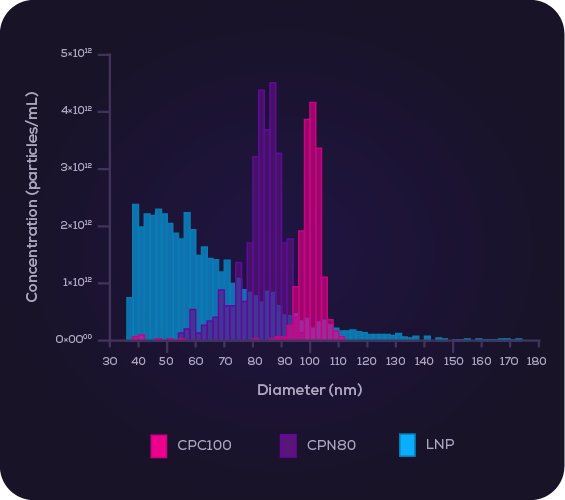
The Pulsoid marks the start of a new era in nanoparticle characterisation, combining high-resolution, single-particle analysis with a fast, easy-to-use workflow. Today, we’re announcing the Pulsoid, a new particle measurement system that removes the historical trade-off between accuracy and usability. Designed around a silicon chip-based nanopore, the Pulsoid introduces a new RPS technique we call Nanopore Pulse Sensing (NPS). For the first time, high-resolution, single-particle analysis is delivered in a fast, streamlined workflow. Building on a proven foundation: Lessons from TRPS Our original measurement platform, Tunable Resistive Pulse Sensing (TRPS), is known for its high accuracy and resolution but has a steep learning curve. After selling around 1000 TRPS instruments, we’ve learned a great deal from how it has been used in practice. While we continue to believe that high-quality particle data is worth some effort, we also recognise that measurement throughput and ease of use are important factors. The Pulsoid was designed with those realities in mind. For the first time, we are offering a particle analysis methodology that delivers very accurate and high-resolution measurements in a system that is fast and straightforward to use. A solid-state nanopore chip at the core In contrast to TRPS, which uses a flexible, tunable polymer nanopore, NPS uses a solid-state silicon nanopore chip. The chip is fixed in size and manufactured with extreme precision and consistency, enabling a simpler, faster user experience with fewer calibration steps across multiple measurements, while maintaining the detail and resolution of single-particle analysis. Exceptional size measurement accuracy The precision and consistency of solid-state nanopores enable incredibly accurate measurement of small particles from 40 nm and above, with smaller size ranges currently in development. Size accuracy is exceptionally high, as demonstrated by the 99.7% agreement with TEM shown below. Rapid single-particle analysis ensures the Pulsoid maintains accuracy even when analysing polydisperse samples. True particle-count–based concentration measurement The Pulsoid concentration measurements are based on particle counts and scale linearly with dilution, confirming accurate particle-by-particle counting across a wide concentration range, currently 10 9 to 10 12 particles/mL. This predictable response provides confidence that measured changes reflect true differences in particle number, not measurement artefacts, making the system well suited to formulation, process monitoring, and comparability studies. Direct, single-particle zeta potential analysis The Pulsoid measures particle size and zeta potential (which is a measure of surface charge density), simultaneously on a particle-by-particle basis. This delivers far more precise, high-resolution data than ensemble techniques such as PALS, particularly for heterogeneous samples. By measuring charge directly at the single-particle level, the Pulsoid provides clearer insight into charge distributions and subpopulations that are otherwise obscured by averaged measurements. Designed for high throughput and ease of use We set out to develop the most capable and easiest to use single-particle measurement system available. Every aspect of the system was designed with throughput in mind. The transparent fluid cell that houses the chip is easy to clean, and while the chip is user-loaded at launch, it is intended to become a single consumable item in the near future. This approach reduces handling time and sanitisation requirements. Beyond the fluid cell, the system requires minimal routine maintenance or cleaning. The fixed, solid-state nature of the silicon chips also reduces the need for repeated calibration when processing multiple samples, and we are testing a calibration-free approach with the aim of removing this step entirely. While we continue to work towards a fully plug-and-play solution, the Pulsoid Beta already requires only a fraction of the setup time compared with the Exoid. In addition to higher throughput, the Pulsoid has a much lower learning curve than the Exoid, with fewer opportunities for user error and reduced between-user variability. Sample preparation and purity are important for accurate particle measurement on any system, and ease of use can vary depending on the sample. Monitoring change High resolution combined with high accuracy allows you to detect small, potentially rapid changes that ensemble techniques cannot resolve. These changes may arise from aggregation, contamination, instability, or bioprocessing issues. Crucially, monitoring change is not limited to particle size. Meaningful insight requires tracking particle concentration and zeta potential alongside size, as all three can shift independently and signal different underlying issues. Optimised for lipid nanoparticle applications The launch of the Pulsoid marks an important step forward in nanoparticle analysis, and this is only the beginning. From the outset, the Pulsoid is focused on addressing the immediate needs of researchers working with lipid nanoparticles in drug delivery and gene therapy, where access to reliable, high-resolution data is essential. At the same time, its underlying methodology supports a much broad errange of applications across nanoparticle research, wherever detailed insight into particle size, concentration, and charge is required. We look forward to exploring these opportunities alongside researchers working across diverse particle types and applications. Beta packages are now available for early access, with discounted pricing for participating researchers. To learn more about the Pulsoid, discuss beta access, or arrange a demo with your samples, we invite you to get in touch with our team.
CATEGORY
