By Innolume
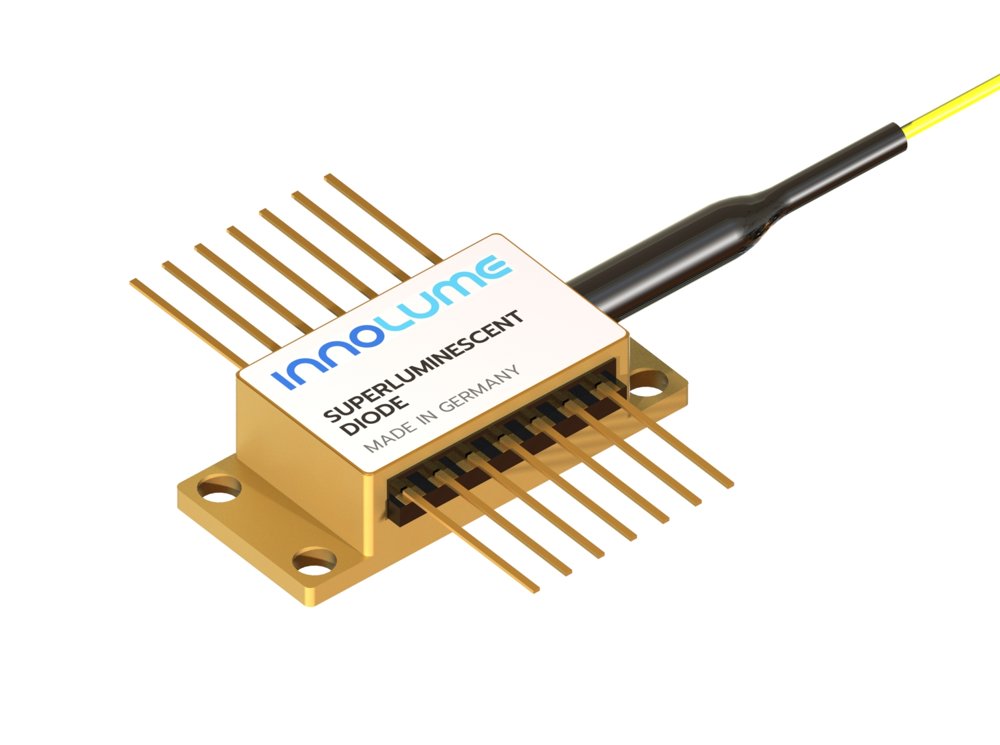
Fiber-coupled superluminescent diode (SLD) in 14-pin BTF package. A superluminescent diode (SLD) is a semiconductor device, generating amplified spontaneous emission over a broad spectrum when biased in the forward direction. Unlike lasers, SLDs have a broad optical spectrum, making them suitable for various applications. SLDs lack the feedback to achieve lasing action. The suppression of the optical feedback is achieved by a tilted waveguide and anti-reflective coatings with <0.001% reflectivity, which allow for significantly reducing spectrum ripples. The peak wavelength and intensity of SLDs depend on active material composition and injection current. Certain SLDs manufactured by Innolume demonstrate high output optical power, exceeding 250mW, low spectral ripples and a broad spectrum. The width of the optical spectrum is important as it affects coherence length. Broader spectrum width can be beneficial for certain applications. SLDs, characterized by a high degree of spatial coherence, are effective for coupling into single-mode optical fibers. Innolume provides various packaging options, offering 14-pin modules with the availability of PM/HI fiber types, a loose tube, and a photodiode. Also, Innolume has the capability to provide configurations with the chip mounted on a submount, chip on a heatsink (e.g. C-Mount), or in a TO can. Key features of Superluminescent diodes (SLD) - High Output Power: Capable of achieving output optical power exceeding 250mW. - Broad Spectrum: Certain Innolume SLDs provide a spectrum width exceeding 100nm. - Feedback Suppression: Tilted waveguides and anti-reflective coatings (<0.001% reflectivity) to reduce optical feedback and minimize spectrum ripples. - Packaging Options: Various packaging configurations available, including 14-pin modules and chip placement options such as on a submount, on a heatsink, or in a TO can. - Customization: Innolume has the capability to produce SLDs with specified wavelength and spectrum width based on customer requests. SLD - main characteristics, features and application. Superluminescent diodes (SLD) in essence are similar to laser diodes and operate based on electrically excited pn-junctions. When excited in the conductivity direction, this junction becomes optically active and generates amplified spontaneous emission (ASE) in a broad spectrum of wavelengths. The specific peak wavelength and intensity of SLD emission depend on the composition of the active material and the level of injected current. Unlike traditional laser diodes, SLDs are designed for high single-pass amplification of spontaneously emitted light along the waveguide, but they lack the necessary feedback to achieve laser action. This is efficiently achieved through a combination of tilted waveguides and anti-reflection coatings. Our SLDs impress with their characteristics: - High Light Quality: Our SLDs provide bright, uniform, and stable light, ideal for measurements, medical diagnostics, and other applications. - Wide Spectral Range: From infrared to visible light our SLDs cover a broad spectral range, making them an excellent choice for various tasks. - Reliability: We guarantee the durability and stability of our SLDs even under intensive use. Superluminescent diodes (SLD) Applications: Medical Diagnostics: From tissue scanning to optical coherence tomography, our SLDs are indispensable for accurate and reliable diagnostic systems. Optical Measurements: Thanks to high light quality and stability, our SLDs are ideal for measuring various parameters in optical systems. Superluminescent diodes (SLD) Features: - High output power up to 300mW; - Broad spectrum with up to 120nm bandwidth; - Ultra-low ripples; - Strong linear polarization; - Individual burn-in and thermal cycling screening; - Proprietary mirror coating technology enabling high reliability. Superluminescent diodes (SLD) Applications: - Fiber sensors; - Spectroscopy; - Instrumentation.
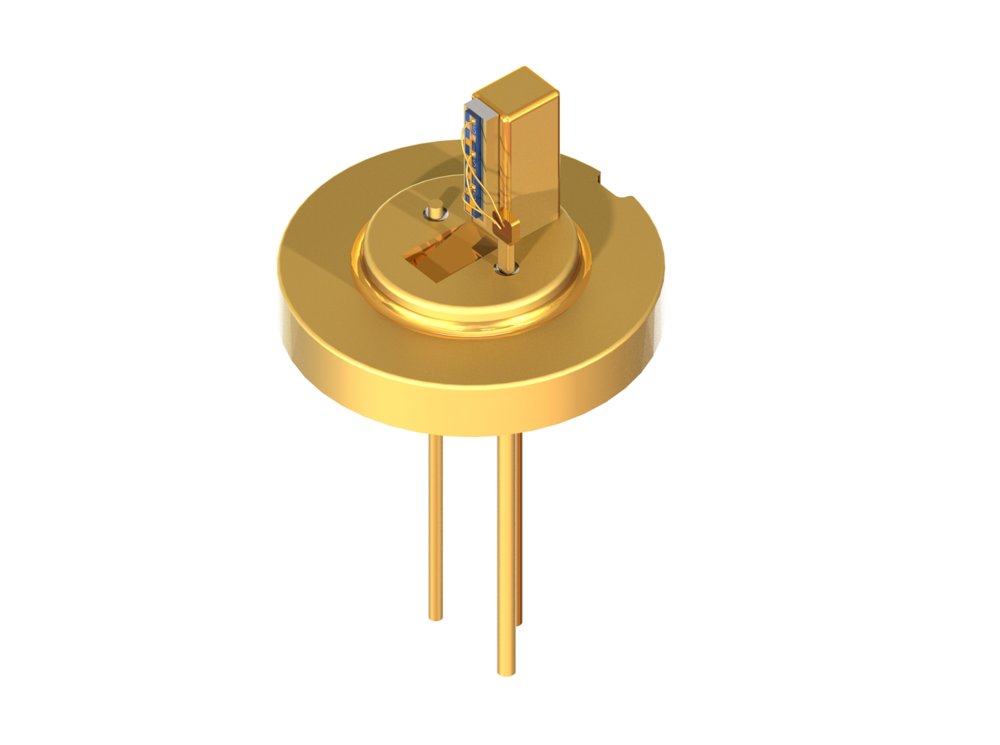
Single-mode Fabry-Perot (FP) laser diodes are engineered to operate in a single transverse mode, delivering a diffraction-limited output beam with high power density, achieved through efficient collimation. The FP configuration, incorporating two parallel mirrors, stabilizes lasing conditions and enhances beam quality, making these diodes suitable for precision-dependent optical systems. This combination of high CW power, precise wavelength control, and customizable packaging solutions underscores the robust adaptability and technical performance of single-mode Fabry-Perot laser diodes, making them indispensable in specialized optical and photonic applications. Key features of Fabry-Perot laser diodes on Fiber-coupled and TO package - High Continuous Wave (CW) Output Power: Engineered for high-performance requirements, these diodes are capable of delivering continuous wave output power levels up to 700mW for fiber-coupled designs and up to 500mW for TO-can packaged models, supporting demanding operational environments. - Wavelength Precision and Tuning: These diodes offer an extensive wavelength range with customization options. Precise wavelength control, achievable through chip temperature tuning, ensures emission stability within a tolerance of +/-5nm or better, optimizing the diode's integration into various photonic systems. - Advanced Packaging Configurations: Designed for versatility, the diodes are available in multiple configurations: Fiber-Coupled Versions: Equipped with single-mode or polarization-maintaining fiber coupling, 900µm loose tube on the fiber, and optional external optical isolators. A variety of connector types, including FC/PC, SC/APC, SC/PC, and APC ferrule, provide adaptable interfacing. TO Package Options: Diodes come in TO-can headers (available in open or sealed configurations), C-mounts, or Aluminum Nitride submounts. Custom packaging solutions ensure seamless integration into complex systems, enhancing performance and system compatibility. Fiber-coupled Fabry-Perot laser diode in 14-pin BTF package Single-mode Fabry-Perot laser diode in TO package Single-mode Fabry-Perot laser diode in TO package with cap Typical parameters of Fabry-Perot Laser Diodes (SML) Part-number; Mean wavelength nm; Output power mW; Forward current mA; Forward voltage V; Threshold current mA; Spectrum bandwidth (3dB) nm; Polarization extinction ratio dB; Slow axis beam divergence deg; Fast axis beam divergence deg; Package - SML1000B50YY250MXXXX: 1000 nm, 250 mW, 450 mA, 1.7 V, 25 mA, 0.2 nm, 17 dB, Fiber-coupled - SML1000B60TC300MXXXX: 1000 nm, 300 mW, 400 mA, 1.6 V, 30 mA, 0.6 nm, 6 dB, 17 deg, TO package - SML1020B50YY400MXXXX: 1020 nm, 400 mW, 800 mA, 1.9 V, 60 mA, 0.2 nm, 17 dB, Fiber-coupled - SML1020B50YY600MXXXX: 1020 nm, 600 mW, 1000 mA, 2.1 V, 70 mA, 0.2 nm, 17 dB, Fiber-coupled - SML1025B50YY400MXXXX: 1025 nm, 400 mW, 800 mA, 1.7 V, 80 mA, 0.2 nm, 18 dB, Fiber-coupled - SML1030B50YY400MXXXX: 1030 nm, 400 mW, 800 mA, 1.7 V, 80 mA, 0.2 nm, 18 dB, Fiber-coupled - SML1050B50YY400MXXXX: 1050 nm, 400 mW, 800 mA, 1.8 V, 50 mA, 0.2 nm, 17 dB, Fiber-coupled - SML1050B50YY600MXXXX: 1050 nm, 600 mW, 1000 mA, 2 V, 50 mA, 0.2 nm, 17 dB, Fiber-coupled - SML1064B50YY400MXXXX: 1064 nm, 400 mW, 800 mA, 1.7 V, 70 mA, 0.2 nm, 17 dB, Fiber-coupled - SML1064B50YY600MXXXX: 1064 nm, 600 mW, 1000 mA, 1.8 V, 70 mA, 0.2 nm, 17 dB, Fiber-coupled - SML1064B50YY670MXXXX: 1064 nm, 670 mW, 1100 mA, 1.9 V, 70 mA, 0.2 nm, 17 dB, Fiber-coupled - SML1064B60TC500MXXXX: 1064 nm, 500 mW, 600 mA, 1.7 V, 30 mA, 0.6 nm, 6 dB, 31 deg, TO package - SML1080B50YY400MXXXX: 1080 nm, 400 mW, 800 mA, 1.7 V, 70 mA, 0.2 nm, 17 dB, Fiber-coupled - SML1085B60TC400MXXXX: 1085 nm, 400 mW, 500 mA, 1.6 V, 40 mA, 0.6 nm, 6 dB, 35 deg, TO package - SML1100B50YY400MXXXX: 1100 nm, 400 mW, 800 mA, 1.6 V, 80 mA, 0.2 nm, 17 dB, Fiber-coupled - SML1120B50YY600MXXXX: 1120 nm, 600 mW, 1100 mA, 1.7 V, 80 mA, 2 nm, 17 dB, Fiber-coupled - SML1125005YY400MXXXX: 1125 nm, 400 mW, 900 mA, 1.6 V, 80 mA, 4 nm, 17 dB, Fiber-coupled - SML1140005YY500MXXXX: 1140 nm, 500 mW, 1200 mA, 1.6 V, 70 mA, 4.5 nm, 18 dB, Fiber-coupled - SML1155005YY350MXXXX: 1155 nm, 350 mW, 1200 mA, 1.6 V, 180 mA, 4.5 nm, 18 dB, Fiber-coupled - SML1155005YY500MXXXX: 1155 nm, 500 mW, 1500 mA, 1.7 V, 180 mA, 5 nm, 18 dB, Fiber-coupled - SML1155005YY600MXXXX: 1155 nm, 600 mW, 1500 mA, 1.85 V, 100 mA, 5 nm, 18 dB, Fiber-coupled - SML1155005TC300MXXXX: 1155 nm, 300 mW, 600 mA, 1.55 V, 40 mA, 4.5 nm, 6 dB, 27 deg, TO package - SML1155005TC500MXXXX: 1155 nm, 500 mW, 800 mA, 1.6 V, 40 mA, 5 nm, 6 dB, 27 deg, TO package - SML1160005YY500MXXXX: 1160 nm, 500 mW, 1200 mA, 1.7 V, 100 mA, 5 nm, 18 dB, Fiber-coupled - SML1165005YY500MXXXX: 1165 nm, 500 mW, 1200 mA, 1.7 V, 100 mA, 5 nm, 18 dB, Fiber-coupled
CATEGORY
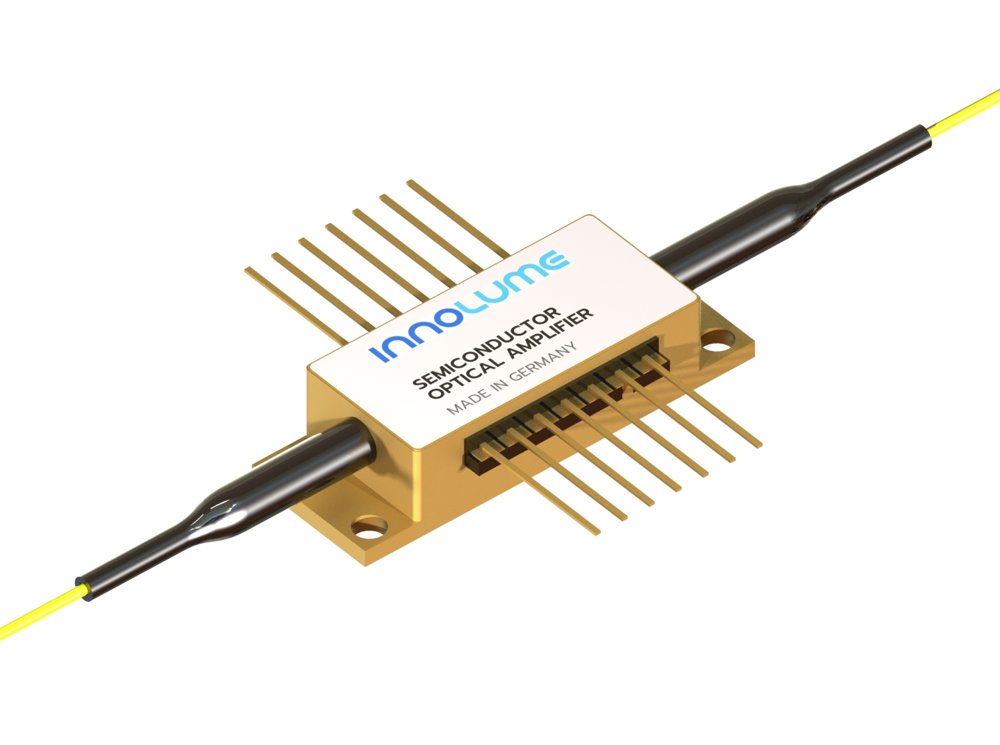
Fiber-coupled semiconductor optical amplifier (SOA) in 14-pin BTF package The Semiconductor Optical Amplifier (SOA) is a device fabricated to amplify optical signals. The amplification is achieved by guiding the signal light through a semiconductor single-mode waveguide, serving as the gain medium. SOA chips are designed similarly to SLDs, solving similar challenges. The chip design incorporates a tilted waveguide and anti-reflection facet coating, minimizing facet reflection to less than 0.001% and reducing spectrum ripples. SOAs are engineered to amplify optical signals by up to 40dB, and certain devices offer a gain bandwidth extending up to 110nm. Key features of Semiconductor optical amplifiers (SOA) - High gain: Certain Innolume SOAs are engineered to amplify optical signals by up to 40dB, providing substantial gain for effective signal amplification. - Broad-band gain: SOAs have a broad gain bandwidth, extending 110nm for some devices. - Feedback Suppression: Tilted waveguides and anti-reflective coatings (<0.001% reflectivity) to reduce optical feedback and minimize spectrum ripples. - Packaging Options: Different packaging options are available, ranging from 14-pin SOA modules to alternative chip placement, including on a submount or as a bare die. - Customization: Innolume provides customization options for the SOAs, allowing adjustments to wavelength, spectrum width, and output power based on customer requests. Typical parameters of Semiconductor Optical Amplifiers (SOA) Part-number Wavelength nm Gain bandwith (3dB) nm Small signal gain dB Saturation output power dBm Noise figure dB Forward current mA Forward voltage V Polarization extinction ratio dB Package 16 31 12 6.5 300 1.9 15 ... (parameter table) What are Semiconductor Optical Amplifiers? A semiconductor optical amplifier (SOA) is a semiconductor device that amplifies input optical signals without converting input signals into the electric current. It has a similar design to laser diodes but the mirrors of the resonator are transparent. Due to broad gain bandwidth, compact size and low power consumption semiconductor optical amplifiers are an optimal choice for modern telecommunications systems. They are most commonly used in fiber optic networks, signal regeneration devices and wavelength-division multiplexing (WDM) systems. Operating Principle of Semiconductor Optical Amplifiers SOA chips are based on the same technology as laser diodes stimulated photon emission. The first stage of SOA operation is a carrier injection. An electric current is supplied to the amplifier's active region, exciting electrons from the valence band to the conduction band. This process creates a population inversion and more electrons occupy higher energy states, making the medium optically active. The next step is a stimulated emission. Optical signal passes through the active region and existing photons generate additional photons with the same phase and wavelength characteristics, creating thus amplification effect. This allows the signal photons to trigger additional emission, amplifying the output signal compared to the input signal. Considering the principle of operation of SOAs it is important to pay attention to the following features: - Gain saturation. SOAs demonstrate saturation with increasing input power. The depletion of the carrier reduces the amplification effect. This nonlinear characteristic curve is useful for optical switching, wavelength conversion and signal regeneration. - Noise and spontaneous emission. Due to the design features amplified spontaneous emission occurs in SOAs. This increases the noise level in the output signal, limiting the line capacity when transmitting data over long distances. - Polarization sensitivity. SOAs are polarization-sensitive. Their amplification level depends on the polarization of the input signal. Characteristics of Semiconductor Optical Amplifiers Unique characteristics make semiconductor optical amplifiers indispensable for optical communications and signal processing systems. You can find Innolume’s SOAs for your specific request with the following parameters: - The spectral range of amplification is from 780 to 1330 nm, which corresponds to the various industrial and research implementations. - Gain is up to 35 dB. It shows the ratio of signal power at the output to the input. With higher gain, the weak signal is amplified more. - The saturation output power up to 18 dBm. This level of amplification makes it possible to use SOA chips in communication lines. - Gain bandwidth ranges from 16 to 110 nm and define the effective wavelength range with which the SOA operates. - The noise figure is from 6.5 to 10 dB. It shows the level of signal-to-noise ratio deterioration due to internal spontaneous emission. The lower this value is, the less signal distortion will occur when transmitting over long distances. - Polarization extinction ratio (from 15 to 18 dB) defines the change in gain depending on the polarization of the input signal. High values can lead to signal distortion or interruption in case of polarization. - Integration capabilities. SOAs can be embedded in photonic integrated circuits (PICs) to create optical processors, WDM converters, and laser sources. Advantages and applications of Semiconductor Optical Amplifiers SOAs are one of the most popular types of amplifiers for optical networks, communications and sensors due to their significant advantages: - Compact size; - Easy integration into complex photonic circuits; - Minimum reaction time; - Wide spectral range; - Low power consumption; - Versatility — SOAs can be used as switches, wavelength converters, modulators, and logic elements. All mentioned features of SOAs make them desirable components in the following systems: - Short- and medium-range optical communication networks; - Optical signal regeneration systems; - Wavelength division multiplexers; - Optical signal converters; - Logical elements of networks; - Fiber optic sensors; - Biomedical equipment; - LiDAR and laser rangefinders; - Quantum communication networks; - Cryptographic systems; - Nonlinear optics. Advantages of Ordering SOA Optical Amplifiers at Innolume Innolume specializes in the design and manufacture of high-quality semiconductor components for high-speed optical communications and photonic systems. Our company uses its expertise in quantum dots and quantum wells to improve chip performance – increasing performance, reducing noise and ensuring signal stability over a wide spectral range. Innolume's SOAs can be easily integrated into standard and custom equipment due to their compact size, low power consumption and various package options. Contact our experts to find the optimal solution for your application and learn more about the benefits of Innolume semiconductor components.
CATEGORY
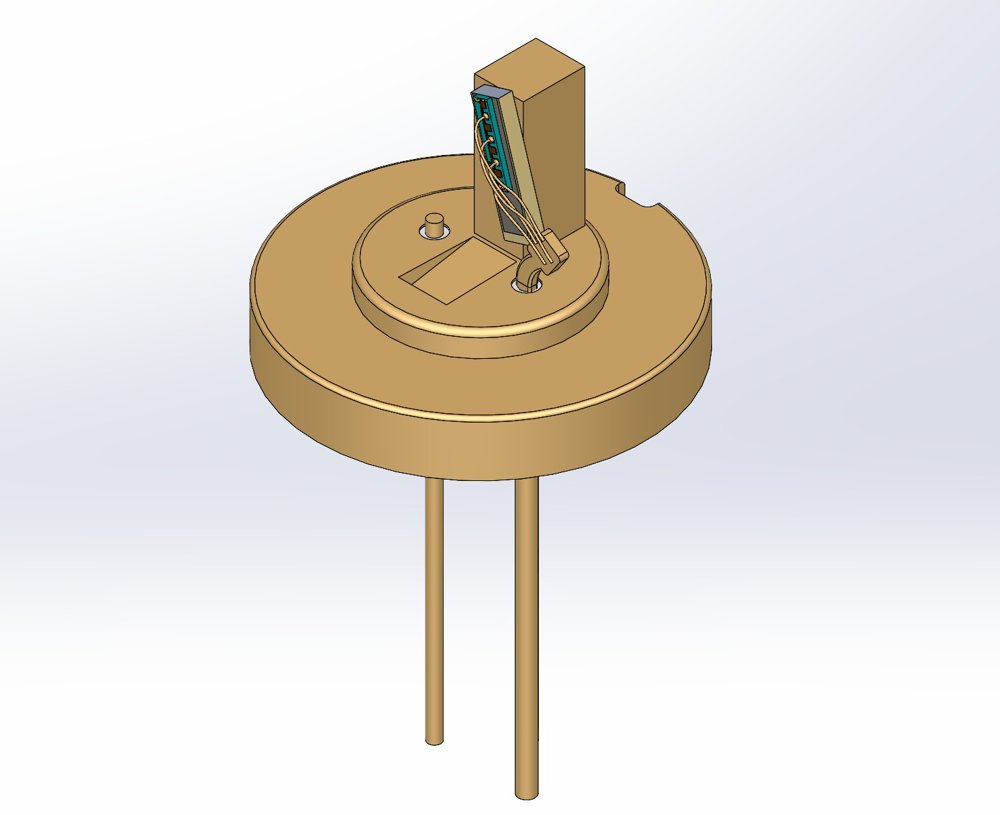
Distributed-Feedback Lasers (DFB) DFB laser in 14-pin BTF package DFB Laser Chip on Carrier DFB Laser Chip in TO-9 package A distributed feedback laser is type of semiconductor laser utilizes the Bragg reflection of a diffraction grating along an active waveguide to consolidate the laser's longitudinal mode. This design ensures elevated wavelength stability and a narrow linewidth. By adjusting the pitch of the diffraction grating, the desired wavelength can be precisely attained. Key features of Distributed Feedback Lasers (DFB) - Wide range of available wavelengths: Select your desired wavelengths from our portfolio with a tolerance of +/-1nm, ensuring alignment with your specifications for emitted wavelength. - Wavelength Precision: Fine-tune the precise peak wavelength with below 0.1nm precision through continuous adjustment using chip temperature and current. - Narrow linewidth: Employing the built-in isolator enables achieving a typical linewidth down to several hundred kilohertz. - Available options variety: polarisation maintaining or single mode fiber, 900um loose tube on the fiber, external optical isolator, different connectors (FC/PC, SC/APC, SC/PC, APC ferrule, etc.) What Is a Distributed Feedback Laser? A Distributed-feedback (DFB) laser is a semiconductor source of coherent light, whose active region includes periodic changes in the effective refractive index along the cavity. This periodic structure is the basis of the distributed Bragg reflector (DBR) – the main feature of DFB lasers. It allows obtaining predominantly single-mode operation with high stability and narrow optical spectral linewidth. The DBR inside the laser functions as a wavelength filter. It passes the target mode and suppresses others. As a result, DFB lasers operate in a predominantly single longitudinal mode at a certain wavelength, making them an optimal choice for various applications, including telecommunication systems, spectroscopic research, and various sensors. Innolume's DFB laser diodes operate in part of the near-infrared (NIR) range. This wavelength range (780-1330nm) suited for optical communications, industrial sensors, quality control devices, scientific equipment, and other modern photonic systems. Benefits of DFB Lasers Over Other Types of Lasers A distributed feedback laser has high spectral purity, stable operating characteristics, and its wavelength can be precisely adjusted for use in specific technical processes. Its key advantages over other devices include: - Single-mode operation. A single longitudinal mode at a required wavelength, making them a good choice for various applications. - Stable operation. These devices are the most stable laser sources, certain devices can provide mode-hop-free performance over the wide current and temperature ranges. - Narrow linewidth. DFB lasers can achieve a very narrow linewidth, down to hundreds of kilohertz (in some special cases, down to a few kilohertz). This ensures a high coherence length. - High temperature stability. High wavelength temperature stability, which is several times better than FP lasers (e.g. 100 pm/K vs 300-600 pm/K). - High-frequency. DFB lasers are widely used in high-frequency applications, some of them are capable of direct modulation at frequencies exceeding 10 GHz. Types of Our DFB Lasers Distributed feedback laser diodes can differ in configuration and other technical features, making them possible to adapt them to specific applications and technical requirements. Innolume provides a range of popular device options, including: - Single-wavelength DFB lasers (standard). Distributed feedback lasers with a narrow spectral optical linewidth at a specific wavelength. Stable emission with high coherence length makes them indispensable for telecommunications, spectroscopy, and metrology. Integrated optical isolator is highly recommended for linewidth stability. - Multi-wavelength DFB arrays (custom R&D). This type is available upon specific customer request. - High-power DFB lasers. Retain a single-mode operation with a significant increase in power compared to low-power models (< 50mW). Suitable for free-space optical communication and material processing. They are used as pumping sources for nonlinear optics. - Narrow-linewidth DFB lasers. DFB lasers with an ultra-narrow linewidth (down to 150kHz). This design is optimized for applications where a high degree of coherence is required. These state-of-the-art devices are designed for spectroscopy, quantum optics, coherent communication, optical metrology, LIDAR and even atomic clocks. - Pulsed DFB lasers. DFB lasers can achieve a peak power of 300mW in nanosecond pulses. They are capable to generate ultra-short pulses of 50 picoseconds with a peak power of 250mW using gain switching technology. - RF-modulated DFB lasers. DFB lasers, assembled in RF modules are designed for high-frequency applications, supporting direct modulation from tens to hundreds of megahertz, with capabilities extending up to several gigahertz. Versions with integrated Bias-T simplify connections by combining RF and DC bias signals. These versatile modules are suitable for a wide range task. Specifications of Our DFB Laser Diodes Distributed feedback laser diodes have controlled, stable characteristics that make them effective in many applications. Their performance is determined by the following parameters: - Wavelength range: 780-1330 nm for the near-infrared (NIR). - Temperature-current tunability. DFB lasers are slightly tunable by current and temperature. The typical wavelength tunability with current is about a few pm/mA, while the temperature dependence is about hundreds of pm/K. The wavelength can be accurately adjusted within the recommended current and temperature ranges. - Optical output power: up to 100mW, depending on the wavelength and design features. - Linewidth: down to hundreds of kilohertz (in some special cases, down to a few kilohertz). A narrow spectral line is a distinctive characteristic of DFB diode lasers, which allows them to be used in various industries. - Sidemode suppression ratio (SMSR): more than 40 dB, with typical values around 50 dB. This level significantly reduces spectral noise, allowing the lasers to be used in single-mode operation even at high power. - Pulsed Operation & RF Modulation. DFB lasers typically provide up to 300mW peak power in nanosecond pulses. Gain switching technology allows generating 50 ps pulses with typical peak power of 250mW. DFB lasers in RF modules support direct modulation from tens to hundreds of megahertz. Versions with integrated Bias-T simplify electrical connections by combining RF and DC bias signals inside the module. In terms of form factors, distributed-feedback (DFB) lasers are available in TO-can, 14-pin butterfly (type 1), 7-pin RF, and chip-on-submount formats. This makes them versatile and flexible, allowing their use in various photonic systems. Advantages of Our Distributed-Feedback (DFB) Lasers Innolume's DFB laser diodes have an optimized design developed through years of work with semiconductor lasers. Our key advantages are wide range of available wavelengths, wavelength precision, narrow linewidth, customized solutions. Below are some of the advantages these devices provide: - High signal purity in single-mode operation. A DFB laser is capable of operation in single mode, while more affordable Fabry-Pérot (FP) diodes always emit multiple longitudinal modes. Single mode operation eliminates unwanted spectral noise and mode hopes. - Narrow spectral linewidth. DFB technology allows achieving single mode lasers with the optical spectral linewidth down to hundreds of kilohertz (in some special cases, down to a few kilohertz). This makes them an ideal choice for industries with high requirements for signal purity, such as coherent optical communication systems and spectroscopy. - Temperature-stable wavelength. The DFB diode laser has a lower temperature dependence compared to conventional FP lasers. This guarantees accurate measurements in laser rangefinders and industrial sensors, even with temperature variations, as well as clean communication. - RF modulation. The ability of laser diodes to quickly switch between different power levels allows them to be used in fiber-optic networks. They effectively transmit large amounts of information in a short time with minimal distortion. Additionally, they are used in scientific research (e.g. stimulated Brillouin scattering suppression). - Long coherence length. A distributed-feedback laser has a long coherence length, making it suitable for interferometry, fiber optic sensors, and precision metrology compared to FP and VCSEL devices. - Customized solutions. Our catalog includes distributed feedback lasers with wavelengths from 968 to 1330 nm and the possibility of individual customization. They can be used in high-tech industries, such as quantum optics, medical equipment, and laser rangefinders. - Packaging options. Innolume manufactures laser diodes in TO-can, 14-pin butterfly (type 1), 7-pin RF, and chip-on-submount form factors. Typical Applications of Our Distributed Feedback Laser Diodes Our DFB lasers are used across a wide range of applications, from telecommunications and data communications (datacom) to quantum communications and space projects. They are also used in precision measurements, medical diagnostics, and various scientific research fields, such as spectroscopy and gas sensing. Here are the most popular applications for Innolume diodes: - Optical communication and Datacom — including high-speed data transmission systems, optical modules, and data center communication. - Quantum technologies — including applications in quantum computing, quantum communication, and random number generation for quantum cryptography. - Biomedical research — such as fluorescence spectroscopy and photon-based diagnostics and glucose analysis. - Industrial applications — including laser material processing, precision calibration, picosecond pulse generation, and atomic transition spectroscopy. - Scientific research — gravitational wave detectors, high-precision experiments, and short pulse generation. - Sensing and detectors — for fiber-optic sensors, atomic spectroscopy, and frequency conversion in spectroscopy setups. - LIDAR and remote sensing — including distance measurement, 3D mapping, environmental monitoring, object detection, and autonomous vehicle control. Why You Should Order Distributed Feedback (DFB) Lasers from Innolume Innolume offers DFB laser diodes with a wide range of available wavelengths, high wavelength stability, narrow optical spectrum linewidth, and customized options. Our lasers are ideal for telecommunications, spectroscopy, LIDAR, and quantum technologies. We offer affordable prices for DFB lasers with different wavelengths, assembled in various housings, suitable for CW, pulsed, and RF applications. This makes it easy to integrate these devices into your systems.
CATEGORY
Gain-chip - main characteristics, features and application. Gain-chips, also known as Reflective Semiconductor Optical Amplifier (Reflective SOA or RSOA) are indispensable components utilized in a diverse range of laser systems, encompassing external cavity lasers, swept sources, and broadband sources. These chips, akin to conventional laser diode chips yet distinguished by their deep anti-reflective coatings on one or both facets, play a pivotal role in augmenting system performance and stability. External cavity lasers, which leverage Gain-chips as their gain medium, benefit from their unique design, substantially elevating the threshold of self-lasing or eliminating it entirely. Configurations such as Littrow and Littman/Metcalf cavities are frequently employed, utilizing diffraction gratings to precisely manipulate the wavelength of emitted light. Swept sources, another domain where Gain-chips excel, rely on their robust construction to ensure steadfast and precise wavelength scanning. By rotating the diffraction grating, these sources adeptly traverse a broad spectrum of wavelengths, rendering them indispensable in domains like optical coherence tomography (OCT) and spectroscopy. Furthermore, Gain-chips serve as pivotal components in broadband sources, where their adeptness at delivering high output power and relatively pristine beam quality is invaluable. These sources find utility across telecommunications, medical diagnostics, scientific inquiry, and industrial realms such as laser material processing and marking. In essence, Gain-chips exhibit versatility, finding application across an extensive array of laser systems, including external cavity lasers, swept sources, and broadband sources. Their distinctive design and performance attributes make them indispensable in diverse industries and applications, ensuring stability, precision, and efficacy in laser technology. Gain-chips find applications across various fields: Medical diagnostics: Facilitating the creation of precise and reliable medical devices. Also used in medical diagnostics, helping to create precise and reliable medical devices, including those that utilize optical coherence tomography (OCT) for high-resolution imaging of tissue structures. Scientific research: Supporting the development of high-precision laser systems for physical and chemical research. LiDAR: Often used in LiDAR systems equipped with swept-source technology, providing high scanning speed and improved resolution for precise mapping and object detection. Manufactured to ensure system stability, efficiency, and expanded application possibilities, Gain-chips exhibit versatility across an extensive array of laser systems. Their distinctive design and performance attributes make them indispensable in diverse industries and applications, ensuring stability, precision, and efficacy in laser technology. Gain-chip features: - Any customized wavelength from the 780-1330 nm range is possible; - Quantum dot and quantum well technology; - Broad hopping free tuning range; - High Signal/ASE ratio; - Deep antireflecting coating; - No self-lasing. Gain-chip applications: - External cavity diode lasers; - Tunable laser sources; - Swept sources. Innolume – Reliable products and solutions for various industries Is your company in need of a Gain-Chip? Contact us - Innolume offers suitable and unique solutions for any business purpose and guarantees high standards for our products. You demand, we supply – our portfolio includes semiconductor optical amplifier, Single Mode Laser as well as comb laser and many more products with our revolutionary quantum dot laser technology. Given the wide range of our products, our adaptability and experience, we are eager to present you a solution that fits your business needs.
CATEGORY
