
OLI Cloud App Builder empowers users to create custom chemistry applications tailored to their specific industrial challenges. With seamless integration of OLI’s advanced simulation capabilities, this tool enables precise, scalable solutions for process optimization and innovation. Unlock the potential of your data and drive efficiency with personalized cloud-based applications. Simple, easy to use electrolyte apps for industrial applications that can be accessed anywhere, anytime. Any process simulation model developed in OLI Flowsheet: ESP can be delivered as a simple, easy-to-use OLI Cloud App with a limited number of inputs, outputs and calculations using the OLI Cloud App Builder. The OLI Cloud Apps leverage first principles-based analysis capabilities with an unparalleled chemistry property database and three thermodynamic models that deliver accurate, rigorous multi-component calculations for the broadest range of phenomena and operating conditions. These are the same first principles-based models and database capabilities that are currently available in the OLI Flowsheet: ESP and OLI Studio Windows platforms. Rapidly define and publish Cloud Apps with the OLI Cloud App Builder The OLI Cloud App Builder has the ability to design cloud applications and run them with design and run-time capabilities. With the Cloud App Builder Design capability, process models built in OLI Flowsheet: ESP can be accessed by a subject matter expert model curator to create and publish Cloud Apps. The published Apps are accessed by end users and executed with the Cloud App Builder Run capability. The Cloud App Builder Run capability uses the OLI Cloud APIs to access the OLI Engine in the Cloud to execute the required calculations. Increase operations efficiency, reliability and sustainability with ubiquitous access to electrolyte insights Empower plant/unit engineers, operations supervisors and maintenance staff with access to valuable insight
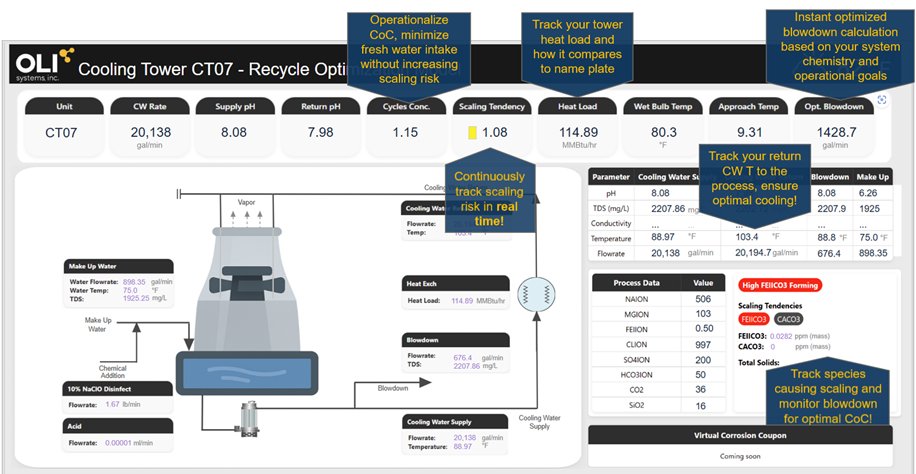
Objective Cooling towers are critical to industrial operations, but their management often suffers from limited visibility, unreliable measurements, and vendor-driven decisions. OLI’s Cooling Tower Digital Twin pilot solution integrates OLI Flowsheet: ESP, the OLI Process API, and machine learning (ML) to create a smart, self-optimizing digital twin of your cooling tower system. This unified platform empowers operators with actionable insights to reduce costs, improve reliability, and enable informed water chemistry decisions. OLI Solution: Digital Twin Powered by First-Principles Thermodynamics and ML Machine Learning – Bridging Data Gaps Data gaps are inevitable—pH meters drift, sensors fail, and some ions are rarely measured. This is where ML can serve as a soft sensor for pH and other unmeasured variables. In OLI’s cooling tower solution: - A Partial Least Squares (PLS) model built with the PLSRegression module from scikit-learn¹⁻³ predicts critical values like pH using reliable proxies (such as conductivity) - Enables accurate scaling and precipitation risk assessment even when pH data is incomplete - Supports hybrid modeling: using both measured and predicted values for higher model confidence This ML model is trained on plant-specific historical data and several pieces of analytical data from the lab. Hybrid Model Workflow 1. The trained PLS model predicts pH. 2. Process API runs the water analysis at the specified pH and ionic composition. 3. This reconciled water stream enters the full system simulation in Process API, which runs the cooling tower model previously built in Flowsheet: ESP. 4. An optimization calculation recommends the optimal blowdown rate for minimizing scale risk. Benefits to Users - Optimized Water and Chemical Use: Control CoC dynamically, based on real-time risk—not guesswork. - Robust real-time predictions of scaling based on live operating conditions, even under the limiting factors of poor physical sensors, missing data, or infrequent water analysis. - Seamless Integration: Designed to work with any historian or dashboard system. - Insights into Tower Health: Quickly compare how your tower is performing against internal KPIs and design values to assess the efficiency of your system. - Identify areas of improvement and optimize tower performance. OLI’s Commercial-off-the-Shelf (COTS) Cooling Tower solution features an intuitive interface that highlights key variables such as CoC, scaling risks, and optimal blowdown.
CATEGORY

OLI Flowsheet: ESP is a powerful process simulation software built to help you command complex multiphase systems with precision. Achieve peak efficiency, streamline designs and lead innovation with cutting-edge chemistry simulation capabilities. Simulate electrolyte based processes and optimize process design in industrial chemical processes Accurately simulate multi-unit operations to optimize process design, minimize CAPEX, OPEX and maximize yields and process efficiency with rigorous and accurate simulations in water treatment, mining, oil & gas and chemicals industries. OLI Flowsheet: ESP enables electrolyte based, steady-state process simulation for multi-phase systems with speciation and can be used to improve quality of process design, troubleshoot operations challenges, enhance sustainability and make environmental compliance cost effective. It is a first principles-based analysis tool with an unparalleled chemistry property database and three thermodynamic models that deliver accurate, rigorous multi-component calculations for the broadest range of phenomena and operating conditions. Key capabilities - Energy, mass, species balance - pH control, membrane purification, mass transfer limitation (ESP Blocks) - Multi-phase systems (OLI Engine) - Controllers - Specialized ESP blocks and 100+ unit operations designed for electrolytes; RO membrane - Flowsheet simulation with speciation, sensitivity analysis, diffusion, mobility and permeability calculations - Effects of temperature, salinity, and speciation on viscosity, osmotic pressure, diffusivity constants, and other critical transport properties. - Effects of temperature, salinity, and speciation on viscosity, osmotic pressure, diffusivity constants, and other critical transport properties. Sample applications - Optimize design of wet/dry flue gas scrubbing and oxidation - Improve design of sour water stripping process - Improve material selection and lower costs with Autoclave testing simulations
CATEGORY

Continuous Visibility into Corrosion Behavior OLI TrueCORR™ transforms live plant data into continuous corrosion intelligence, helping teams understand when process conditions are creating real integrity risk and which operational changes can reduce exposure before corrosion escalates. Corrosion Risk Does Not Wait Most corrosion programs rely on static integrity limits and periodic inspection data from isolated points. This leaves teams uncertain whether changing operating conditions signal a true integrity threat or routine noise. Because corrosion exposure is multi-variable and inspection coverage is limited, teams often respond conservatively, even when existing historian, alarm, and operating data could provide clearer insight. The Chemistry Behind Corrosion Exposure OLI TrueCORR is built on decades of first-principles corrosion chemistry modeling, enabling the conversion of live operating chemistry into corrosion rate, dominant corrosion drivers, remaining life, and integrity limit status. Instead of relying on threshold alarms or historical failure patterns alone, OLI TrueCORR evaluates whether the active process environment is genuinely creating corrosive conditions. It also allows OLI TrueCORR to work beyond failure history, supporting assets where operating conditions have changed or historical corrosion data is limited. Calculate the actual corrosion risk OLI TrueCORR calculates corrosion risk directly from process chemistry and plant metallurgy, helping teams understand when changing operating conditions are materially increasing integrity exposure. Identify the corrosion driver The model shows which chemistry is causing the risk, so teams can act on cause rather than symptom.
CATEGORY
OLI’s thermophysical modeling software offers versatile capabilities to simulate the complexities of real-world environments with scientific precision. From multicomponent, multiphase systems containing electrolytes and non-electrolytes to wide-ranging temperature and pressure conditions, our models address challenges in diverse industries. Whether working with dilute toxic contaminants, concentrated salt solutions, pure acids, or ionic liquids, our software delivers unmatched reliability and accuracy. Nature is infinitely complex and we have to deal with multicomponent, multiphase systems that contain electrolytes and non-electrolytes. We need to cover wide ranges of temperatures—from cryogenic conditions to high temperatures in boilers—and deep well environments. The concentrations of interest can vary from extremely dilute solutions of toxic contaminants to very concentrated salt solutions or even pure acids or ionic liquids. Aqueous Model A reliable, time tested legacy model that covers a wide range of components in systems dominated by water. MSE Model The state of the art model for mixtures containing any combination of electrolytes and nonelectrolytes without concentration limits. MSE-SRK A special version of the MSE model maximizes accuracy for upstream oil and gas applications. MSE corrosion model for CRA The OLI MSE (Mixed Solvent Electrolyte) corrosion model is a sophisticated tool developed for predicting corrosion in a variety of environments, including non-aqueous systems. This model utilizes the MSE framework to accurately predict chemical and phase equilibria in complex systems.
CATEGORY
