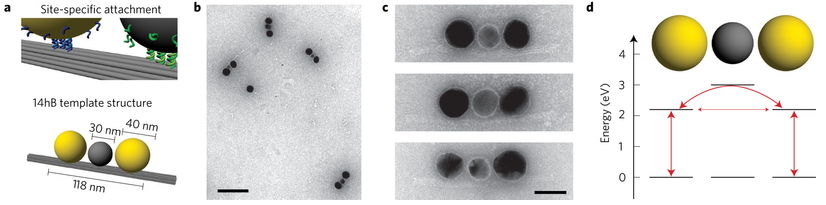
Tomorrow's computers will run on light, and gold nanoparticle chains show much promise as light conductors. Now Ludwig-Maximilians-Universitaet (LMU) in Munich scientists have demonstrated how tiny spots of silver could markedly reduce energy consumption in light-based computation.
Today's computers are faster and smaller than ever before. The latest generation of transistors will have structural features with dimensions of only 10 nanometers. If computers are to become even faster and at the same time more energy efficient at these minuscule scales, they will probably need to process information using light particles instead of electrons. This is referred to as "optical computing".
Fiber-optic networks already use light to transport data over long distances at high speed and with minimum loss. The diameters of the thinnest cables, however, are in the micrometer range, as the light waves -- with a wavelength of around one micrometer -- must be able to oscillate unhindered. In order to process data on a micro- or even nanochip, an entirely new system is therefore required.
One possibility would be to conduct light signals via so-called plasmon oscillations. This involves a light particle (photon) exciting the electron cloud of a gold nanoparticle so that it starts oscillating. These waves then travel along a chain of nanoparticles at approximately 10% of the speed of light. This approach achieves two goals: nanometer-scale dimensions and enormous speed. What remains, however, is the energy consumption. In a chain composed purely of gold, this would be almost as high as in conventional transistors, due to the considerable heat development in the gold particles.
A tiny spot of silver
Tim Liedl, Professor of Physics at LMU and PI at the cluster of excellence Nanosystems Initiative Munich (NIM), together with colleagues from Ohio University, has now published an article in the journal Nature Physics, which describes how silver nanoparticles can significantly reduce the energy consumption. The physicists built a sort of miniature test track with a length of around 100 nanometers, composed of three nanoparticles: one gold nanoparticle at each end, with a silver nanoparticle right in the middle.
The silver serves as a kind of intermediary between the gold particles while not dissipating energy. To make the silver particle's plasmon oscillate, more excitation energy is required than for gold. Therefore, the energy just flows "around" the silver particle. "Transport is mediated via the coupling of the electromagnetic fields around the so-called hot spots which are created between each of the two gold particles and the silver particle," explains Tim Liedl. "This allows the energy to be transported with almost no loss, and on a femtosecond time scale."
Textbook quantum model
The decisive precondition for the experiments was the fact that Tim Liedl and his colleagues are experts in the exquisitely exact placement of nanostructures. This is done by the DNA origami method, which allows different crystalline nanoparticles to be placed at precisely defined nanodistances from each other. Similar experiments had previously been conducted using conventional lithography techniques. However, these do not provide the required spatial precision, in particular where different types of metals are involved.
In parallel, the physicists simulated the experimental set-up on the computer - and had their results confirmed. In addition to classical electrodynamic simulations, Alexander Govorov, Professor of Physics at Ohio University, Athens, USA, was able to establish a simple quantum-mechanical model: "In this model, the classical and the quantum-mechanical pictures match very well, which makes it a potential example for the textbooks."
Hotspot-mediated non-dissipative and ultrafast plasmon passage
Eva-Maria Roller, Lucas V. Besteiro, Claudia Pupp, Larousse Khosravi Khorashad, Alexander O. Govorov & Tim Liedl
Nature Physics (2017) doi:10.1038/nphys4120
Ludwig-Maximilians-Universitaet (LMU)
#Nanoparticles #GoldNanoparticles #Nanosystems #Computing #Plasmonics
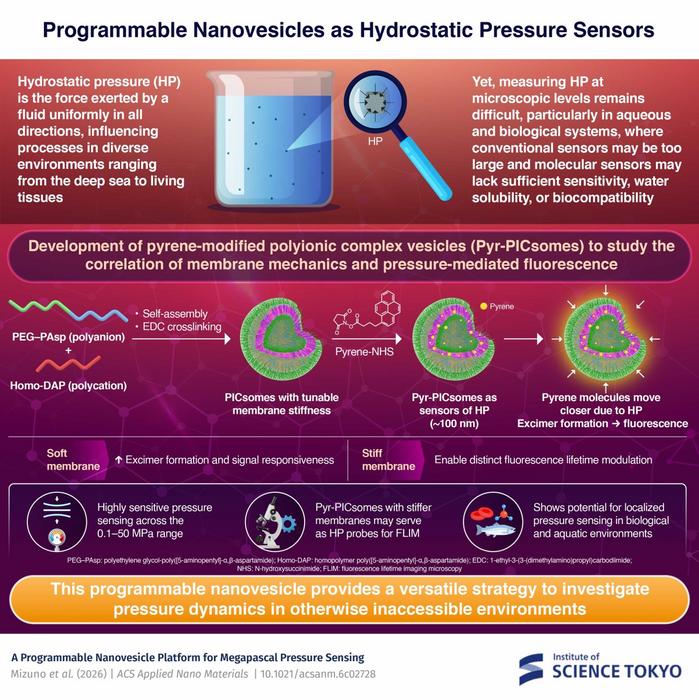
Pyrene-modified polyionic complex vesicles, or Pyr-PICsomes, convert hydrostatic pressure into measurable fluorescence. Crosslinking density tunes membrane stiffness, which governs sensing behavior: soft vesicles give strong excimer-to-monomer ratio changes from 0.1 to 50 MPa, while stiff membranes respond through fluorescence lifetime, suiting lifetime imaging.
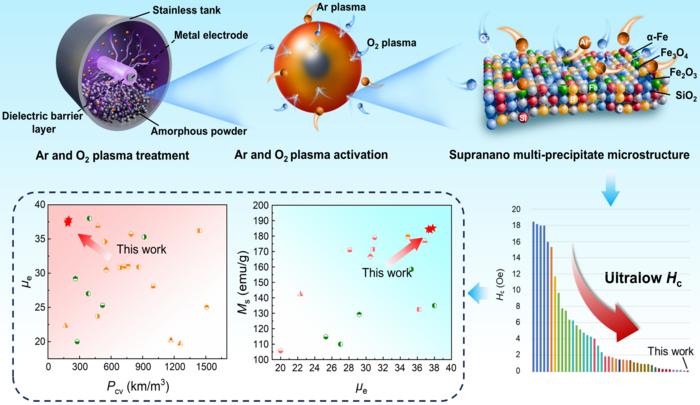
Ar/O₂ plasma treatment generates supranano α-Fe, Fe₃O₄, SiO₂ and Fe₂O₃ precipitates just 0.8–2.5 nm across amorphous powder surfaces, creating nucleation sites that ease magnetic-moment reversal. The resulting soft magnetic composite combines 0.13 Oe coercivity, 37.3 permeability, 185 emu g⁻¹ saturation magnetization and 191.18 kW m⁻³ core loss at 1 MHz and 20 mT. The surface route avoids bulk composition changes, aiding scale-up for high-frequency inductors and power chokes.
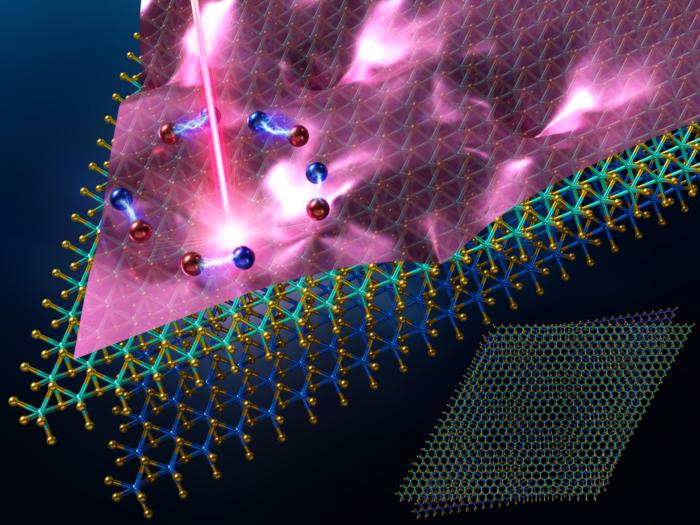
Researchers at MANA have introduced a theoretical framework that extracts hidden disorder from complex photoluminescence spectra in twisted MoSe2/WSe2 moiré heterostructures, bypassing unreliable peak-by-peak analysis. By tracking how simple descriptors like peak and average energy vary spatially, the work reveals a hierarchy of disorder, from micrometer-scale background variations to localized exciton-trapping defects.