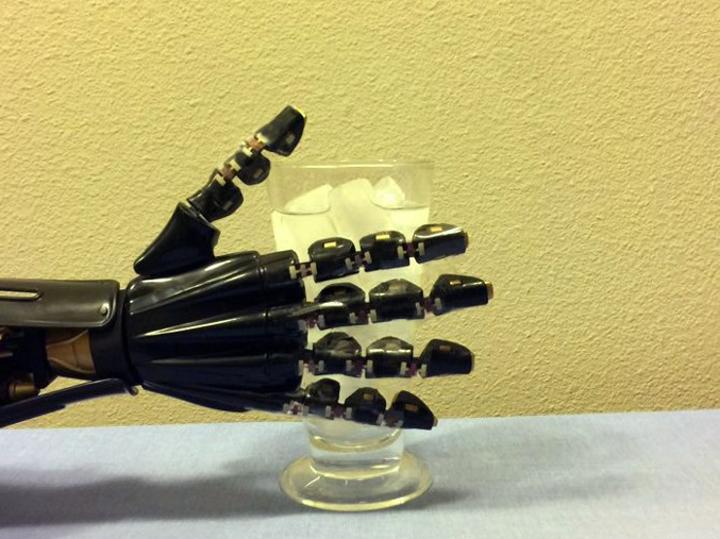
A team of researchers from the University of Houston has reported a breakthrough in stretchable electronics that can serve as an artificial skin, allowing a robotic hand to sense the difference between hot and cold, while also offering advantages for a wide range of biomedical devices.
The work, reported in the journal Science Advances, describes a new mechanism for producing stretchable electronics, a process that relies upon readily available materials and could be scaled up for commercial production.
Cunjiang Yu, Bill D. Cook Assistant Professor of mechanical engineering and lead author for the paper, said the work is the first to create a semiconductor in a rubber composite format, designed to allow the electronic components to retain functionality even after the material is stretched by 50 percent.
The work is the first semiconductor in rubber composite format that enables stretchability without any special mechanical structure, Yu said.
He noted that traditional semiconductors are brittle and using them in otherwise stretchable materials has required a complicated system of mechanical accommodations. That's both more complex and less stable than the new discovery, as well as more expensive, he said.
"Our strategy has advantages for simple fabrication, scalable manufacturing, high-density integration, large strain tolerance and low cost," he said.
Yu and the rest of the team - co-authors include first author Hae-Jin Kim, Kyoseung Sim and Anish Thukral, all with the UH Cullen College of Engineering - created the electronic skin and used it to demonstrate that a robotic hand could sense the temperature of hot and iced water in a cup. The skin also was able to interpret computer signals sent to the hand and reproduce the signals as American Sign Language.
"The robotic skin can translate the gesture to readable letters that a person like me can understand and read," Yu said.
The artificial skin is just one application. Researchers said the discovery of a material that is soft, bendable, stretchable and twistable will impact future development in soft wearable electronics, including health monitors, medical implants and human-machine interfaces.
The stretchable composite semiconductor was prepared by using a silicon-based polymer known as polydimethylsiloxane, or PDMS, and tiny nanowires to create a solution that hardened into a material which used the nanowires to transport electric current.
"We foresee that this strategy of enabling elastomeric semiconductors by percolating semiconductor nanofibrils into a rubber will advance the development of stretchable semiconductors, and ... will move forward the advancement of stretchable electronics for a wide range of applications, such as artificial skins, biomedical implants and surgical gloves," they wrote.
University of Houston
#MaterialScience #Nanoelectronics #FlexibleElectronics #Semiconductors #Nanorobots
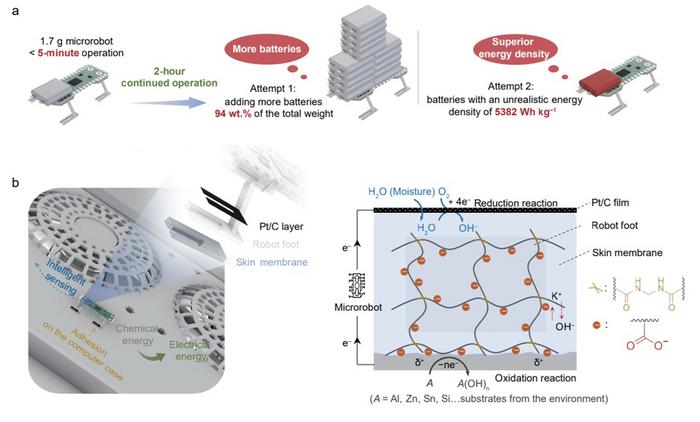
A Fudan University team has built a microrobot skin that generates electricity from the surface it walks on, eliminating onboard batteries. The crosslinked potassium polyacrylate membrane, as thin as 135 micrometres, reacts with aluminum, zinc and other active substrates plus atmospheric moisture and oxygen, reaching 133 mW cm−2 on zinc, roughly ten times typical microbatteries.
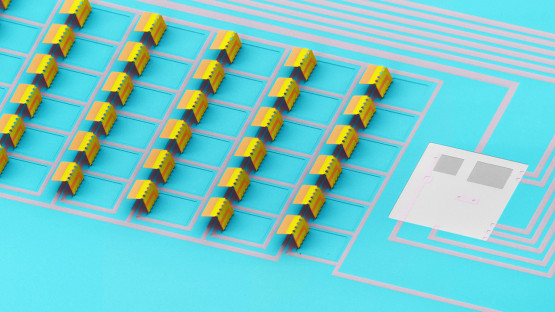
In northeastern Brazil, termites have transformed an area about the size of Great Britain by sensing their environment, communicating with each other about it and working together to build vast tunnel systems. Inspired by this and other instances of the small but mighty collective activity in nature, Cornell physics researchers have made robots that for the first time can sense the temperature of their surroundings and react together to change it. “Little things can have a large impact,” said...
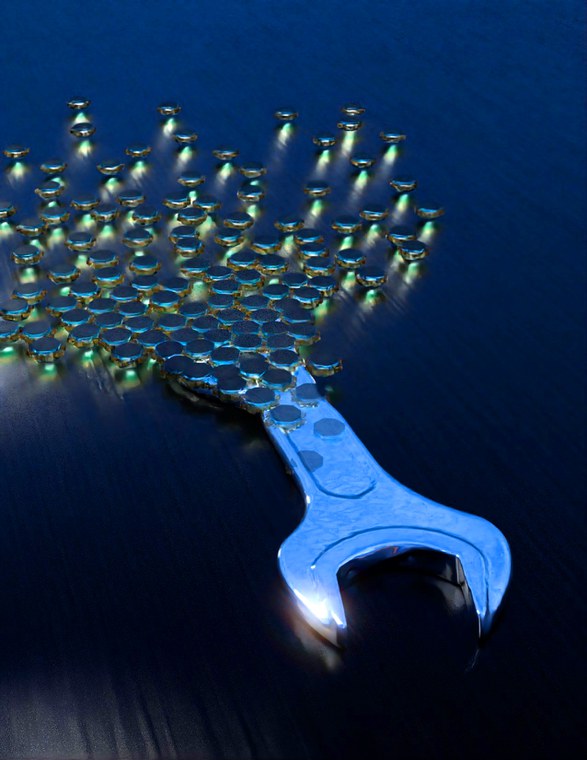
In the world of robots, the equivalent of cell-cell adhesion is achieved with magnets, which are incorporated into the perimeter of the robo
This week in nanotech
$740.7M raised
5 funding rounds · 35 deals tracked
New products
 Orion Sputtering Deposition SystemsAJA International Featured
 Nion-compatible In Situ STEM Holders for Electrical BiasingHummingbird Scientific Featured
 GiiiGii
Market insights
Last 30 days: Quantum Technologies drew the most money: $3.18B.
Money raised per month
Behind the deal
Who led Xanadu Quantum Technologies Limited’s $10M Grant?
See the investors with Insights Pro →