
Physicists at MIPT and their British and Russian colleagues revealed the mechanisms leading to photocurrent in graphene under terahertz radiation. The paper published in Applied Physics Lettersnot only puts a period to a long-lasting debate about the origins of direct current in graphene illuminated by high-frequency radiation but also sets the stage for the development of high-sensitivity terahertz detectors. Such detectors are highly demanded in medical diagnostics, wireless communications and security systems.
In 2005 MIPT alumni Andre Geim and Konstantin Novoselov experimentally studied the behavior of electrons in graphene, a flat honeycomb lattice of carbon atoms. They found that electrons in graphene respond to electromagnetic radiation with an energy of quantum, whereas the common semiconductors have an energy threshold below which the material does not respond to light at all. However, the direction of electron motion in graphene exposed to radiation has long remained a point of controversy, as there is a plenty of factors pulling it in different directions. The controversy was especially stark in the case of the photocurrent caused by terahertz radiation.
What sets terahertz radiation apart is its unique set of properties. As an example, it easily passes through many dielectrics without ionizing them: this is of particular value to medical diagnostic or security systems. A terahertz camera can "see" the weapons concealed under a person's clothes, and a medical scanner can detect skin diseases at early stages by the spectral lines ("fingerprints") of characteristic biomolecules in the terahertz range. Finally, raising the carrier frequency of Wi-Fi devices from several to hundreds of gigahertz (into the sub-terahertz range) will proportionally increase the bandwidth. But all these applications need a sensitive and low-noise terahertz detector which is simple in fabrication.
A terahertz detector designed by researchers at MIPT, MSPU and the University of Manchester (the place where graphene was first discovered) is a graphene sheet (colored green in figures 1 and 2) sandwiched between dielectric layers of boron nitride and electrically coupled to a terahertz antenna--a metal spiral about a millimeter in size. As radiation impinges on the antenna, it rocks electrons on one side of the graphene sheet, while the resulting direct current is measured on the other side. It is the "packing" of graphene into boron nitride that enables record-high electric characteristics, giving the detector a sensitivity that is a cut above the earlier designs. However, the main result of the research is not a better-performing instrument; it is the insight into the physical phenomena responsible for the photocurrent.
There are three main effects leading to the electric current flowing in graphene exposed to terahertz radiation. The first one, the photothermoelectric effect, is due to the temperature difference between the antenna terminal and the sensing terminal. This sends electrons from the hot terminal to the cold one, like air rising up from a warm radiator up to cold ceiling. The second effect is the rectification of current at the terminals: it turns out that the edges of graphene let through only the high-frequency signal of a certain polarity. The third and most interesting effect is called plasma wave rectification. We can think of the antenna terminal as stirring up "waves in the electronic sea" of the graphene strip, while the sensing terminal registers the average current associated with these waves.
"Earlier attempts to explain the photocurrent in such detectors used only one of these mechanisms and excluded all the others," says Dmitry Svintsov, head of the Laboratory of 2d Materials' Optoelectronics at MIPT. "In reality, all three of them are at play, and our study found which effect dominates at which conditions.
Thermoelectric effects dominate at low temperatures, while plasmonic rectification prevails at high temperatures and in longer-channel instruments. And the main thing is that we figured out how to make a detector in which the different photoresponse mechanisms will not cancel each other, but rather reinforce each other"
These experiments will help choose the best design for terahertz detectors and bring us closer to remote detection of dangerous substances, safe medical diagnostics, and high-speed wireless communications.
Dual origin of room temperature sub-terahertz photoresponse in graphene field effect transistors
D. A. Bandurin, I. Gayduchenko, Y. Cao, M. Moskotin, A. Principi, I. V. Grigorieva, G. Goltsman, G. Fedorov, and D. Svintsov
Appl. Phys. Lett. 112, 141101 (2018); https://doi.org/10.1063/1.5018151
Moscow Institute of Physics and Technology
#Graphene #Nanoelectronics #Nanomedicine

Alemnis has reached controlled, constant indentation strain rates up to 100,000 s-1 while maintaining quantitative load-displacement measurement, using true displacement control. The capability was demonstrated on molybdenum, nanocrystalline nickel and fused silica.
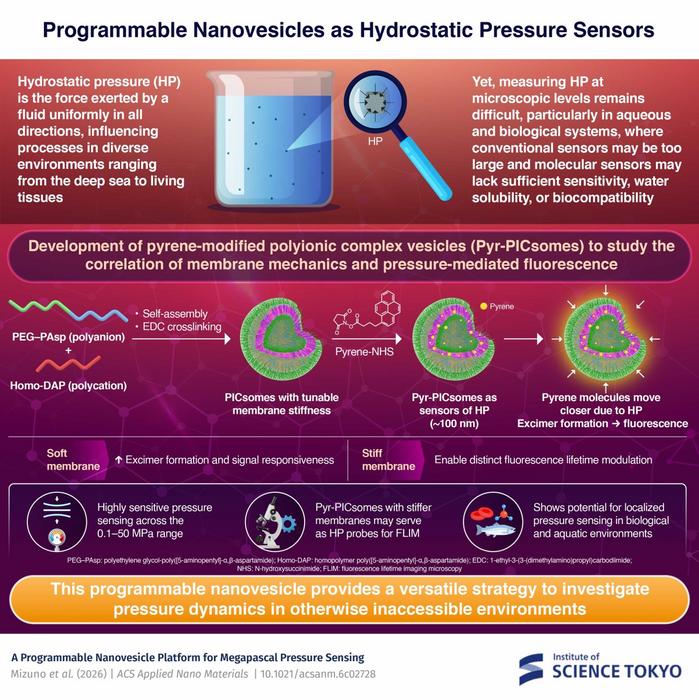
Pyrene-modified polyionic complex vesicles, or Pyr-PICsomes, convert hydrostatic pressure into measurable fluorescence. Crosslinking density tunes membrane stiffness, which governs sensing behavior: soft vesicles give strong excimer-to-monomer ratio changes from 0.1 to 50 MPa, while stiff membranes respond through fluorescence lifetime, suiting lifetime imaging.
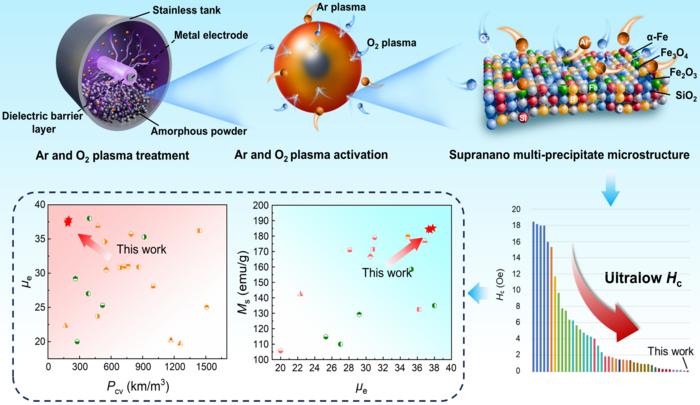
Ar/O₂ plasma treatment generates supranano α-Fe, Fe₃O₄, SiO₂ and Fe₂O₃ precipitates just 0.8–2.5 nm across amorphous powder surfaces, creating nucleation sites that ease magnetic-moment reversal. The resulting soft magnetic composite combines 0.13 Oe coercivity, 37.3 permeability, 185 emu g⁻¹ saturation magnetization and 191.18 kW m⁻³ core loss at 1 MHz and 20 mT. The surface route avoids bulk composition changes, aiding scale-up for high-frequency inductors and power chokes.






