Max Planck Institute for Chemical Physics of Solids
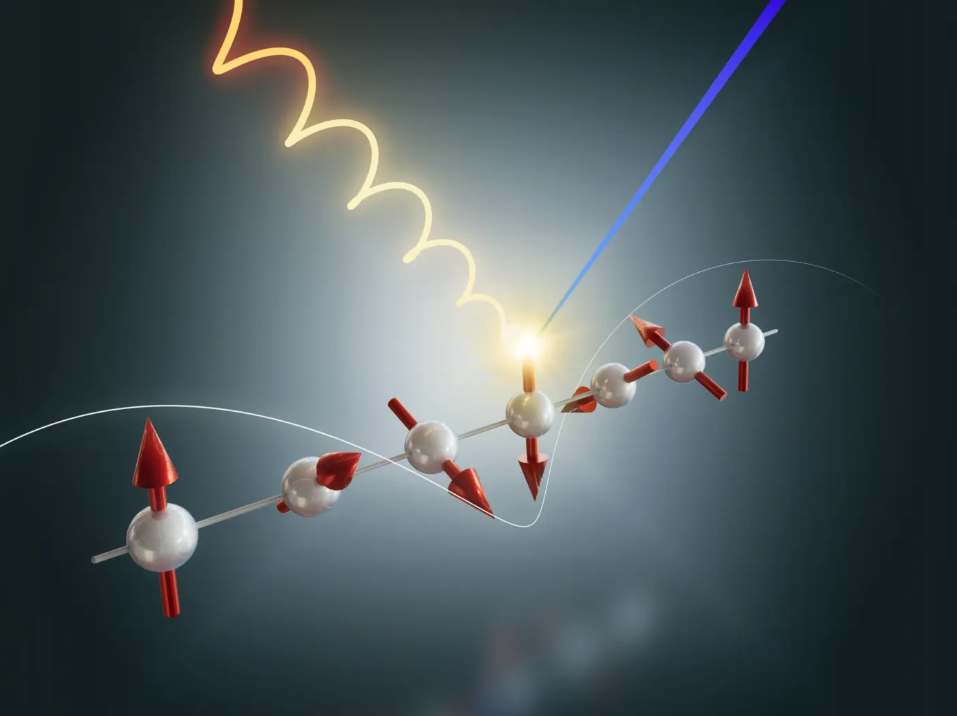
Magnets are usually associated with a familiar property: they produce a magnetic field because the magnetic moments of their electrons align. But nature allows much more unusual forms of magnetic order. An international research team has now identified compelling experimental evidence for p-wave magnetism in europium silicide (EuSi), a chemically simple metallic compound. Published in Nature, the discovery provides an important experimental platform for exploring how magnetic symmetry and chirality influence electronic properties. The findings could open new directions in spintronics, topological quantum materials and unconventional superconductivity.
A surprising discovery in a simple compound
The story began at the Max Planck Institute for Chemical Physics of Solids (MPI CPfS) in Dresden, where Dr. Erjian Cheng grew high-quality single crystals of EuSi approximately three years ago. Initial photoemission experiments revealed an unexpectedly large influence of magnetic order on the electronic band structure. The observation prompted a fundamental question: Could EuSi host an unconventional magnetic state in which electron spin is linked to the direction of electron motion? “When we first measured the electronic structure of EuSi, we were surprised by the exceptionally large effect of magnetism on the electrons,” explains Cheng. “That observation led us to investigate whether this simple compound could host a much more unusual magnetic state. The combination of crystal growth, neutron scattering and spin-resolved spectroscopy now provides compelling evidence for p-wave magnetism.” The investigation brought together 38 researchers from 19 institutions, including ShanghaiTech University, the Hong Kong University of Science and Technology, the Max Planck Institute for the Physics of Complex Systems and Oak Ridge National Laboratory.
Magnetism without a net magnetic moment
In a conventional ferromagnet, electron spins tend to align in the same direction, producing a net magnetization. In EuSi, however, the researchers identified a very different magnetic arrangement. Between approximately 33 and 62 kelvin, the magnetic moments of europium atoms form an ordered spiral. Although the individual atoms carry substantial magnetic moments, their contributions cancel overall, resulting in no net magnetization in this phase. Nevertheless, the electrons display an unusual spin-dependent electronic structure. In the predicted p-wave state, electrons moving in opposite directions have opposite spin polarizations. This characteristic relationship between electron momentum and spin is known as an odd-parity spin texture. Unlike familiar spin-splitting effects driven primarily by spin–orbit coupling, the p-wave spin structure in EuSi arises predominantly from magnetic exchange interactions and the symmetry of the spiral magnetic order.
Experimental evidence for p-wave magnetism
To establish the nature of the magnetic state, the researchers combined several complementary experimental techniques with theoretical calculations. Neutron diffraction revealed the spiral arrangement of the europium magnetic moments and confirmed that its symmetry satisfies the conditions required for p-wave magnetism. Angle-resolved photoemission spectroscopy showed a pronounced reconstruction of the electronic structure, with magnetism-driven energy separations exceeding 100 millielectronvolts. Most importantly, spin-resolved photoemission measurements revealed a characteristic change in the sign of electron spin polarization across successive magnetic Brillouin zones. The polarization was also strongly suppressed near regions where the p-wave spin texture is predicted to vanish. Together, these observations provide spin-resolved spectroscopic evidence consistent with the theoretically predicted p-wave magnetic state.
When magnetic handedness shapes electronic properties
Another striking aspect of EuSi is the relationship between magnetism and chirality, or handedness. Although the underlying crystal structure is centrosymmetric, the spiral arrangement of the magnetic moments can form states with opposite handedness. Using magnetic force microscopy and spatially resolved photoemission spectroscopy, the researchers identified magnetic domains approximately ten micrometres across. Measurements with circularly polarized light revealed distinct electronic responses associated with domains of opposite magnetic chirality. These observations demonstrate that the handedness of magnetic order is coupled to the electronic structure. “What makes EuSi particularly exciting is that an unconventional electronic spin structure emerges from the magnetic order of a chemically simple metal,” says Prof. Claudia Felser, Director at MPI CPfS. “This demonstrates how the discovery of new materials can reveal entirely new electronic phenomena. EuSi now gives us an experimental platform to investigate how magnetic symmetry and chirality can be used to control electronic properties, with potential implications for future spintronics and unconventional superconductivity.”
A new platform for quantum materials research
Finding suitable materials has been a major challenge in the emerging field of p-wave magnetism. Previously investigated candidates include insulating compounds and metallic systems with very low magnetic ordering temperatures or additional symmetry complications. EuSi offers an unusual combination of advantages: it is a stoichiometric metal, high-quality single crystals can be grown, and its spiral magnetic phase realizes the characteristic symmetry conditions of p-wave magnetism. These properties make EuSi particularly suitable for systematic experimental investigations. Theoretical studies predict that metallic p-wave magnets may exhibit unusual phenomena, including spin-polarized electronic transport without an external magnetic field, strong current-induced spin responses and unconventional superconducting states. These effects have not yet been demonstrated in EuSi, but the newly established material platform makes it possible to investigate such predictions experimentally. The discovery illustrates a broader principle of modern quantum materials research: the properties of a solid are determined not only by its chemical composition and crystal structure, but also by the symmetry, magnetic order and quantum states of its electrons.
Reference
Evidence for p-wave magnetism in electronic band structure of metallic EuSi.
E. Cheng, Y. Yang, Y. Gao, J. Priessnitz, Y. Hao, J. Liu et al.
Researchers at MLU Halle-Wittenberg and the Max Planck Institute of Microstructure Physics have identified an unintended ferromagnetic interlayer that forms between ultrashort-pulse-excited Mn3Sn films and platinum, masking the chiral antiferromagnet's true properties. Curing the Mn3Sn layer before platinum deposition avoids the artefact, revealing spin-to-charge conversion at roughly 10% of platinum's efficiency.

Researchers have linked atomic vibrations that carry heat and sound, known as acoustic phonons, to electron spin in ultrathin sheets of the semiconductor nickel phosphorous trisulfide. Using Brillouin-Mandelstam inelastic light scattering spectroscopy, they found the two properties correlate more strongly once spins organize into a zigzag pattern at low temperature, and that surface phonons slow near that transition.
Researchers have built a perovskite chiral multiple quantum-well system that sustains spin polarization roughly 300 times longer at room temperature, reaching about 5 nanoseconds. A two-step seed-assisted crystallization creates coupled wells with graded energy and continuous intrinsic chirality, enabling an efficient spin cascade that limits interfacial losses.
This week in nanotech
$129.9M raised
6 funding rounds · 39 deals tracked
New products
 Nion-compatible In Situ STEM Holders for Electrical BiasingHummingbird Scientific Featured
 Ti-WCMBN Nanomaterialia Featured
 NanoFlow® S1-20Levidian
Market insights
Last 30 days: Semiconductors & Electronics drew the most money: $547.7M.
Money raised per month