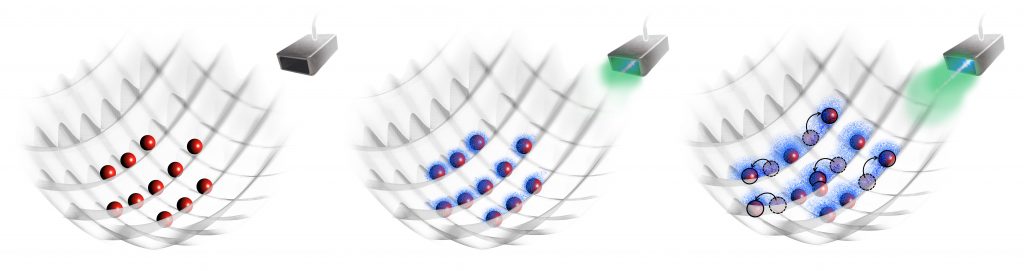
The development of experimental platforms that advance the field of quantum science and technology (QIST) comes with a unique set of advantages and challenges common to any emergent technology. Researchers at Stony Brook University, led by Dominik Schneble, PhD, report the formation of matter-wave polaritons in an optical lattice, an experimental discovery that enables studies of a central QIST paradigm through direct quantum simulation using ultracold atoms. The researchers project that their novel quasiparticles, which mimic strongly interacting photons in materials and devices but circumvent some of the inherent challenges, will benefit the further development of QIST platforms that are poised to transform computing and communication technology.
The findings are detailed in a paper published in Nature Physics.
The research sheds light on fundamental polariton properties and related many-body phenomena, and it opens up novel possibilities for studies of polaritonic quantum matter.
An important challenge in work with photon-based QIST platforms is that while photons can be ideal carriers of quantum information they do not normally interact with each other. The absence of such interactions also inhibits the controlled exchange of quantum information between them. Scientists have found a way around this by coupling the photons to heavier excitations in materials, thus forming polaritons, chimera-like hybrids between light and matter. Collisions between these heavier quasiparticles then make it possible for the photons to effectively interact. This can enable the implementation of photon-based quantum gate operations and eventually of an entire QIST infrastructure.
However, a major challenge is the limited lifetime of these photon-based polaritons due to their radiative coupling to the environment, which leads to uncontrolled spontaneous decay and decoherence.
According to Schneble and colleagues, their published polariton research circumvents such limitations caused by spontaneous decay completely. The photon aspects of their polaritons are entirely carried by atomic matter waves, for which such unwanted decay processes do not exist. This feature opens access to parameter regimes that are not, or not yet, accessible in photon-based polaritonic systems.
“The development of quantum mechanics has dominated the last century, and a ‘second quantum revolution’ toward the development of QIST and its applications is now well underway around the globe, including at corporations such as IBM, Google and Amazon,” says Schneble, a Professor in the Department of Physics and Astronomy in the College of Arts and Sciences. “Our work highlights some fundamental quantum mechanical effects that are of interest for emergent photonic quantum systems in QIST ranging from semiconductor nanophotonics to circuit quantum electrodynamics.”
The Stony Brook researchers conducted their experiments with a platform featuring ultracold atoms in an optical lattice, an egg-crate-like potential landscape formed by standing waves of light. Using a dedicated vacuum apparatus featuring various lasers and control fields and operating at nanokelvin temperature, they implemented a scenario in which the atoms trapped in the lattice “dress’’ themselves with clouds of vacuum excitations made of fragile, evanescent matter waves.
The team found that, as a result, the polaritonic particles become much more mobile. The researchers were able to directly probe their inner structure by gently shaking the lattice, thus accessing the contributions of the matter waves and the atomic lattice excitation. When left alone, the matter-wave polaritons hop through the lattice, interact with each other, and form stable phases of quasiparticle matter.
“With our experiment we performed a quantum simulation of an exciton-polariton system in a novel regime,” explains Schneble. “The quest to perform such `analogue’ simulations, which in addition are `analog` in the sense that the relevant parameters can be freely dialed in, by itself constitutes an important direction within QIST.”
Reference
Formation of matter-wave polaritons in an optical lattice
Joonhyuk Kwon, Youngshin Kim, Alfonso Lanuza & Dominik Schneble
https://www.nature.com/articles/s41567-022-01565-4
Stony Brook University
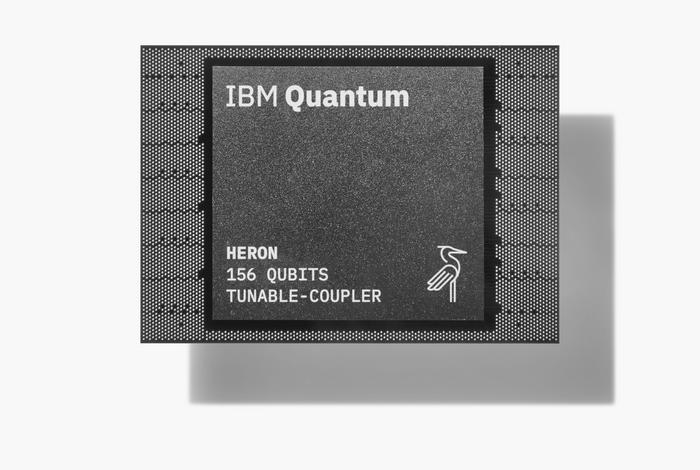
Researchers from Rutgers, IBM and collaborators demonstrated real-time quantum feedback control on a 156-qubit Heron processor, using up to 100 connected qubits. By alternately scrambling information and resetting qubits nearly 5,000 times each, they steered the system from chaos to an ordered state, revealing a sharp phase transition.

Oxford physicists used a hybrid quantum computer, pairing trapped-ion qubits with quantum oscillators, to simulate the Aharonov-Bohm effect inside a lattice gauge theory. Encoding magnetic flux in entangled qubits made the gauge field dynamical, and the resulting destructive interference froze matter tunneling entirely.
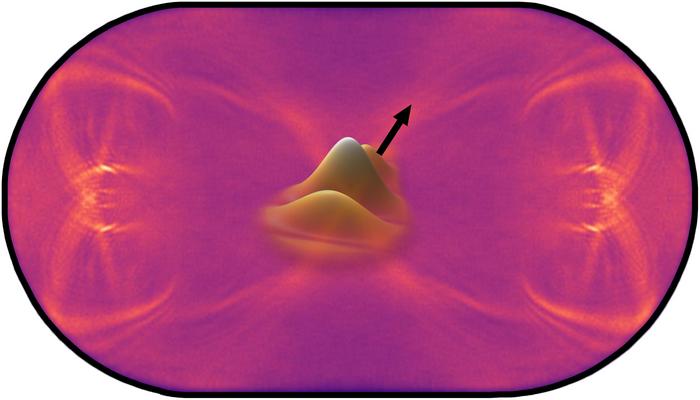
A quantum "wave packet" (in the middle) launched from the same kind of starting point behaves differently. Even after bouncing around for a very long time, faint filament-like patterns (bright glow) are still visible, a tattoo tracing back to its early history. This lingering imprint is the "quantum birthmark" described in the study. Credit: Joonas Keski-Rahkonen, Tampere University Even the most chaotic quantum systems keep a permanent mark of their own past – a "quantum birthmark" – that...






