Osaka - Organic light-emitting diode (OLED) displays are now very popular features of many mainstream products including smartphones and televisions. OLEDs have the advantages of being low cost, light, flexible, and easy to modify, making them ideal display materials. However, current OLEDs that achieve commercially viable quantum efficiencies contain rare metal atoms such as iridium and platinum that increase costs and reduce sustainability. Now, an international team including researchers from Osaka University has reported the best performing heavy-atom-free OLED of its kind.
Although OLEDs that do not contain heavy atoms--such as rare metals and halogens--are an obvious choice for reducing the cost and improving the long-term viability of products, the heavy-atom-free emitters that are currently available have limitations.
Materials known as thermally activated delayed fluorescence (TADF) emitters are efficient; however, they typically have broad emission spectra that make them more suitable for use as light sources than as the precise emitters required for display applications. Another type of heavy-atom-free emitter is room-temperature phosphorescence (RTP) emitters; however, the OLEDs using them show very low efficiencies of <1%, due to the quenching of long-lived triplet excitons in the device.
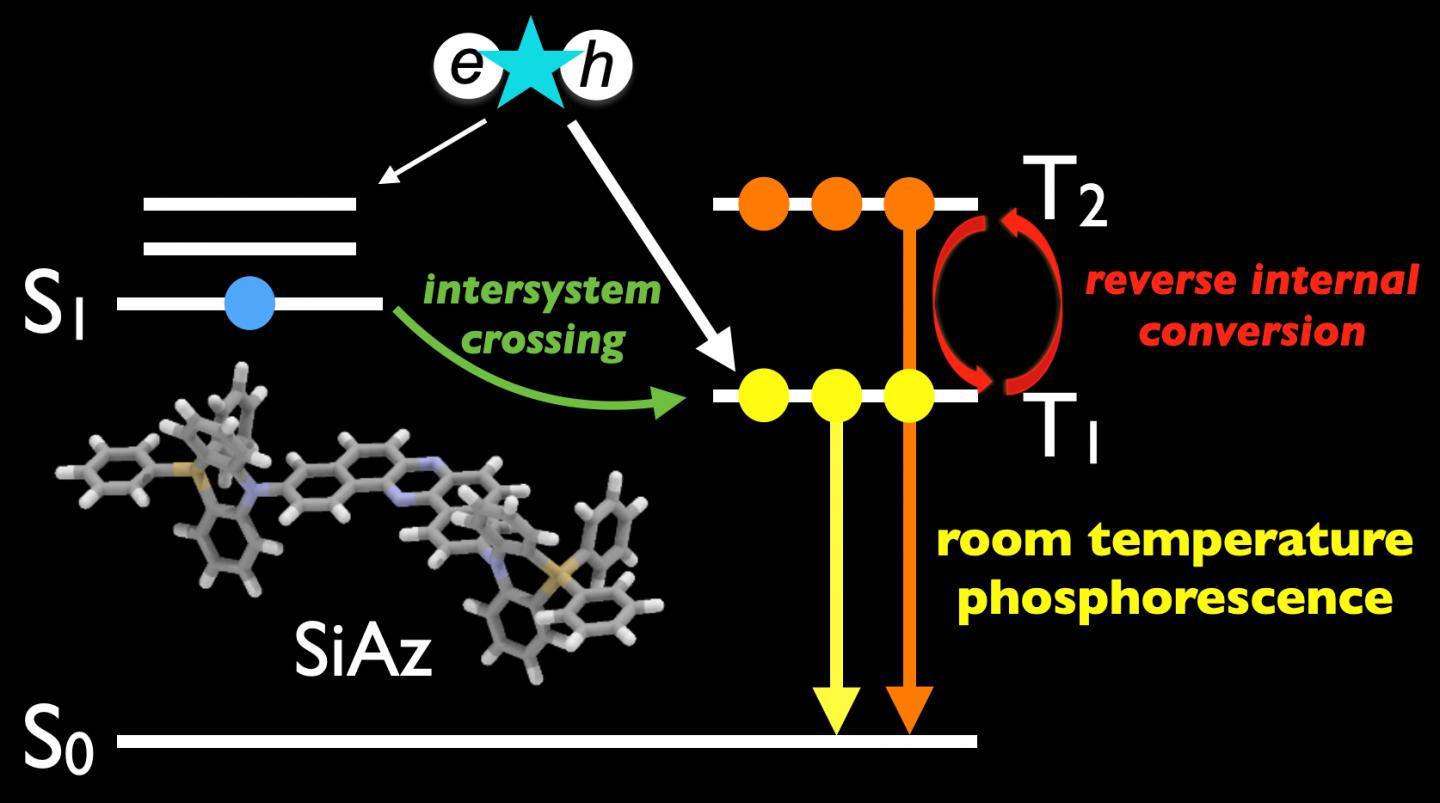
The researchers therefore merged the mechanisms of TADF and RTP phenomena to produce a hybrid emitter that combines features of both systems. Their TADF/RTP material--called SiAz--contains only carbon, hydrogen, nitrogen, and silicon atoms, which are easy to obtain naturally abundant elements, making SiAz viable for widespread use.
"The energy level gaps in the excited states of an emitting material determine how the materials can behave upon the excitation and the emission they produce," study corresponding author Youhei Takeda explains. "Combining the two mechanisms meant that we could alter the way an excitonic molecule undergoes transition between the spin- and energetically-different states to produce the overall characteristics that we wanted. Specifically, by tuning energy levels, our material can utilize thermal upconversion system to produce RTP."
The researchers achieved a high degree of control over the energy levels through careful selection of the host material that the emitter molecule was impregnated into--which allowed thermally activated transition of the energetically-lowest triplet excited state to the higher triplet state of the emitter molecules to irradiate pure RTP in an efficient way. The SiAz material was successfully used in a device that achieved an external quantum efficiency of 4%, which is the best reported to date for a heavy-atom-free OLED based on RTP.
"We hope that further efforts to understand the structure-property relationships of these hybrid systems will allow us to identify clear design principles going forward," Takeda explains. "Application of the control we have demonstrated is expected to lead to the widespread availability of heavy-atom-free OLED products and high-resolution bio-imaging agents that are sustainable and cost-effective."
Contact
Przemyslaw Data
Faculty of Chemistry
Silesian University of Technology
przemyslaw.data@polsl.pl
Reference
Heavy-Atom-Free Room-Temperature Phosphorescent Organic Light-Emitting Diodes Enabled by Excited States Engineering
Heather F. Higginbotham, Masato Okazaki, Piotr de Silva, Satoshi Minakata, Youhei Takeda & Przemyslaw Data
