
Leonardo DRS, Inc. announced today that it has launched the Stretto family of high-precision lasers, a next-generation system with unparalleled performance covering the ultraviolet, visible, and near-infrared spectrum. The technology is designed to bring a range of new benefits to quantum information science, including computing, sensing, timing and networking.
Stretto lasers are designed to bring the reliability and adaptability required for cutting-edge quantum applications and are engineered as a versatile product platform, enabling expansion across a broad wavelength range while maintaining a uniform footprint and interface. This design enables scientific discovery while facilitating scalability in quantum information science applications and ensuring seamless OEM integration without the need for extensive redesigns.
“We are proud to introduce this next generation set of products to the marketplace,” said Dr. Timothy Day senior vice president and general manager of the Leonardo DRS Daylight Solutions business, Dr. Timothy Day. “We have designed the Stretto family of lasers to be very compact with long term reliability crafted to endure harsh environmental conditions, including wide operating temperature range, shock and vibration.”
In the rapidly evolving field of quantum technology, Stretto stands out with its resistance to temperature and pressure fluctuations, and an extensive mode-hop-free tuning range. It epitomizes the fusion of advanced engineering and adaptability, making it an indispensable tool for quantum sensors, clocks, and computing systems.
“DRS is excited to offer Stretto to those pioneering in quantum research and applications, designed for a combination of precision, flexibility, and resilience,” Day said. “Stretto is more than just a high-precision laser; it's a symbol of innovation in the realm of tunable lasers.”
DRS is a world leading provider of best-in-class semiconductor laser sources for the life sciences, research, industrial, and defense industries. With a range of advanced sensing technology across these industries, the company has a large installed base and a historic track record of providing world class solutions. This footprint has the company uniquely positioned for success in leading the future of sensing.

Researchers from Rutgers, IBM and collaborators demonstrated real-time quantum feedback control on a 156-qubit Heron processor, using up to 100 connected qubits. By alternately scrambling information and resetting qubits nearly 5,000 times each, they steered the system from chaos to an ordered state, revealing a sharp phase transition.

Oxford physicists used a hybrid quantum computer, pairing trapped-ion qubits with quantum oscillators, to simulate the Aharonov-Bohm effect inside a lattice gauge theory. Encoding magnetic flux in entangled qubits made the gauge field dynamical, and the resulting destructive interference froze matter tunneling entirely.
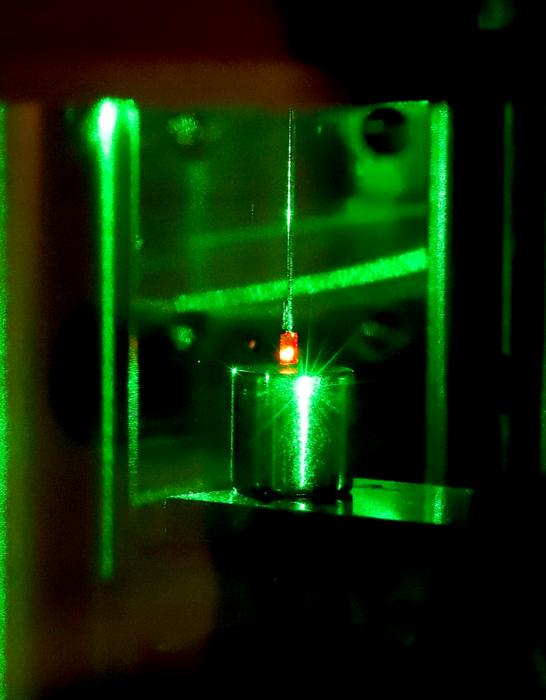
Researchers at OIST have for the first time used electron spin alone to move a levitating centimeter-scale diamond, a quantum effect acting on an object massive enough to feel gravity. Nitrogen-vacancy centers in the diamond generate spin forces detected by a picometer-precision interferometer. The platform opens routes to testing quantum gravity and building ultrasensitive sensors for dark matter and gravitational waves.






