Kyoto University
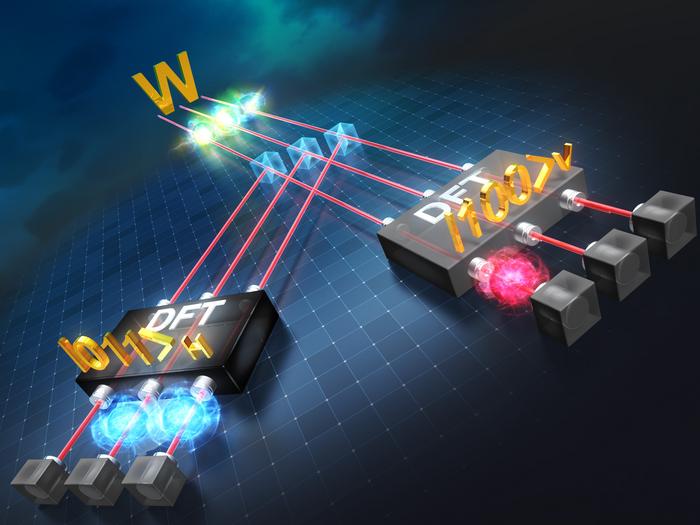
The concept of quantum entanglement is emblematic of the gap between classical and quantum physics. Referring to a situation in which it is impossible to describe the physics of each photon separately, this key characteristic of quantum mechanics defies the classical expectation that each particle should have a reality of its own, which gravely concerned Einstein. Understanding the potential of this concept is essential for the realization of powerful new quantum technologies.
Developing such technologies will require the ability to freely generate a multi-photon quantum entangled state, and then to efficiently identify what kind of entangled state is present. However, when performing conventional quantum tomography, a method commonly used for state estimation, the number of measurements required grows exponentially with the number of photons, posing a significant data collection problem.
If available, an entangled measurement can identify the entangled state with a one-shot approach. Such a measurement for the Greenberger-Horne-Zeilinger -- GHZ -- entangled quantum state has been realized, but for the W state, the other representative entangled multi-photon state, it has been neither proposed nor discovered experimentally.
This motivated a team of researchers at Kyoto University and Hiroshima University to take on this challenge, ultimately succeeding in developing a new method of entangled measurement to identify the W state.
"More than 25 years after the initial proposal concerning the entangled measurement for GHZ states, we have finally obtained the entangled measurement for the W state as well, with genuine experimental demonstration for 3-photon W states," says corresponding author Shigeki Takeuchi.
The team focused on the characteristics of the W state's cyclic shift symmetry, and theoretically proposed a method to create an entangled measurement using a photonic quantum circuit that performs quantum Fourier transformation for the W state of any number of photons.
They created a device to demonstrate the proposed method for three photons using high-stability optical quantum circuits, which allowed the device to operate stably without active control for an extended period of time. By inserting three single photons into the device in appropriate polarization states, the team was able to demonstrate that the device can distinguish different types of three-photon W states, each corresponding to a specific non-classical correlation between the three input photons. The researchers were able to evaluate the fidelity of the entangled measurement, which is equal to the probability of obtaining the correct result for a pure W-state input.
This achievement opens the door for quantum teleportation, or the transfer of quantum information. It could also lead to new quantum communication protocols, the transfer of multi-photon quantum entangled states, and new methods for measurement-based quantum computing.
"In order to accelerate the research and development of quantum technologies, it is crucial to deepen our understanding of basic concepts to come up with innovative ideas," says Takeuchi.
In the future, the team aims to apply their method to a larger-scale, more general multi-photon quantum entangled state, and plans to develop on-chip photonic quantum circuits for entangled measurements.
Reference
Entangled measurement for W states
Geobae Park, Holger F. Hofmann, Ryo Okamoto, and Shigeki Takeuchi
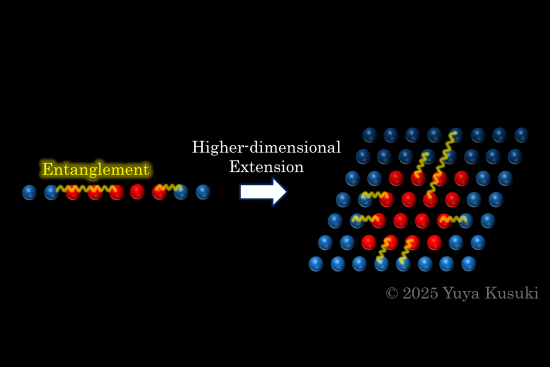
A research group led by Kusuki, The University of Tokyo Kavli Institute for the Physics and Mathematics of the Universe (Kavli IPMU, WPI) and the California Institute of Technology (Caltech) Professor Hirosi Ooguri, and Caltech researcher Sridip Pal, has shown the universal features of quantum entanglement structures in higher dimensions by applying theoretical techniques developed in the field of particle physics to quantum information theory. The research team focused on the thermal effecti...

In hyper-entanglement, two characteristics of a particle pair are correlated. As a simple analogy, this would be like a set of twins separated at birth having both the same names and same types of cars: The two traits are correlated between the twins. In the new study, Endres and his team were able to hyper-entangle pairs of atoms such that their individual states of motion and their individual electronic states—their internal energy levels—were correlated among the atoms.

In their proof-of-concept device, consisting of an array of 20 tunable microresonators, the team demonstrated that each multiplexed microresonator produced high-quality entangled photon pairs as compared to the best resonators they produced in previous work — design elements of the components in that paper have found their way into Cisco Systems’ newly unveiled quantum entanglement chip.
