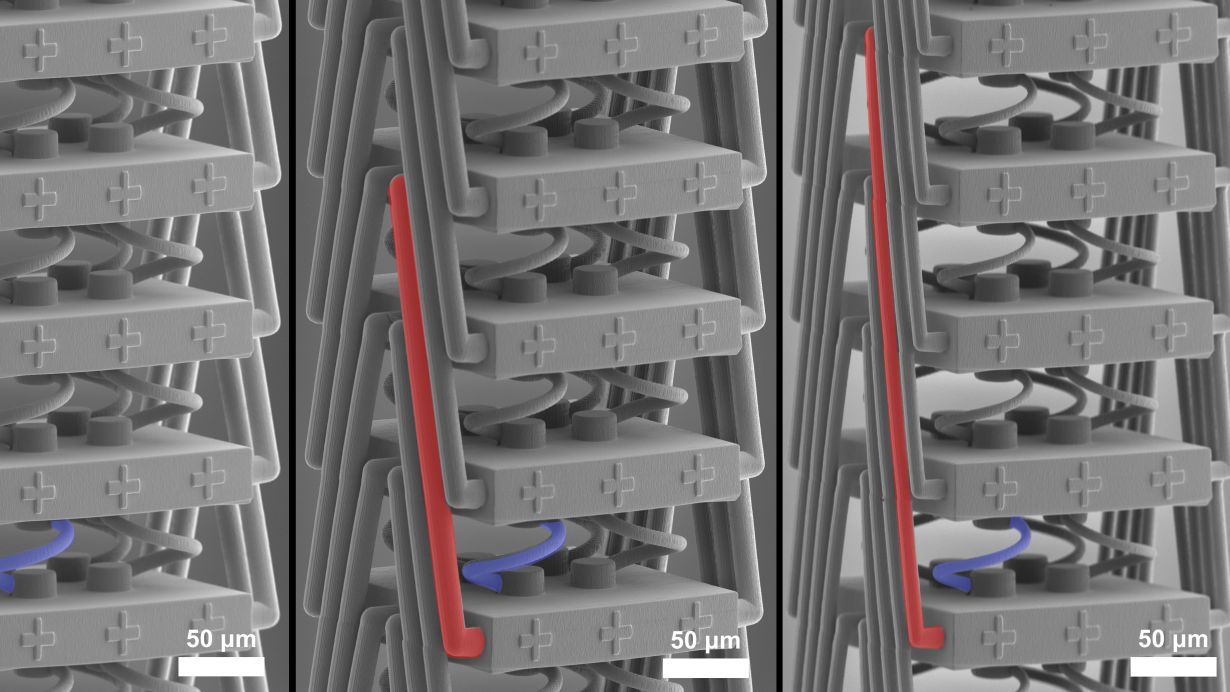
Metamaterials are artificial materials that do not occur in nature. Their components function like atoms in conventional materials but have special optical, electrical and magnetic properties. Interaction between the components is crucial to a metamaterial’s functionality. Previously a component could usually interact only with its immediate neighbors. Researchers at the Karlsruhe Institute of Technology (KIT) have developed a mechanical metamaterial with which these interactions can also be triggered at greater distances within the material. Potential uses of the material include measuring forces and structural monitoring. The findings have been published in Nature Communications.
With this material, the working group headed by Professor Martin Wegener at KIT’s Institute of Applied Physics (APH) has overcome a limitation of metamaterials. Lead author Dr. Yi Chen compares this with human communication and an effect known from the “telephone game”: When people communicate through a chain of intermediaries, the message received by the last person can be completely different than if the first and last people had spoken to each other directly. According to Chen, this principle also applies to metamaterials. “The material we designed has special structures (red in the illustration). With these structures, individual components no longer ‘communicate’ only via their neighbors with components farther away, now they can also communicate directly with all other components in the material,” Chen said.
Experiments on 3D-printed Microscopic Samples
“These structures give the material fascinating properties such as unusual stretching characteristics,” said co-author Ke Wang, also from the APH. The team was able to show this with micron-sized samples of the material, which they produced using 3D laser printing technology and examined with a camera-equipped microscope. Their analysis showed that a one-dimensional (1D) beam stretched in an irregular manner when pulled from one end.
In contrast to an object such as a rubber band, which stretches uniformly when pulled, the metamaterial actually exhibited compression in some places, while some short sections stretched more than longer sections even though the same force was applied throughout. “This unusual behavior with locally occurring stretching and compression is impossible in conventional materials,” said Jonathan Schneider of APH, another co-author. “Now we will investigate this in two-dimensional (planar) and three-dimensional materials.”
The metamaterial is extremely sensitive to loads, which could be a potentially useful property. Depending on the point at which force is applied in the material, completely different stretching reactions can result even at relatively distant points. According to the researchers, reactions in conventional materials are only observed directly at the point where force is applied, while only weak or negligible effects can be identified at distant locations in the material. A material with this sensitivity could be valuable for engineering applications in which large-scale forces need to be measured, as in monitoring building deformations, or in biological research to characterize forces in cells.
Reference
Anomalous frozen evanescent phonons
Yi Chen, Jonathan L. G. Schneider, Ke Wang, Philip Scott, Sebastian Kalt, Muamer Kadic & Martin Wegener
https://www.nature.com/articles/s41467-024-52956-5
Karlsruhe Institute of Technology (KIT)
Alemnis has reached controlled, constant indentation strain rates up to 100,000 s-1 while maintaining quantitative load-displacement measurement, using true displacement control. The capability was demonstrated on molybdenum, nanocrystalline nickel and fused silica.
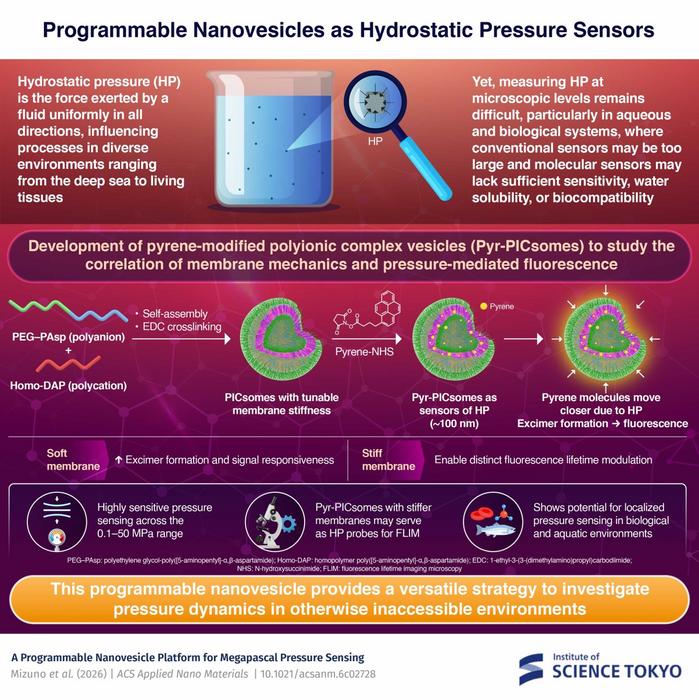
Pyrene-modified polyionic complex vesicles, or Pyr-PICsomes, convert hydrostatic pressure into measurable fluorescence. Crosslinking density tunes membrane stiffness, which governs sensing behavior: soft vesicles give strong excimer-to-monomer ratio changes from 0.1 to 50 MPa, while stiff membranes respond through fluorescence lifetime, suiting lifetime imaging.
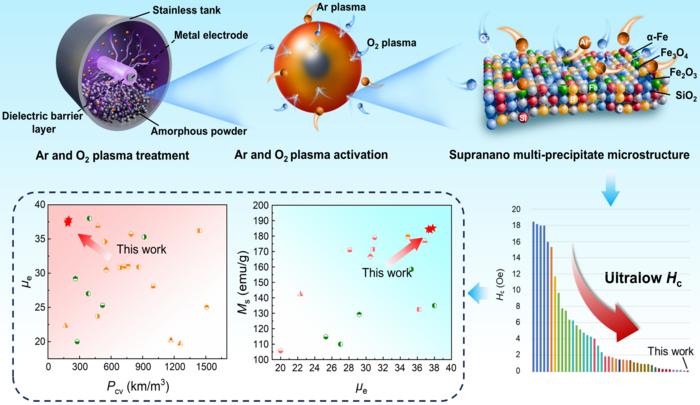
Ar/O₂ plasma treatment generates supranano α-Fe, Fe₃O₄, SiO₂ and Fe₂O₃ precipitates just 0.8–2.5 nm across amorphous powder surfaces, creating nucleation sites that ease magnetic-moment reversal. The resulting soft magnetic composite combines 0.13 Oe coercivity, 37.3 permeability, 185 emu g⁻¹ saturation magnetization and 191.18 kW m⁻³ core loss at 1 MHz and 20 mT. The surface route avoids bulk composition changes, aiding scale-up for high-frequency inductors and power chokes.






