
Since the 1950s, scientists have used radio waves to uncover the molecular “fingerprints” of unknown materials, aiding in tasks as varied as scanning the human body with MRI machines and detecting explosives at airports.
These methods, however, rely on signals averaged from trillions of atoms, making it impossible to detect tiny variations between individual molecules. Such limitations hinder applications in fields like protein research, where small differences in shape control functionality and can determine the difference between health and disease.
Sub-Atomic Insights
Now, engineers at the University of Pennsylvania School of Engineering and Applied Science (Penn Engineering) have utilized quantum sensors to realize a groundbreaking variation of nuclear quadrupolar resonance (NQR) spectroscopy, a technique traditionally used to detect drugs and explosives or analyze pharmaceuticals.
Described in Nano Letters, the new method is so precise that it can detect the NQR signals from individual atoms — a feat once thought unattainable. This unprecedented sensitivity opens the door to breakthroughs in fields like drug development, where understanding molecular interactions at the atomic level is critical.
“This technique allows us to isolate individual nuclei and reveal tiny differences in what were thought to be identical molecules,” says Lee Bassett, Associate Professor in Electrical and Systems Engineering (ESE), Director of Penn’s Quantum Engineering Laboratory (QEL) and the paper’s senior author. “By focusing on a single nucleus, we can uncover details about molecular structure and dynamics that were previously hidden. This capability allows us to study the building blocks of the natural world at an entirely new scale.”
An Unexpected Discovery
The discovery stemmed from an unexpected observation during routine experiments. Alex Breitweiser, a recent doctoral graduate in Physics from Penn’s School of Arts & Sciences and the paper’s co-first author, who is now a researcher at IBM, was working with nitrogen-vacancy (NV) centers in diamonds — atomic-scale defects often used in quantum sensing — when he noticed unusual patterns in the data.
The periodic signals looked like an experimental artifact, but persisted after extensive troubleshooting. Returning to textbooks from the 1950s and ‘60s on nuclear magnetic resonance, Breitweiser identified a physical mechanism that explained what they were seeing, but that had previously been dismissed as experimentally insignificant.
Advances in technology allowed the team to detect and measure effects that were once beyond the reach of scientific instruments. “We realized we weren’t just seeing an anomaly,” Brietweiser says. “We were breaking into a new regime of physics that we can access with this technology.”
Unprecedented Precision
Understanding of the effect was further developed through collaboration with researchers at Delft University of Technology in the Netherlands, where Breitweiser had spent time conducting research on related topics as part of an international fellowship. Combining expertise in experimental physics, quantum sensing and theoretical modeling, the team created a method capable of capturing single atomic signals with extraordinary precision.
“This is a bit like isolating a single row in a huge spreadsheet,” explains Mathieu Ouellet, a recent ESE doctoral graduate and the paper’s other co-first author. “Traditional NQR produces something like an average — you get a sense of the data as a whole, but know nothing about the individual data points. With this method, it’s as though we’ve uncovered all the data behind the average, isolating the signal from one nucleus and revealing its unique properties.”
Deciphering the Signals
Determining the theoretical underpinnings of the unexpected experimental result took significant effort. Ouellet had to carefully test various hypotheses, running simulations and performing calculations to match the data with potential causes. “It’s a bit like diagnosing a patient based on symptoms,” he explains. “The data points to something unusual, but there are often multiple possible explanations. It took quite a while to arrive at the correct diagnosis.”
Looking ahead, the researchers see vast potential for their method to address pressing scientific challenges. By characterizing phenomena that were previously hidden, the new method could help scientists better understand the molecular mechanisms that shape our world.
Reference
Quadrupolar Resonance Spectroscopy of Individual Nuclei Using a Room-Temperature Quantum Sensor
S. Alex Breitweiser, Mathieu Ouellet, Tzu-Yung Huang, Tim H. Taminiau, and Lee C. Bassett
https://pubs.acs.org/doi/10.1021/acs.nanolett.4c04112

Researchers from Rutgers, IBM and collaborators demonstrated real-time quantum feedback control on a 156-qubit Heron processor, using up to 100 connected qubits. By alternately scrambling information and resetting qubits nearly 5,000 times each, they steered the system from chaos to an ordered state, revealing a sharp phase transition.

Oxford physicists used a hybrid quantum computer, pairing trapped-ion qubits with quantum oscillators, to simulate the Aharonov-Bohm effect inside a lattice gauge theory. Encoding magnetic flux in entangled qubits made the gauge field dynamical, and the resulting destructive interference froze matter tunneling entirely.
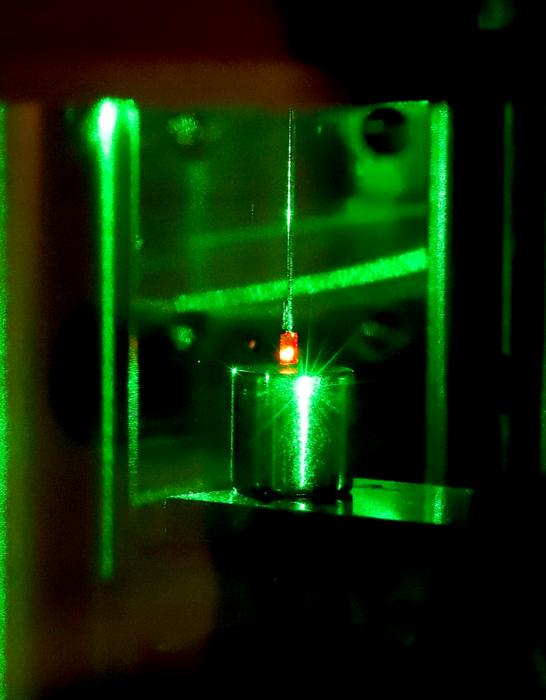
Researchers at OIST have for the first time used electron spin alone to move a levitating centimeter-scale diamond, a quantum effect acting on an object massive enough to feel gravity. Nitrogen-vacancy centers in the diamond generate spin forces detected by a picometer-precision interferometer. The platform opens routes to testing quantum gravity and building ultrasensitive sensors for dark matter and gravitational waves.