University of California, Los Angeles
UCLA researchers have conducted an in-depth analysis of nonlinear information encoding strategies for diffractive optical processors, offering new insights into their performance and utility. Their study, published in Light: Science & Applications, a journal of the Springer Nature, compared simpler-to-implement nonlinear encoding strategies that involve phase encoding, with the performance of data repetition-based nonlinear information encoding methods, shedding light on their advantages and limitations in the optical processing of visual information.
Diffractive optical processors, built using linear materials, perform computational tasks through the manipulation of light using structured surfaces. Nonlinear encoding of optical information can enhance these processors’ performance, enabling them to better handle complex tasks such as image classification, quantitative phase imaging, and encryption.
The UCLA research team, led by Professor Aydogan Ozcan, evaluated various nonlinear encoding strategies using different datasets to assess their statistical inference performance. Their findings revealed that data repetition within a diffractive volume, while enhancing inference accuracy, compromises the universal linear transformation capability of diffractive optical processors. As a result, data repetition-based diffractive blocks cannot serve as optical analogs to fully-connected or convolutional layers commonly used in digital neural networks. More generally, data-repetition-based diffractive processors can be perceived as a simplified optical analog of the dynamic convolution kernel concept used in some neural network architectures. Despite its different features, data repetition architecture within a diffractive optical processor is still effective for inference tasks and offers advantages in terms of noise resilience.
As an alternative, phase encoding of input information, without data repetition, offers a simpler-to-implement nonlinear encoding strategy with statistically comparable inference accuracy. Implemented through spatial light modulators or phase-only objects, directly, phase encoding is a practical alternative due to its simplicity and effectiveness. Furthermore, diffractive processors without data repetition do not need pre-processing of input information through a digital system, which is required for visual data repetition. Therefore, data repetition can be time-consuming, especially for phase-only input objects, due to the need for digital phase recovery and pre-processing before visual data repetition can occur.
The research team’s findings provide valuable insights into the push-pull relationship between linear material-based diffractive optical systems and nonlinear information encoding strategies. These results hold potential for a wide range of applications, including optical communications, surveillance, and computational imaging. The ability to enhance inference accuracy through nonlinear encoding strategies can improve the performance of optical processors in various fields, leading to more advanced and efficient visual information processing systems.
Reference
Nonlinear encoding in diffractive information processing using linear optical materials
Yuhang Li, Jingxi Li & Aydogan Ozcan
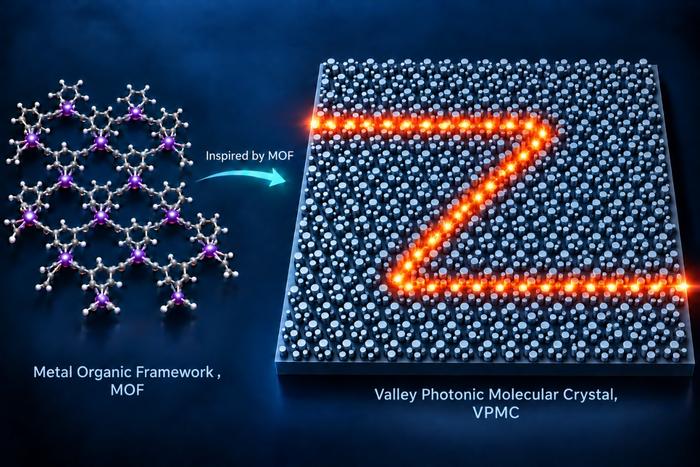
Inspired by Metal-Organic Framework based topological insulators, researchers at Tsinghua University proposed valley photonic molecular crystal (VPMC) and investigated the impact of molecular rotation on the valley-topological properties of VPMC. Credit: Tsinghua University/Xue Feng A research team led by Yidong Huang at Tsinghua University, including Xue Feng and Yongzhuo Li, has developed valley photonic molecular crystals (VPMCs) on a silicon platform. Combining theoretical modeling,...
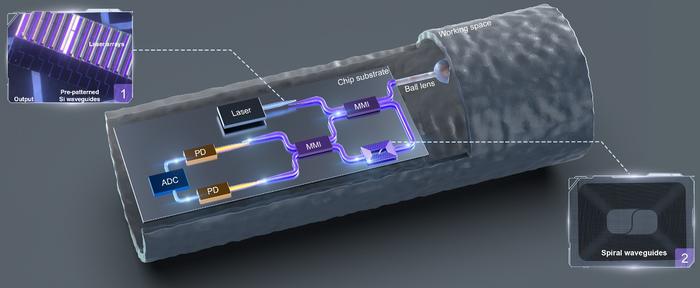
The system integrates a III-V semiconductor light source, SiN-based interferometers, Si-Ge photodetectors (PDs), and an integrated ball-lens microprobe, thereby combining the distinct advantages of multiple photonic integration platforms. The insets illustrate complementary technologies that can be incorporated to realize a miniaturized, fully integrated OCT system. Abbreviations: ADC, analog-to-digital converter. Inset 1: Foundry-scalable embedded III-V lasers on silicon-on-insulator (SOI)...

From left to right: Three photons with different quantum states enter an interferometer with three beam splitters. At each beam splitter, they can take different paths at the same time in superposition. The researchers then measured how often the three photons ended up together at the same output. Counterintuitively, it is possible to make the photons more similar to each other and at the same make them less likely to “bunch” together. AI-generated illustration, by Leonardo Novo. We usually...
