
Be fast, avoid light, and roll through a curvy ramp: This is the recipe for a pioneering experiment proposed by theoretical physicists in a recent paper published in Physical Review Letters. An object evolving in a potential created through electrostatic or magnetic forces is expected to rapidly and reliably generate a macroscopic quantum superposition state.
The boundary between everyday reality and the quantum world remains unclear. The more massive an object, the more localized it becomes when being made quantum through cooling down its motion to the absolute zero. Researchers, led by Oriol Romero-Isart from the Institute for Quantum Optics and Quantum Information (IQOQI) of the Austrian Academy of Sciences (ÖAW) and the Department of Theoretical Physics at the University of Innsbruck, propose an experiment in which an optically levitated nanoparticle, cooled to its ground state, evolves in a non-optical (“dark”) potential created by electrostatic or magnetic forces. This evolution in the dark potential is expected to rapidly and reliably generate a macroscopic quantum superposition state.
Laser light can cool a nanoscale-sized glass sphere to its motional ground state. Left alone, bombarded by air molecules and scattering incoming light, such glass spheres quickly heat up and leave the quantum regime, limiting quantum control. To avoid this, the researchers propose letting the sphere evolve in the dark, with the light switched off, guided solely by nonuniform electrostatic or magnetic forces. This evolution is not only fast enough to prevent heating by stray gas molecules but also lifts the extreme localization and imprints unequivocally quantum features.
The recent paper in Physical Review Letters also discusses how this proposal circumvents the practical challenges of these type of experiments. These challenges include the need for fast experimental runs, minimal use of laser light to avoid decoherence, and the ability to quickly repeat experimental runs with the same particle. These considerations are crucial in mitigating the impact of low-frequency noise and other systematic errors.
This proposal has been extensively discussed with experimental partners in Q-Xtreme, an ERC Synergy Grant project financially supported by the European Union. “The proposed method is aligned with current developments in their labs and they should soon be able to test our protocol with thermal particles in the classical regime, which will be very useful to measure and minimize sources of noise when lasers are off,” says the theory team of Oriol Romero-Isart. “We believe that while the ultimate quantum experiment will be unavoidably challenging, it should be feasible as it meets all the necessary criteria for preparing these macroscopic quantum superposition states.” Quantenüberlagerungszustände erfüllt.“
Reference
Macroscopic Quantum Superpositions via Dynamics in a Wide Double-Well Potential
M. Roda-Llordes, A. Riera-Campeny, D. Candoli, P. T. Grochowski, and O. Romero-Isart
https://journals.aps.org/prl/abstract/10.1103/PhysRevLett.132.023601
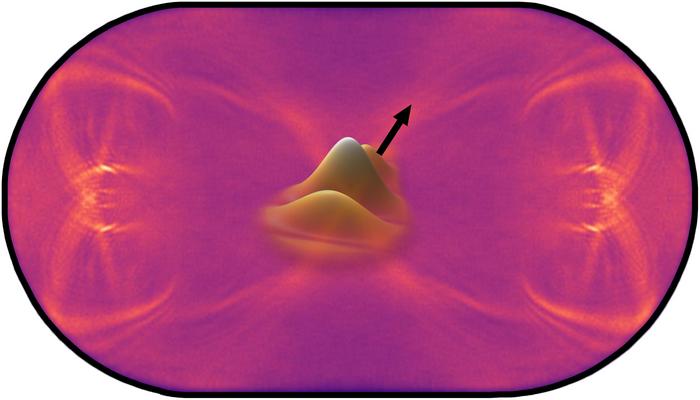
A quantum "wave packet" (in the middle) launched from the same kind of starting point behaves differently. Even after bouncing around for a very long time, faint filament-like patterns (bright glow) are still visible, a tattoo tracing back to its early history. This lingering imprint is the "quantum birthmark" described in the study. Credit: Joonas Keski-Rahkonen, Tampere University Even the most chaotic quantum systems keep a permanent mark of their own past – a "quantum birthmark" – that...
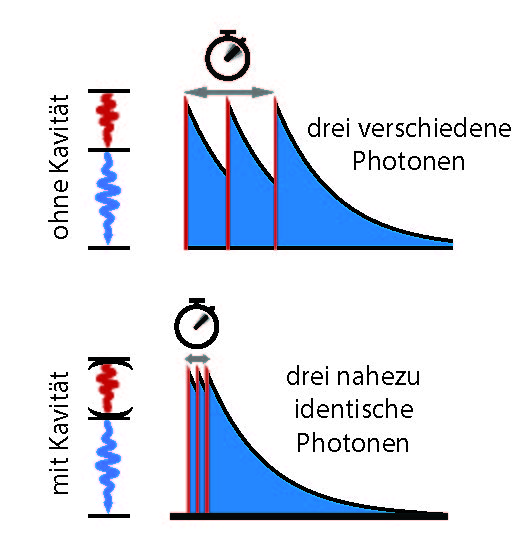
Illustration (University of Basel, Timon Baltisberger): Biexziton decay can generate photons of very high quality if the system is specifically controlled using an optical cavity. Under these conditions, 90 per cent of the photons are indistinguishable. Working in close collaboration, researchers from Paderborn University, the University of Basel and Ruhr University Bochum have made a significant breakthrough in the field of quantum communication. In their recently published paper in the...
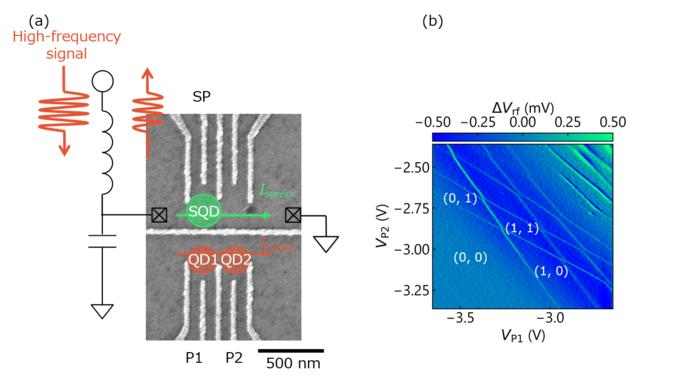
(a) The structure of the gate electrodes on the ZnO device used in the experiment in this paper. (b) The charge stability diagram indicating the formation of ZnO double quantum dot in few-electron regime. Researchers at Tohoku University, in collaboration with the National Institute for Materials Science (NIMS) and the University of Tokyo, have taken an important step toward semiconductor quantum computing using zinc oxide (ZnO). The team successfully demonstrated charge sensing,...
