Advanced Institute for Materials Research (AIMR), Tohoku University
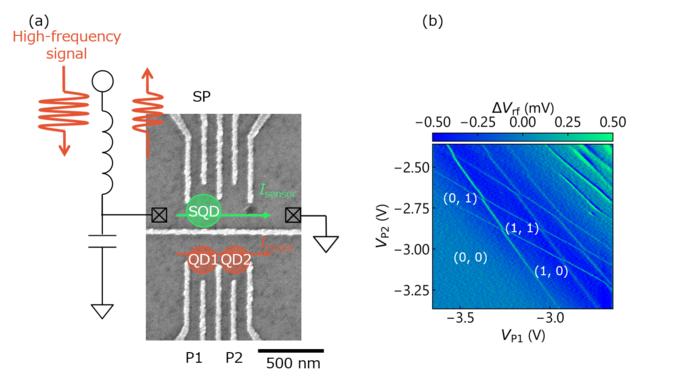
Researchers at Tohoku University, in collaboration with the National Institute for Materials Science (NIMS) and the University of Tokyo, have taken an important step toward semiconductor quantum computing using zinc oxide (ZnO). The team successfully demonstrated charge sensing, high-frequency reflectometry, and the formation of a few-electron double quantum dot in a ZnO device - three key technologies for developing and evaluating spin qubits.
Semiconductor quantum dots are promising building blocks for scalable quantum computers because they can confine individual electrons and use their spins to store quantum information. Silicon and gallium arsenide have been extensively studied for this purpose, while ZnO has emerged as an alternative material with attractive properties, including a low nuclear spin environment that may help preserve electron spin states and a direct bandgap for possible optical coupling.
However, rapidly and accurately detecting the charge state of electrons in ZnO quantum dots has remained a challenge. To address this, the researchers fabricated a ZnO device containing two target quantum dots (QD1 and QD2) alongside a sensor quantum dot (SQD), which acts as a sensitive electrometer. By integrating the sensor with a radio-frequency resonant circuit, they achieved high-frequency reflectometry, enabling much faster detection of changes in electron charge.
"For quantum computing, technologies that enable rapid readout of quantum states are essential," says Associate Professor Tomohiro Otsuka of the Advanced Institute for Materials Research (WPI-AIMR), Tohoku University. "By demonstrating high-frequency reflectometry in zinc oxide, we have established an important measurement technique for high-speed evaluation of quantum states in this unique material."
Using the integrated device, the researchers also successfully confined individual electrons and confirmed the formation of a few-electron double quantum dot. This configuration is an important foundation for investigating and operating spin qubits.
"This achievement bridges a critical experimental gap for zinc oxide quantum devices," says Otsuka. "We now have a high-speed measurement platform that will allow us to investigate fundamental spin properties, including spin relaxation and coherence times, bringing us closer to realizing high-performance quantum devices based on new semiconductor materials."
The study was published online in Physical Review Applied on July 21, 2026.
The research team's next steps include demonstrating electron spin readout and manipulation in ZnO quantum dots, as well as measuring key properties such as spin relaxation and coherence times.
Reference
Charge sensing of few-electron ZnO double quantum dots probed by radio-frequency reflectometry
Kosuke Noro, Motoya Shinozaki, Yusuke Kozuka, Koichi Baba, Kazuma Matsumura, Yoshihiro Fujiwara, Takeshi Kumasaka, Atsushi Tsukazaki, Masashi Kawasaki, and Tomohiro Otsuka
Atom Computing has signed an agreement for up to $100 million with the U.S. Department of Commerce to accelerate R&D of fault-tolerant, utility-scale quantum computers, following an earlier Letter of Intent.

Researchers have linked atomic vibrations that carry heat and sound, known as acoustic phonons, to electron spin in ultrathin sheets of the semiconductor nickel phosphorous trisulfide. Using Brillouin-Mandelstam inelastic light scattering spectroscopy, they found the two properties correlate more strongly once spins organize into a zigzag pattern at low temperature, and that surface phonons slow near that transition.
AMD and IQM demonstrated a hybrid chemistry workflow that splits a problem between an IQM quantum computer and an AMD GPU powered by ROCm. The full QSCI pipeline ran on hydrogen on real hardware.
This week in nanotech
$109M raised
3 funding rounds · 18 deals tracked
New products
 Ti-WCMBN Nanomaterialia Featured
 DLS-1 Mass Spectrometer for Fusion Gas AnalysisHiden Analytical Featured
 Aether®Lam Research
Market insights
Last 30 days: Semiconductors & Electronics drew the most money: $545M.
Money raised per month
Behind the deal
Who led Sandia National Laboratories’s $3.4M Grant?
See the investors with Insights Pro →