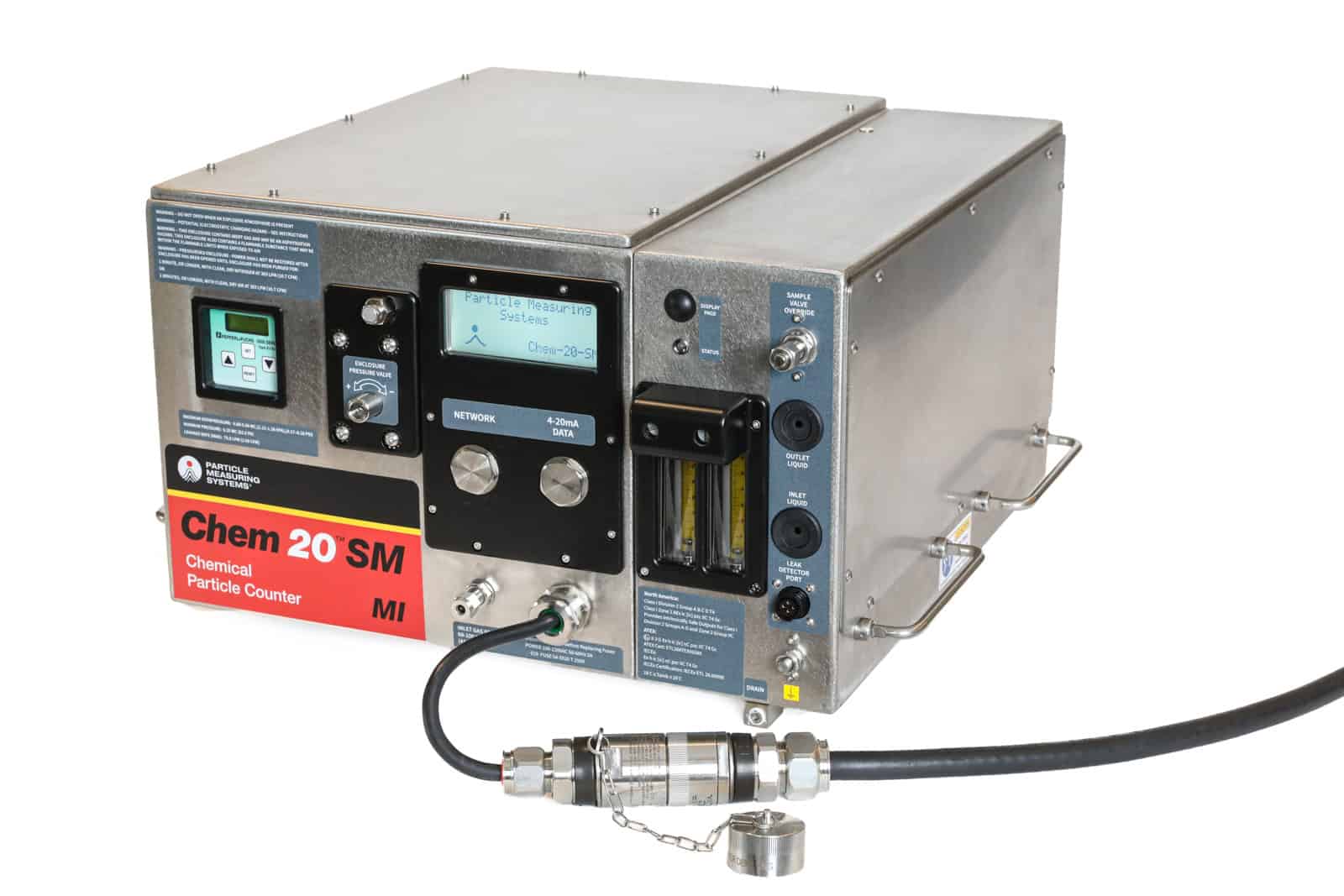
Niwot, 12 October 2026. Particle Measuring Systems (PMS) has launched the Chem 20 SM, a 20 nm solvent particle counter engineered for use in hazardous areas. The company said the product is the first 20 nm particle counter certified for hazardous-area solvent monitoring.
The Chem 20 SM is designed to monitor solvents such as IPA and PGMEA. It provides inline particle monitoring with hazardous-area certifications without the customer-built containment enclosures commonly used today, according to PMS.
The company said semiconductor manufacturers have faced challenges monitoring particles in hazardous solvent environments. Traditional approaches often require expensive, custom-built nitrogen-purged enclosures around standard particle counters, adding complexity, cost and maintenance requirements.
PMS said the Chem 20 SM will meet global hazardous-location requirements, including IECEx, ATEX and NFPA 70 NEC Class I Division 2 standards. "By combining 20 nm particle detection with hazardous-area certification and a compact, installable design, we enable customers to monitor critical solvent chemistries more efficiently and confidently," said Badr Astiphan, Vice President of Particle Measuring Systems.
The company said semiconductor manufacturers and chemical suppliers can monitor contamination closer to the process, identify yield-limiting particle events earlier and simplify hazardous-area deployment without sacrificing performance or safety.
Source: Particle Measuring Systems news
Applied Materials opened its Equipment and Process Innovation and Commercialization (EPIC) Center in Silicon Valley on Oct. 12. The company bets $5 billion on the facility to develop future semiconductor technologies.
Fraunhofer IZM and Swissbit described Europe's advanced packaging gap between pilot production and mass manufacturing. Fraunhofer's Rolf Aschenbrenner and Swissbit's Lars Lust said low volumes such as 20 to 100 wafers per year are too small for large OSAT providers.
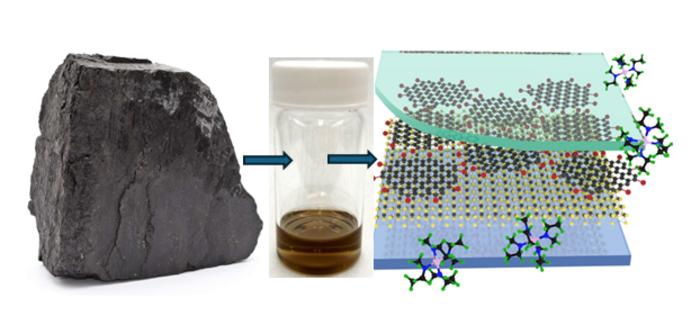
Researchers at the University of Illinois Urbana-Champaign and NETL have shown that carbon nanodots derived from bituminous coal can serve as an atomic-scale interfacial binder for integrating high-κ dielectrics with 2D semiconductors such as molybdenum disulfide.






