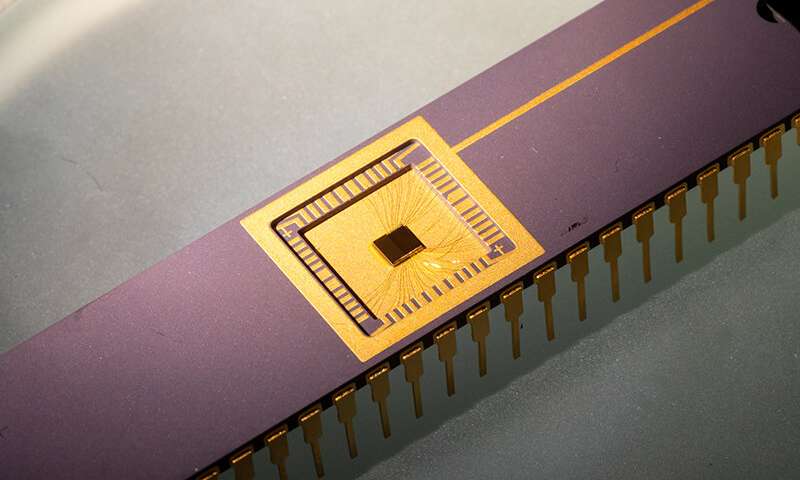
A team of University of Arkansas physicists has successfully developed a circuit capable of capturing graphene's thermal motion and converting it into an electrical current.
"An energy-harvesting circuit based on graphene could be incorporated into a chip to provide clean, limitless, low-voltage power for small devices or sensors," said Paul Thibado, professor of physics and lead researcher in the discovery.
The findings, published in the journal Physical Review E, are proof of a theory the physicists developed at the U of A three years ago that freestanding graphene—a single layer of carbon atoms—ripples and buckles in a way that holds promise for energy harvesting.
The idea of harvesting energy from graphene is controversial because it refutes physicist Richard Feynman's well-known assertion that the thermal motion of atoms, known as Brownian motion, cannot do work. Thibado's team found that at room temperature the thermal motion of graphene does in fact induce an alternating current (AC) in a circuit, an achievement thought to be impossible.
In the 1950s, physicist Léon Brillouin published a landmark paper refuting the idea that adding a single diode, a one-way electrical gate, to a circuit is the solution to harvesting energy from Brownian motion. Knowing this, Thibado's group built their circuit with two diodes for converting AC into a direct current (DC). With the diodes in opposition allowing the current to flow both ways, they provide separate paths through the circuit, producing a pulsing DC current that performs work on a load resistor.
Additionally, they discovered that their design increased the amount of power delivered. "We also found that the on-off, switch-like behavior of the diodes actually amplifies the power delivered, rather than reducing it, as previously thought," said Thibado. "The rate of change in resistance provided by the diodes adds an extra factor to the power."
The team used a relatively new field of physics to prove the diodes increased the circuit's power. "In proving this power enhancement, we drew from the emergent field of stochastic thermodynamics and extended the nearly century-old, celebrated theory of Nyquist," said coauthor Pradeep Kumar, associate professor of physics and coauthor.
According to Kumar, the graphene and circuit share a symbiotic relationship. Though the thermal environment is performing work on the load resistor, the graphene and circuit are at the same temperature and heat does not flow between the two.
That's an important distinction, said Thibado, because a temperature difference between the graphene and circuit, in a circuit producing power, would contradict the second law of thermodynamics. "This means that the second law of thermodynamics is not violated, nor is there any need to argue that 'Maxwell's Demon' is separating hot and cold electrons," Thibado said.
The team also discovered that the relatively slow motion of graphene induces current in the circuit at low frequencies, which is important from a technological perspective because electronics function more efficiently at lower frequencies.
"People may think that current flowing in a resistor causes it to heat up, but the Brownian current does not. In fact, if no current was flowing, the resistor would cool down," Thibado explained. "What we did was reroute the current in the circuit and transform it into something useful."
The team's next objective is to determine if the DC current can be stored in a capacitor for later use, a goal that requires miniaturizing the circuit and patterning it on a silicon wafer, or chip. If millions of these tiny circuits could be built on a 1-millimeter by 1-millimeter chip, they could serve as a low-power battery replacement.
Reference:
Fluctuation-induced current from freestanding graphene
P. M. Thibado, P. Kumar, Surendra Singh, M. Ruiz-Garcia, A. Lasanta, and L. L. Bonilla
Published 2 October 2020
DOI: https://doi.org/10.1103/PhysRevE.102.042101
Contact:
Paul M. Thibado
(ARSC)-Arts & Sciences
Physics
thibado@uark.edu
479-575-7932
University of Arkansas
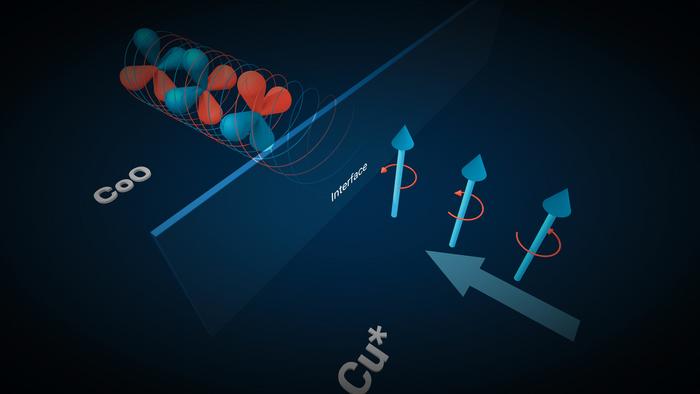
Researchers at Johannes Gutenberg University Mainz (JGU) are the first to directly utilize orbital currents without the need for conversion of the orbital current into a spin current. “We have thus realized the first purely orbitronic device approach,” said Dr. Christin Schmitt, a scientist in the research group of Professor Mathias Kläui at the JGU Institute of Physics. Orbitronics is a promising technology for future memory devices, as it could enable the realization of large-scale storage...
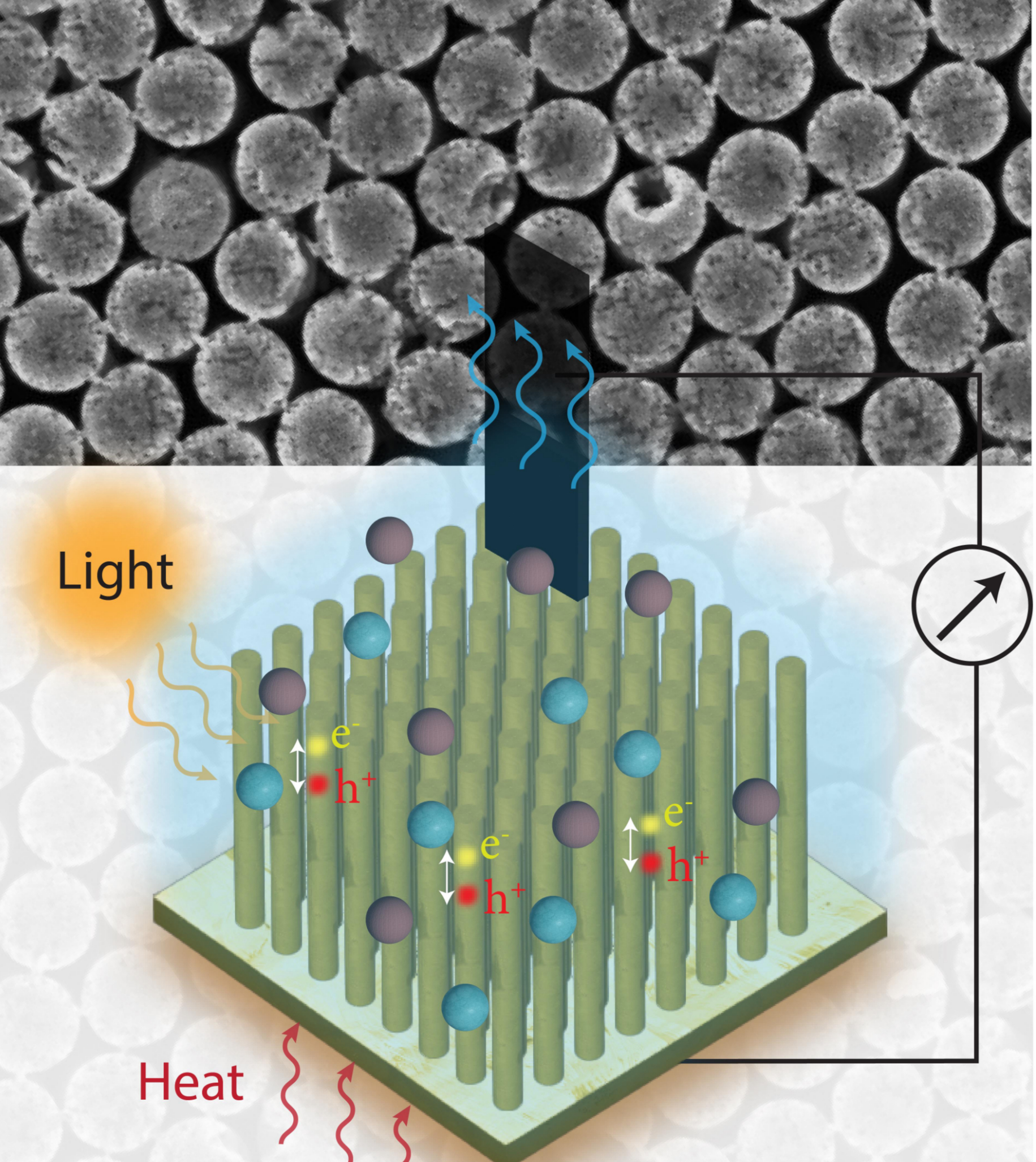
In 2024, researchers in the Laboratory of Nanoscience for Energy Technology (LNET) in EPFL’s School of Engineering reported a platform for studying the hydrovoltaic (HV) effect – a phenomenon that allows electricity to be harvested when fluid is passed over the charged surface of a nanodevice. Their platform consisted of a hexagonal network of silicon nanopillars, the space between which created channels for evaporating fluid samples. Now the LNET team, led by Giulia Tagliabue, has developed...

In a new study, an international group of researchers has found that chiral phonons can create orbital current without needing magnetic elements – in part because chiral phonons have their own magnetic moments. Additionally, this effect can be achieved in common crystal materials. The work has potential for the development of less expensive, energy-efficient orbitronic devices for use in a wide array of electronics. All electronic devices are based upon the charge of an electron, and electron...