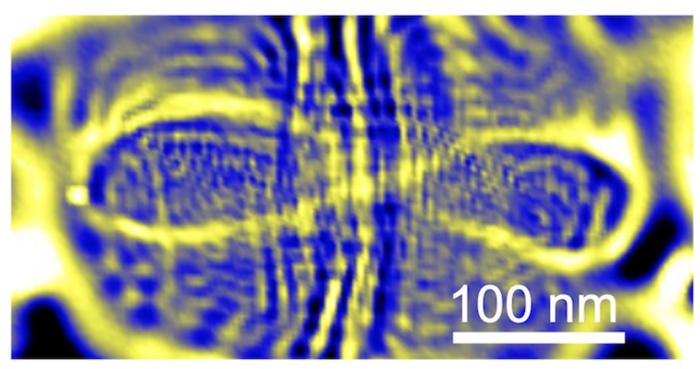
Where do you see patterns in chaos? It has been proven, in the incredibly tiny quantum realm, by an international team co-led by UC Santa Cruz physicist Jairo Velasco, Jr. In a new paper published on November 27 in Nature, the researchers detail an experiment that confirms a theory first put forth 40 years ago stating that electrons confined in quantum space would move along common paths rather than producing a chaotic jumble of trajectories.
Electrons exhibit both particle and wave-like properties—they don’t simply roll like a ball. Electrons behave in ways that are often counterintuitive, and under certain conditions, their waves can interfere with each other in a way that concentrates their movement into certain patterns. The physicists call these common paths “unique closed orbits.”
Achieving this in Velasco’s lab required an intricate combination of advanced imaging techniques and precise control over electron behavior within graphene, a material widely used in research because its unique properties and two-dimensional structure make it ideal for observing quantum effects. In their experiment, Velasco’s team utilized the finely tipped probe of a scanning tunneling microscope to first create a trap for electrons, and then hover close to a graphene surface to detect electron movements without physically disturbing them.
The benefit of electrons following closed orbits within a confined space is that the subatomic particle’s property would be better preserved as it moves from one point to another, according to Velasco. He said this has vast implications for everyday electronics, explaining how information encoded in an electron’s properties could be transferred without loss, conceivably resulting in lower-power, highly efficient transistors.
“One of the most promising aspects of this discovery is its potential use in information processing,” Velasco said. “By slightly disturbing, or ‘nudging’ these orbits, electrons could travel predictably across a device, carrying information from one end to the other.”
Quantum scars make their mark
In physics, these unique electron orbits are known as “quantum scars.” This was first explained in a 1984 theoretical study by Harvard University physicist Eric Heller, who used computer simulations to reveal that confined electrons would move along high-density orbits if reinforced by their wave motions interfering with each other.
“Quantum scarring is not a curiosity. But rather, it is a window onto the strange quantum world,” said Heller, also a co-author on the paper. “Scarring is a localization around orbits that come back on themselves. These returns have no long-term consequence in our normal classical world—they are soon forgotten. But they are remembered forever in the quantum world.”
With Heller’s theory proven, researchers now have the empirical foundation needed to explore potential applications. Today’s transistors, already at the nanoelectronic scale, could become even more efficient by incorporating quantum scar-based designs, enhancing devices like computers, smartphones, and tablets, which rely on densely packed transistors to boost processing power.
“For future studies, we plan to build on our visualization of quantum scars to develop methods to harness and manipulate scar states,” Velasco said. “The harnessing of chaotic quantum phenomena could enable novel methods for selective and flexible delivery of electrons at the nanoscale—thus, innovating new modes of quantum control.”
Classical chaos vs. quantum chaos
Velasco’s team employs a visual model often referred to as a "billiard" to illustrate the classical mechanics of linear versus chaotic systems. A billiard is a bounded area that reveals how particles inside move, and a common shape used in physics is called a “stadium,” where the ends are curved and the edges straight. In classical chaos, a particle would bounce around randomly and unpredictably—eventually covering the entire surface.
In this experiment, the team created a stadium billiard on atom-thin graphene that measured roughly 400 nanometers in length. Then, with the scanning tunneling microscope, they were able to observe quantum chaos in action: finally seeing with their own eyes the pattern of electron orbits within the stadium billiard they created in Velasco’s lab.
“I am very excited we successfully imaged quantum scars in a real quantum system,” said first and co-corresponding author Zhehao Ge, a UC Santa Cruz graduate student at the time of this study’s completion. “Hopefully, these studies will help us gain a deeper understanding of chaotic quantum systems.”
Reference
Direct visualization of relativistic quantum scars in graphene quantum dots
Zhehao Ge, Anton M. Graf, Joonas Keski-Rahkonen, Sergey Slizovskiy, Peter Polizogopoulos, Takashi Taniguchi, Kenji Watanabe, Ryan Van Haren, David Lederman, Vladimir I. Fal’ko, Eric J. Heller & Jairo Velasco Jr
https://www.nature.com/articles/s41586-024-08190-6
University of California, Santa Cruz

Researchers from Rutgers, IBM and collaborators demonstrated real-time quantum feedback control on a 156-qubit Heron processor, using up to 100 connected qubits. By alternately scrambling information and resetting qubits nearly 5,000 times each, they steered the system from chaos to an ordered state, revealing a sharp phase transition.

Oxford physicists used a hybrid quantum computer, pairing trapped-ion qubits with quantum oscillators, to simulate the Aharonov-Bohm effect inside a lattice gauge theory. Encoding magnetic flux in entangled qubits made the gauge field dynamical, and the resulting destructive interference froze matter tunneling entirely.
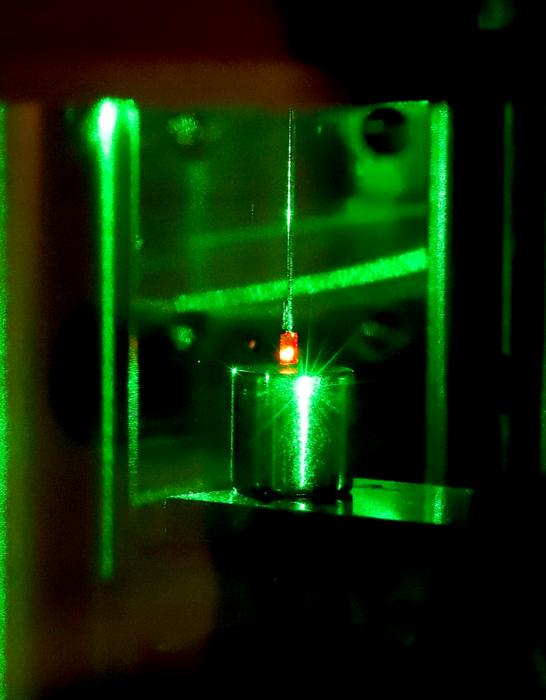
Researchers at OIST have for the first time used electron spin alone to move a levitating centimeter-scale diamond, a quantum effect acting on an object massive enough to feel gravity. Nitrogen-vacancy centers in the diamond generate spin forces detected by a picometer-precision interferometer. The platform opens routes to testing quantum gravity and building ultrasensitive sensors for dark matter and gravitational waves.