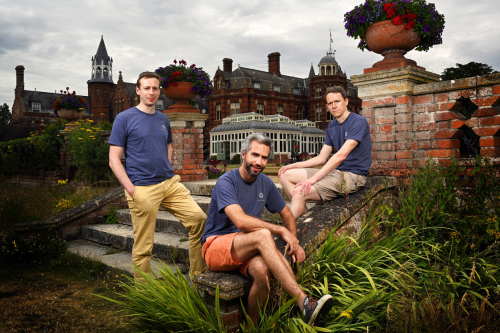
A pioneering quantum computing company co-founded by academics from University College London (UCL) and the University of Bristol has landed more than £13m in funding to develop its revolutionary technology.
Phasecraft has developed algorithms for quantum computers which have been shown to deliver significantly better efficiency compared to others in existence.
The company wants to apply its algorithms to the discovery of new materials important for transitioning to clean energy, and says quantum computing could significantly accelerate this process compared to classical computing and experimental discovery.
Quantum computers are on the cusp of becoming a practical reality and could ultimately solve challenging computational problems we face today, such as investigating unique quantum materials, helping to develop better batteries and more efficient solar panels, simulating chemical reactions and helping to discover new catalysts and optimise key industrial processes.
Phasecraft latest round of funding was led by Silicon Valley deeptech VC, Playground Global, and brings the total amount of venture funding the company has raised to date up to £17.25m, as well a further £3.75m from the likes of Innovate UK and the European Research Council.
Ashley Montanaro, co-founder and CEO of Phasecraft, as well as a Professor of Quantum Computation at the University of Bristol, said: “For all the advances that have been made in quantum hardware, and for all quantum computing’s promise, such progress could end up being for nothing if we can’t build the applications needed to make the technology truly useful. With our record-breaking algorithms and groundbreaking techniques, we are pushing the boundaries of what is possible in this space. With support from such a renowned deep-tech visionary as Playground, we think practical quantum advantage is achievable in years, not decades.”
Phasecraft will use the latest funding to continue building its team of leading quantum scientists, researchers and engineers, and to develop its breakthrough algorithms to provide real-world applications as quantum computing evolves to outperform classical computers.
The company is already working with three of the most advanced superconducting quantum hardware providers in the world, Google, IBM and Rigetti.
Other organisations that have invested in Phasecraft include AlbionVC, Episode1, Parkwalk Advisors, LCIF, and UCL Technology Fund.

Researchers from Rutgers, IBM and collaborators demonstrated real-time quantum feedback control on a 156-qubit Heron processor, using up to 100 connected qubits. By alternately scrambling information and resetting qubits nearly 5,000 times each, they steered the system from chaos to an ordered state, revealing a sharp phase transition.

Oxford physicists used a hybrid quantum computer, pairing trapped-ion qubits with quantum oscillators, to simulate the Aharonov-Bohm effect inside a lattice gauge theory. Encoding magnetic flux in entangled qubits made the gauge field dynamical, and the resulting destructive interference froze matter tunneling entirely.
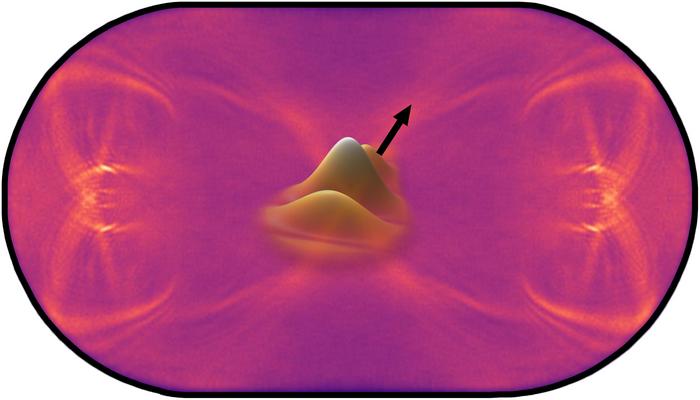
A quantum "wave packet" (in the middle) launched from the same kind of starting point behaves differently. Even after bouncing around for a very long time, faint filament-like patterns (bright glow) are still visible, a tattoo tracing back to its early history. This lingering imprint is the "quantum birthmark" described in the study. Credit: Joonas Keski-Rahkonen, Tampere University Even the most chaotic quantum systems keep a permanent mark of their own past – a "quantum birthmark" – that...






