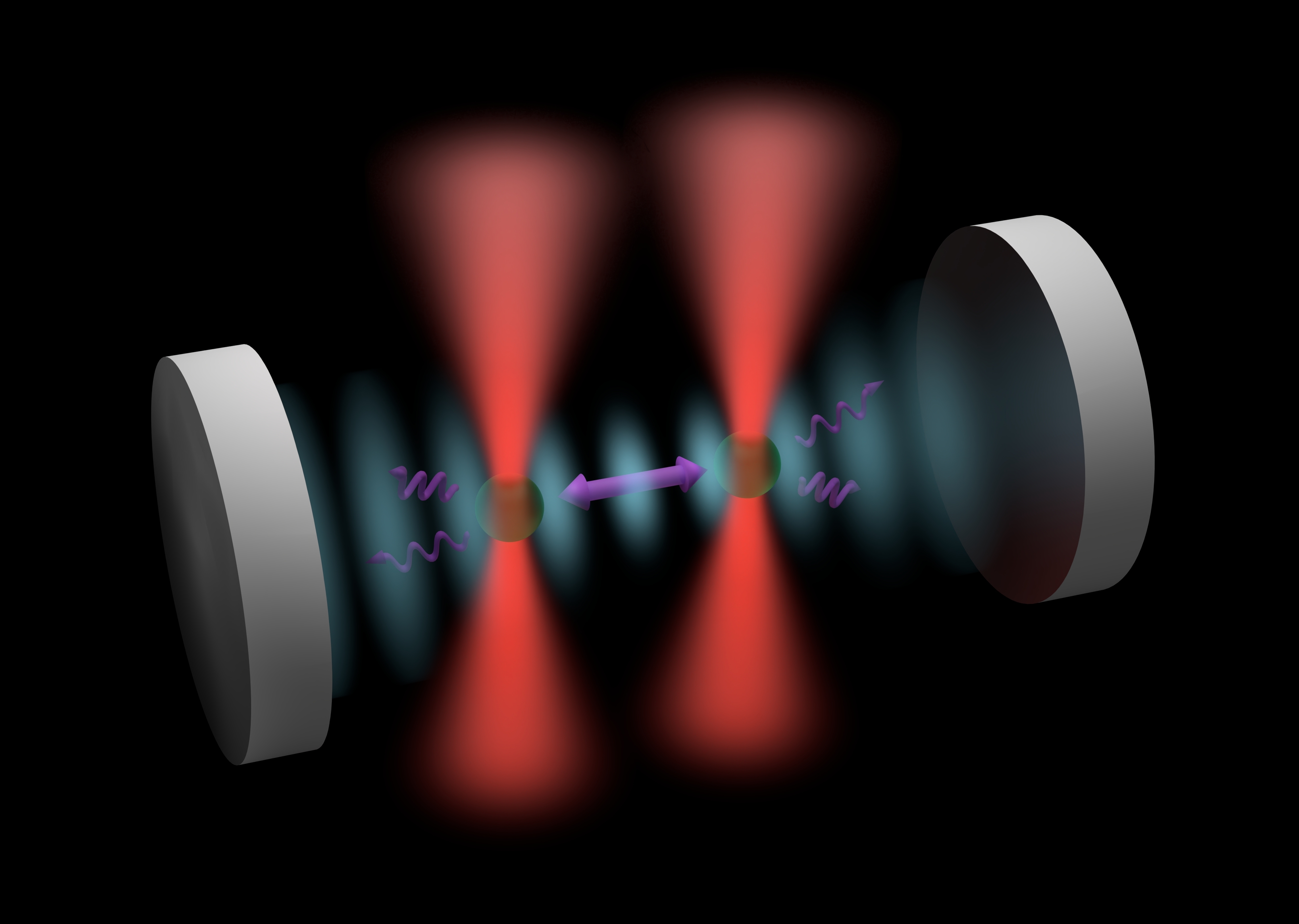
The question of where the boundary between classical and quantum physics lies is one of the longest-standing pursuits of modern scientific research and in new research published today, scientists demonstrate a novel platform that could help us find an answer.
The laws of quantum physics govern the behaviour of particles at miniscule scales, leading to phenomena such as quantum entanglement, where the properties of entangled particles become inextricably linked in ways that cannot be explained by classical physics.
Research in quantum physics helps us to fill gaps in our knowledge of physics and can give us a more complete picture of reality, but the tiny scales at which quantum systems operate can make them difficult to observe and study.
Over the past century, physicists have successfully observed quantum phenomena in increasingly larger objects, all the way from subatomic particles like electrons to molecules which contain thousands of atoms.
More recently, the field of levitated optomechanics, which deals with the control of high-mass micron-scale objects in vacuum, aims to push the envelope further by testing the validity of quantum phenomena in objects that are several orders of magnitude heavier than atoms and molecules. However, as the mass and size of an object increase, the interactions which result in delicate quantum features, such as entanglement, get lost to the environment, resulting in the classical behaviour we observe.
But now, the team co-led by Dr Jayadev Vijayan, Head of the Quantum Engineering Lab at The University of Manchester, with scientists from ETH Zurich, and theorists from the University of Innsbruck, have established a new approach to overcome this problem in an experiment carried out at ETH Zurich, published in the journal Nature Physics.
The scientists placed the particles between two highly reflective mirrors which form an optical cavity. This way, the photons scattered by each particle bounce between the mirrors several thousand times before leaving the cavity, leading to a significantly higher chance of interacting with the other particle.
Johannes Piotrowski, co-lead of the paper from ETH Zurich added: “Remarkably, because the optical interactions are mediated by the cavity, its strength does not decay with distance meaning we could couple micron-scale particles over several millimetres.”
The researchers also demonstrate the remarkable ability to finely adjust or control the interaction strength by varying the laser frequencies and position of the particles within the cavity.
The findings represent a significant leap towards understanding fundamental physics, but also hold promise for practical applications, particularly in sensor technology that could be used towards environmental monitoring and offline navigation.
Dr Carlos Gonzalez-Ballestero, a collaborator from the Technical University of Vienna said: “The key strength of levitated mechanical sensors is their high mass relative to other quantum systems using sensing. The high mass makes them well-suited for detecting gravitational forces and accelerations, resulting in better sensitivity. As such, quantum sensors can be used in many different applications in various fields, such as monitoring polar ice for climate research and measuring accelerations for navigation purposes.”
Piotrowski added: “It is exciting to work on this relatively new platform and test how far we can push it into the quantum regime.”
Now, the team of researchers will combine the new capabilities with well-established quantum cooling techniques in a stride towards validating quantum entanglement. If successful, achieving entanglement of levitated nano- and micro-particles could narrow the gap between the quantum world and everyday classical mechanics.
At the Photon Science Institute and the Department of Electrical and Electronic Engineering at The University of Manchester, Dr Jayadev Vijayan’s team will continue working in levitated optomechanics, harnessing interactions between multiple nanoparticles for applications in quantum sensing.
Reference
Cavity-mediated long-range interactions in levitated optomechanics
Jayadev Vijayan, Johannes Piotrowski, Carlos Gonzalez-Ballestero, Kevin Weber, Oriol Romero-Isart & Lukas Novotny
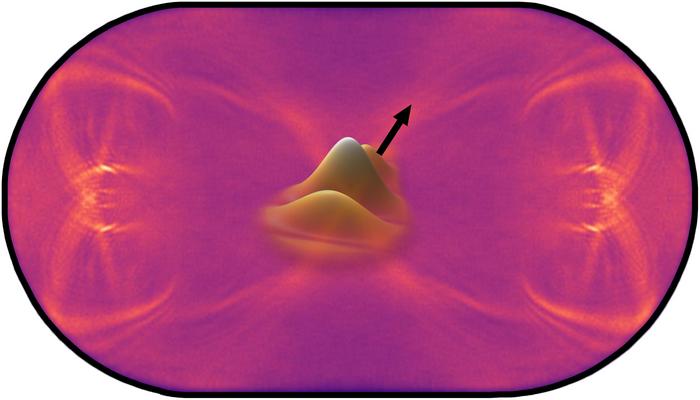
A quantum "wave packet" (in the middle) launched from the same kind of starting point behaves differently. Even after bouncing around for a very long time, faint filament-like patterns (bright glow) are still visible, a tattoo tracing back to its early history. This lingering imprint is the "quantum birthmark" described in the study. Credit: Joonas Keski-Rahkonen, Tampere University Even the most chaotic quantum systems keep a permanent mark of their own past – a "quantum birthmark" – that...
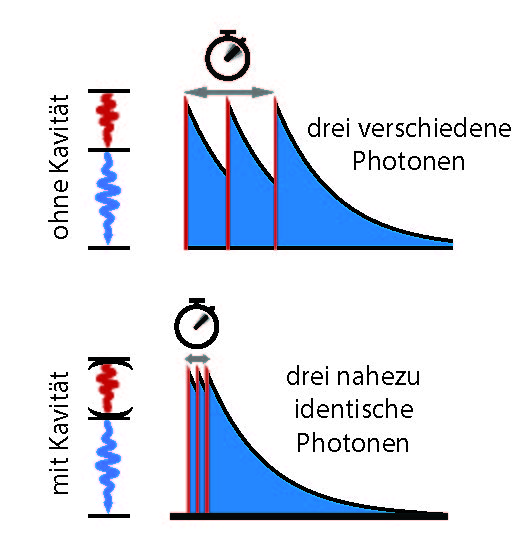
Illustration (University of Basel, Timon Baltisberger): Biexziton decay can generate photons of very high quality if the system is specifically controlled using an optical cavity. Under these conditions, 90 per cent of the photons are indistinguishable. Working in close collaboration, researchers from Paderborn University, the University of Basel and Ruhr University Bochum have made a significant breakthrough in the field of quantum communication. In their recently published paper in the...
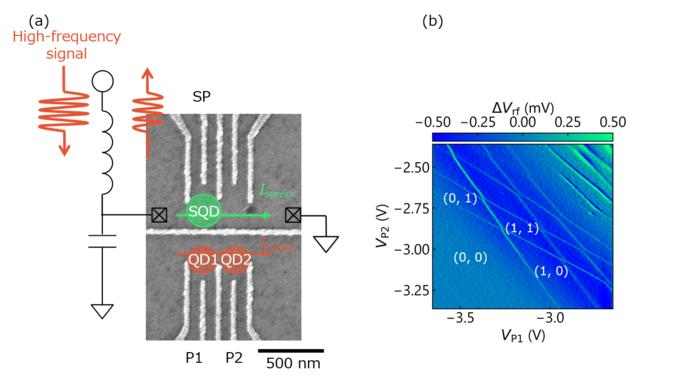
(a) The structure of the gate electrodes on the ZnO device used in the experiment in this paper. (b) The charge stability diagram indicating the formation of ZnO double quantum dot in few-electron regime. Researchers at Tohoku University, in collaboration with the National Institute for Materials Science (NIMS) and the University of Tokyo, have taken an important step toward semiconductor quantum computing using zinc oxide (ZnO). The team successfully demonstrated charge sensing,...