University of Illinois (U of I)
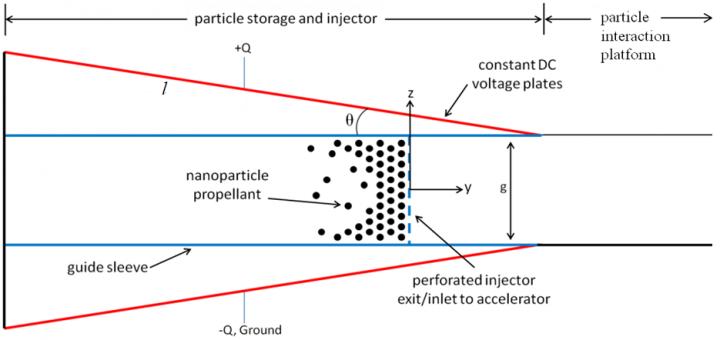
In a new study, researchers at the University of Illinois and the Missouri University of Science and Technology modeled a method to manipulate nanoparticles as an alternative mode of propulsion for tiny spacecraft that require very small levels of thrust.
The team simulated a system that uses light to generate an electromagnetic field. Neutral nanoparticles made from glass or some other material that insulates rather than conducts electric charges are used. The nanoparticles become polarized. All of the positive charges are displaced in the direction of the field and negative charges shift in the opposite direction. It creates an internal electric field that produces a force to move the particles from a reservoir, funneled through an injector, then shot out of an accelerator to produce thrust.
The study, that has been about eight years in the making, analytically showed that the technique can work, and suggested parameters for success.
"The challenge is in selecting the right permittivity of the medium, the right amount of charge, in which all of this happens," said Joshua Rovey, associate professor in the Department of Aerospace Engineering in The Grainger College of Engineering at the U of I. "You have to choose the right materials for the nanoparticles themselves as well as the material surrounding the nanoparticles as they move through the structure."
The technique is based on a field of physics called plasmonics that studies how optical light or optical electromagnetic waves, interact with nanoscale structures, such as a bar or prism.
Rovey explained when the light hits the nanoscale structure, a resonant interaction occurs. It creates strong electromagnetic fields right next to that structure. And those electromagnetic fields can manipulate particles by applying forces to nanoscale particles that are near those structures. The study focused on how to feed the nanoparticles into the accelerator structure, or injector and how the angles of the plates in the injector affect the forces on these nanoparticles.
"One of the main motivating factors for the concept was the absence of or lack of a power supply in space," Rovey said. "If we can just harness the sun directly, have the sun shine directly on the nanostructures themselves, there's no need for an electrical power supply or solar panel to provide power."
Rovey said this study was a numerical simulation. The next step will be to create nanoscale structures in a lab, load then into the system, apply a light source, and observe how the nanoparticles move.
Nanoparticle injector for photonic manipulators using dielectrophoresis
Jaykob Maser and Joshua Rovey
AIP Advances Volume 9, Issue 6 (2019)
DOI: 10.1063/1.5099520
Contact information:
Joshua Rovey
Associate professor of aerospace engineering at the U of I
rovey@illinois.edu
Phone: (217) 300-7092
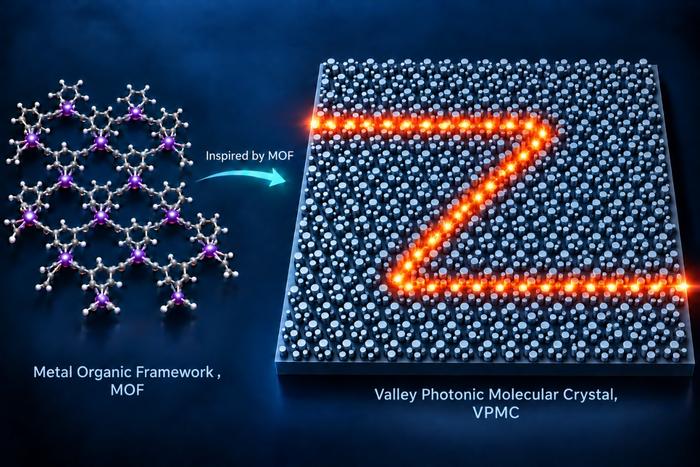
Inspired by Metal-Organic Framework based topological insulators, researchers at Tsinghua University proposed valley photonic molecular crystal (VPMC) and investigated the impact of molecular rotation on the valley-topological properties of VPMC. Credit: Tsinghua University/Xue Feng A research team led by Yidong Huang at Tsinghua University, including Xue Feng and Yongzhuo Li, has developed valley photonic molecular crystals (VPMCs) on a silicon platform. Combining theoretical modeling,...
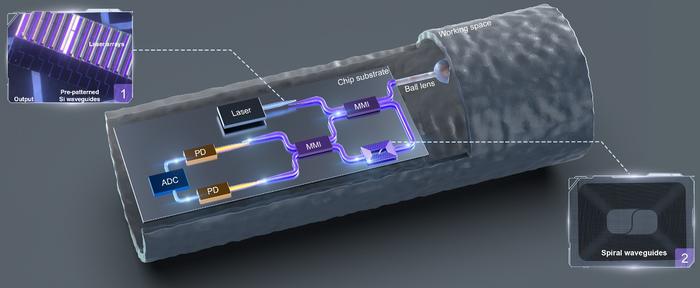
The system integrates a III-V semiconductor light source, SiN-based interferometers, Si-Ge photodetectors (PDs), and an integrated ball-lens microprobe, thereby combining the distinct advantages of multiple photonic integration platforms. The insets illustrate complementary technologies that can be incorporated to realize a miniaturized, fully integrated OCT system. Abbreviations: ADC, analog-to-digital converter. Inset 1: Foundry-scalable embedded III-V lasers on silicon-on-insulator (SOI)...

From left to right: Three photons with different quantum states enter an interferometer with three beam splitters. At each beam splitter, they can take different paths at the same time in superposition. The researchers then measured how often the three photons ended up together at the same output. Counterintuitively, it is possible to make the photons more similar to each other and at the same make them less likely to “bunch” together. AI-generated illustration, by Leonardo Novo. We usually...
