When you think of a robot, images of R2-D2 or C-3PO might come to mind. But robots can serve up more than just entertainment on the big screen. In a lab, for example, robotic systems can improve safety and efficiency by performing repetitive tasks and handling harsh chemicals.
But before a robot can get to work, it needs energy – typically from electricity or a battery. Yet even the most sophisticated robot can run out of juice. For many years, scientists have wanted to make a robot that can work autonomously and continuously, without electrical input.
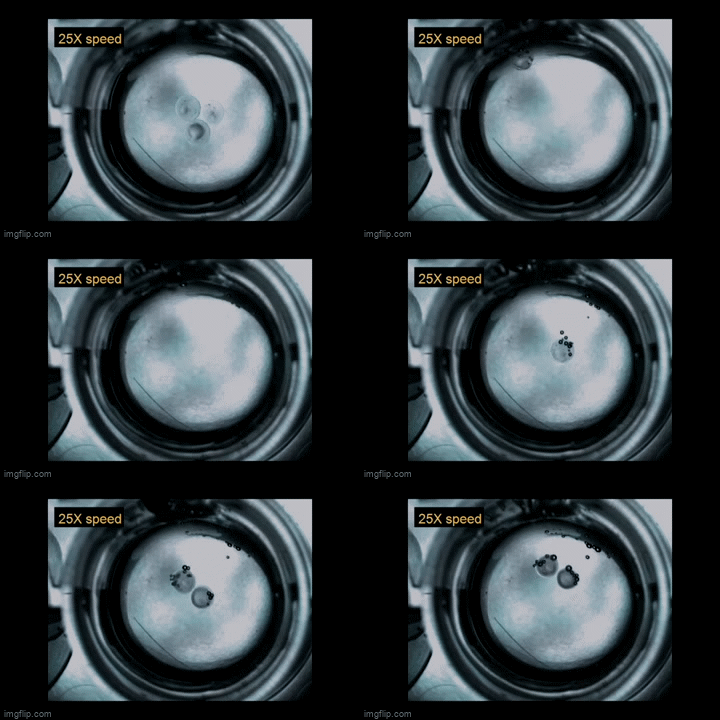
Now, as reported last week in the journal Nature Chemistry, scientists at the Department of Energy’s Lawrence Berkeley National Laboratory (Berkeley Lab) and the University of Massachusetts Amherst have demonstrated just that – through “water-walking” liquid robots that, like tiny submarines, dive below water to retrieve precious chemicals, and then surface to deliver chemicals “ashore” again and again.
The technology is the first self-powered, aqueous robot that runs continuously without electricity. It has potential as an automated chemical synthesis or drug delivery system for pharmaceuticals.
“We have broken a barrier in designing a liquid robotic system that can operate autonomously by using chemistry to control an object’s buoyancy,” said senior author Tom Russell, a visiting faculty scientist and professor of polymer science and engineering from the University of Massachusetts Amherst who leads the Adaptive Interfacial Assemblies Towards Structuring Liquids program in Berkeley Lab’s Materials Sciences Division.
Russell said that the technology significantly advances a family of robotic devices called “liquibots.” In previous studies, other researchers demonstrated liquibots that autonomously perform a task, but just once; and some liquibots can perform a task continuously, but need electricity to keep on running. In contrast, “we don’t have to provide electrical energy because our liquibots get their power or ‘food’ chemically from the surrounding media,” Russell explained.
Through a series of experiments in Berkeley Lab’s Materials Sciences Division, Russell and first author Ganhua Xie, a former postdoctoral researcher at Berkeley Lab who is now a professor at Hunan University in China, learned that “feeding” the liquibots salt makes the liquibots heavier or denser than the liquid solution surrounding them.
Additional experiments by co-investigators Paul Ashby and Brett Helms at Berkeley Lab’s Molecular Foundry revealed how the liquibots transport chemicals back and forth.
Because they are denser than the solution, the liquibots – which look like little open sacks, and are just 2 millimeters in diameter – cluster in the middle of the solution where they fill up with select chemicals. This triggers a reaction that generates oxygen bubbles, which like little balloons lift the liquibot up to the surface.
Another reaction pulls the liquibots to the rim of a container, where they “land” and offload their cargo.
The liquibots go back and forth, like the pendulum of a clock, and can run continuously as long as there is “food” in the system.
Depending on their formulation, an array of liquibots could carry out different tasks simultaneously. For example, some liquibots could detect different types of gas in the environment, while others react to specific types of chemicals. The technology may also enable autonomous, continuous robotic systems that screen small chemical samples for clinical applications, or drug discovery and drug synthesis applications.
Russell and Xie next plan to investigate how to scale up the technology for larger systems, and explore how it would work on solid surfaces.
The Molecular Foundry is a nanoscience user facility at Berkeley Lab.
This work was supported by the DOE Office of Science. Additional support was provided by the U.S. Army Research Office.
Reference
Continuous, autonomous subsurface cargo shuttling by nature-inspired meniscus-climbing systems
Ganhua Xie, Pei Li, Paul Y. Kim, Pei-Yang Gu, Brett A. Helms, Paul D. Ashby, Lei Jiang & Thomas P. Russell
Nature Chemistry (2021) https://www.nature.com/articles/s41557-021-00837-5
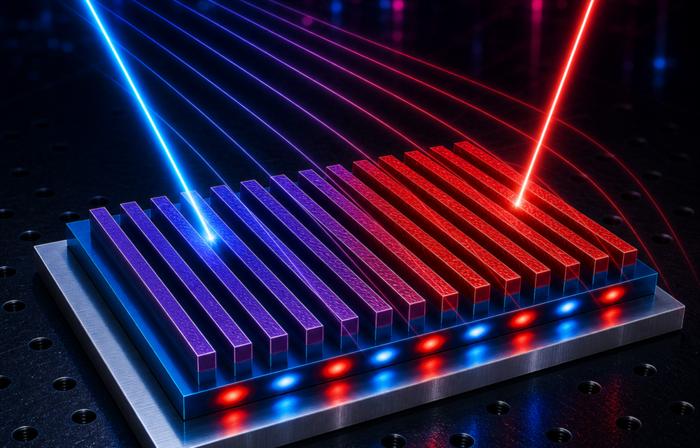
certain wavelength and direction will also emit heat in the same ways. This fundamental relationship, known as reciprocity, limits our ability to independently control heat absorption and heat emission. But if absorption and emission could be separated, engineers could design devices that absorb heat from one direction while emitting it in another. By ‘steering’ thermal energy, they could create more efficient thermal management, energy conversion, infrared sensing, and thermal communicati...
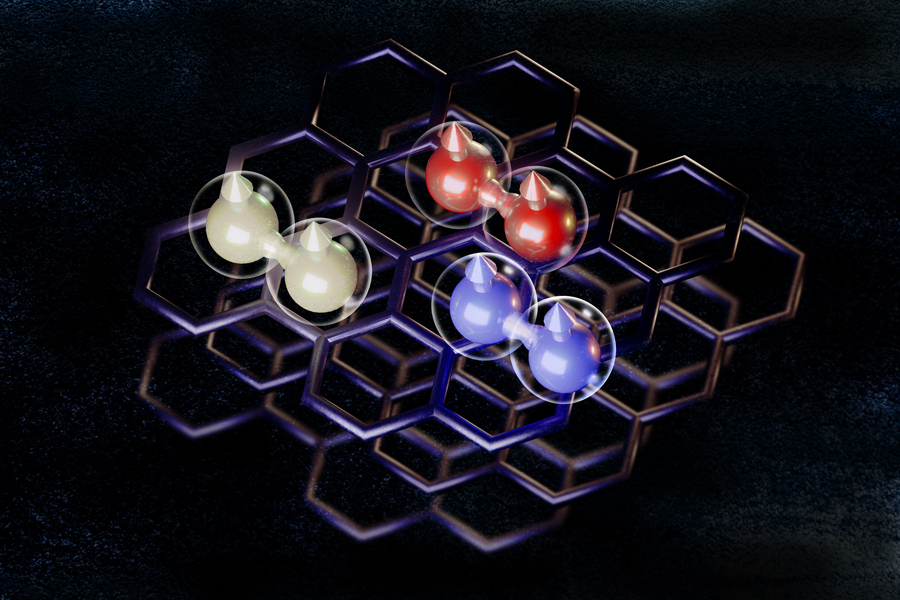
MIT researchers have found that rhombohedral graphene — a naturally occurring staircase-like stack of four or five atomically thin carbon layers found in ordinary graphite — can host multiple distinct superconducting states simultaneously, a rarity among known superconductors. Publishing in Nature, the team reports that three of these states not only survive exposure to magnetic fields up to around 9 tesla (roughly 180,000 times Earth's magnetic field), which would normally destroy supercondu...
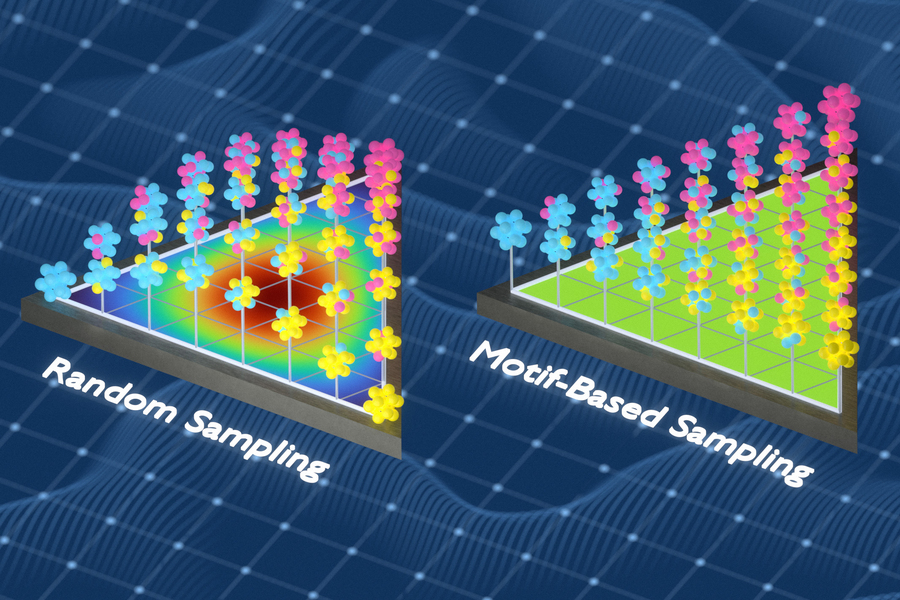
MIT researchers have developed a new approach that dramatically improves the modeling of chemically disordered metal alloys, a long-standing challenge in materials science. Traditional simulation techniques struggle with the complex atomic arrangements in real-world alloys. The team addressed this by creating smarter training datasets for machine-learning models that better capture the diverse local chemical environments in disordered materials. Using information theory to generate more repre...






