Recent advances in solar cell technology use polycrystalline perovskite films as the active layer, with an increase to efficiency of as much as 24.2%. Hybrid organic-inorganic perovskites are especially successful, and they have been used in optoelectronic devices including solar cells, photodetectors, light-emitting diodes and lasers.
But the surface of hybrid perovskites is prone to surface defects, or surface traps, where charge carriers are trapped in the semiconducting material. To solve this problem and reduce the number of traps, the crystal surface must be passivated.
Before use, perovskites can be treated with chemical solutions, vapors and atmospheric gases to remove defects that make the material less effective. Benzylamine is one particularly successful molecule for this purpose. A detailed understanding of the physical and chemical mechanisms by which these treatments work is key to increasing the collection of charge carriers in solar cells.
In their article in this week's Applied Physics Reviews, from AIP Publishing, the authors describe their work testing hybrid organic-inorganic perovskite crystals treated with benzylamine to investigate the mechanisms by which the surface of the crystal is passivated, and traps states are reduced.
"This molecule has been used in polycrystalline fields in solar cells, and people have demonstrated that the solar cells were improved," author Maria A. Loi said. "We wanted to study, in a clean system, why the solar cells were improving and understand why adding this molecule makes the devices better."
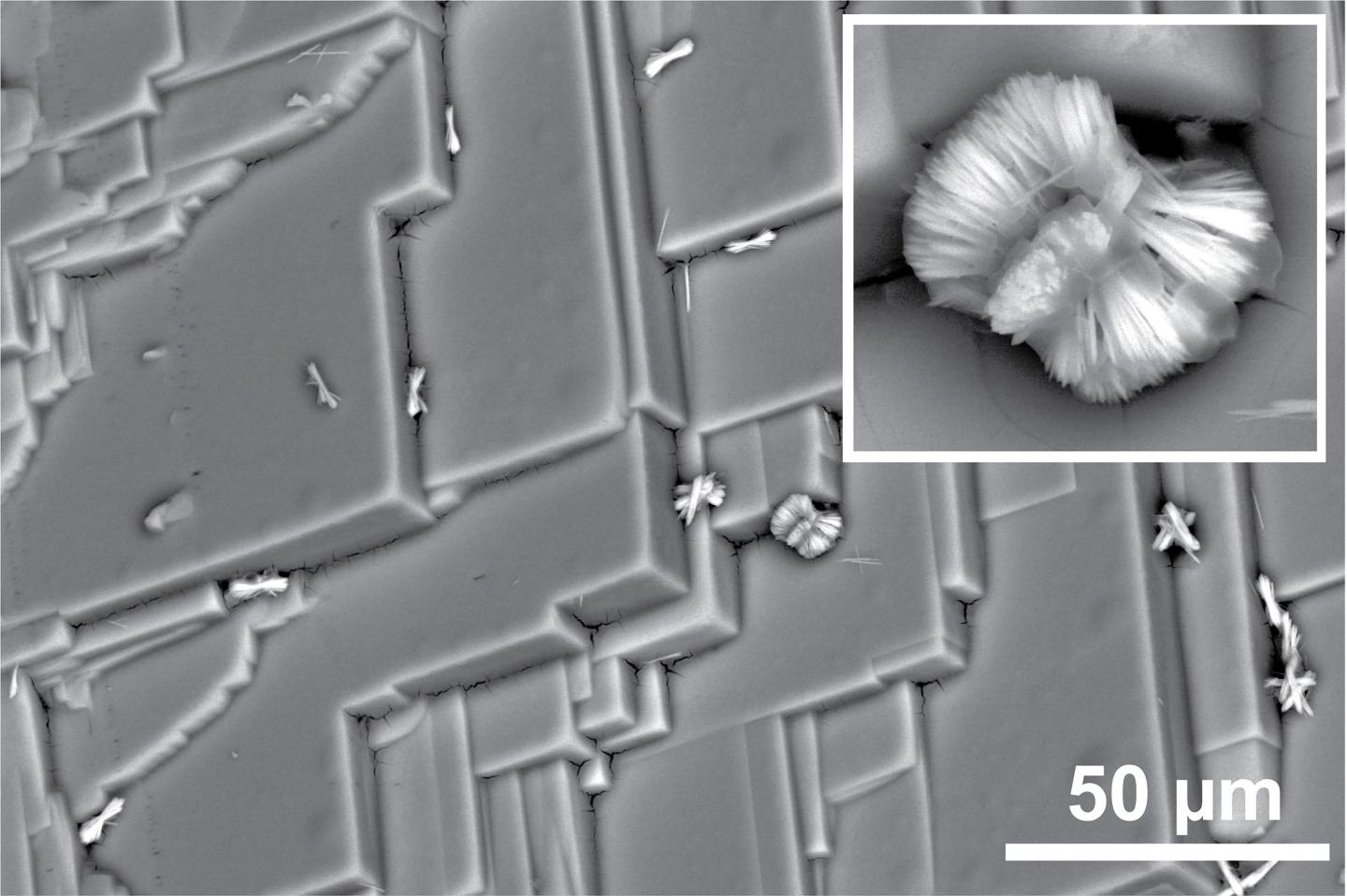
The experiments revealed benzylamine enters into the surface of the crystal to create a new, two-dimensional material -- 2D perovskite -- on the surface of the three-dimensional crystal. Where the 2D version forms and later breaks away from the surface, a terraced etching pattern occurs.
"The main purpose was to passivate the surface to reduce defect states," Loi said. "To our surprise, we found out the surface was modified, which was not an expected mechanism. People report that this molecule can improve the quality of devices, but nobody has reported that, in reality, it was creating a two-dimensional layer and could also restructure the material."
The authors also discovered the combination of benzylamine and atmospheric gases is most effective for passivation. That could mean, Loi said, that more than one type of trap state exists. Further investigation of multiple types of trap states could enable precise tuning of the mechanisms involved in preparing crystals for efficient optoelectronic devices.
Mechanism of surface passivation of methylammonium lead tribromide single crystals by benzylamine
Herman Duim, Hong-Hua Fang, Sampson Adjokatse, Gert H. ten Brink, Miguel A. L. Marques, Bart J. Kooi, Graeme R. Blake, Silvana Botti and Maria A. Loi
Applied Physics Reviews July 30, 2019
DOI: 10.1063/1.5088342
Contact information:
Maria Antonietta Loi
Professor of Photophysics and Optoelectronics at University of Groningen
M.A.Loi@rug.nl
Tel: +31 50 36 34119
Photophysics and OptoElectronics Group (P&O-E)
University of Groningen via AIP Publishing
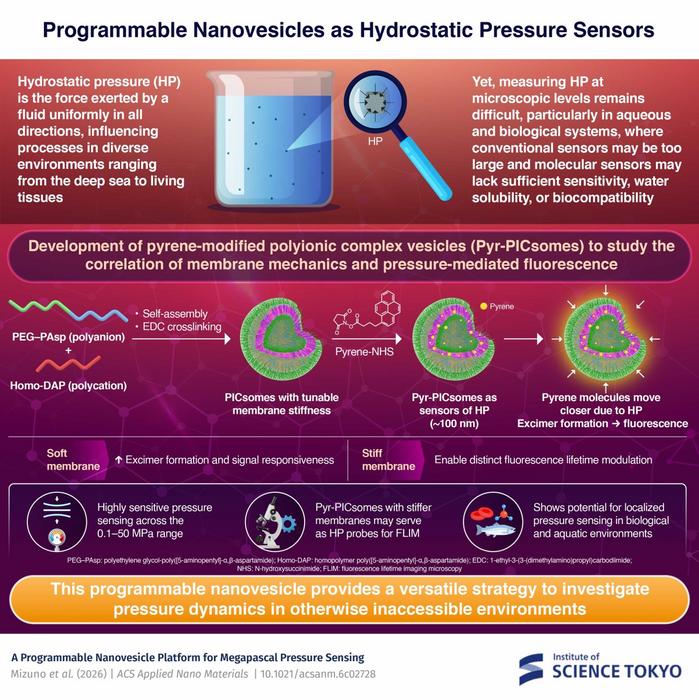
Pyrene-modified polyionic complex vesicles, or Pyr-PICsomes, convert hydrostatic pressure into measurable fluorescence. Crosslinking density tunes membrane stiffness, which governs sensing behavior: soft vesicles give strong excimer-to-monomer ratio changes from 0.1 to 50 MPa, while stiff membranes respond through fluorescence lifetime, suiting lifetime imaging.
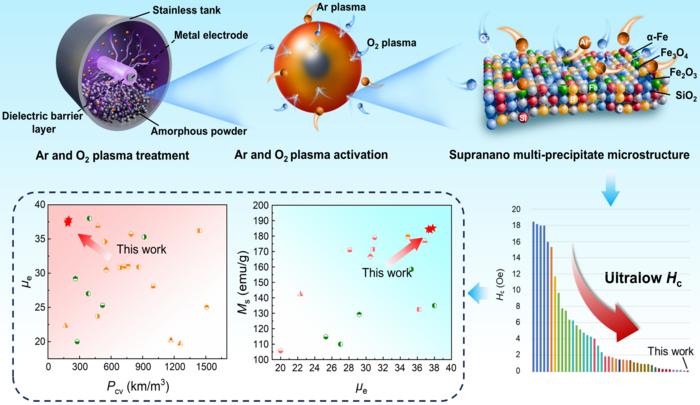
Ar/O₂ plasma treatment generates supranano α-Fe, Fe₃O₄, SiO₂ and Fe₂O₃ precipitates just 0.8–2.5 nm across amorphous powder surfaces, creating nucleation sites that ease magnetic-moment reversal. The resulting soft magnetic composite combines 0.13 Oe coercivity, 37.3 permeability, 185 emu g⁻¹ saturation magnetization and 191.18 kW m⁻³ core loss at 1 MHz and 20 mT. The surface route avoids bulk composition changes, aiding scale-up for high-frequency inductors and power chokes.
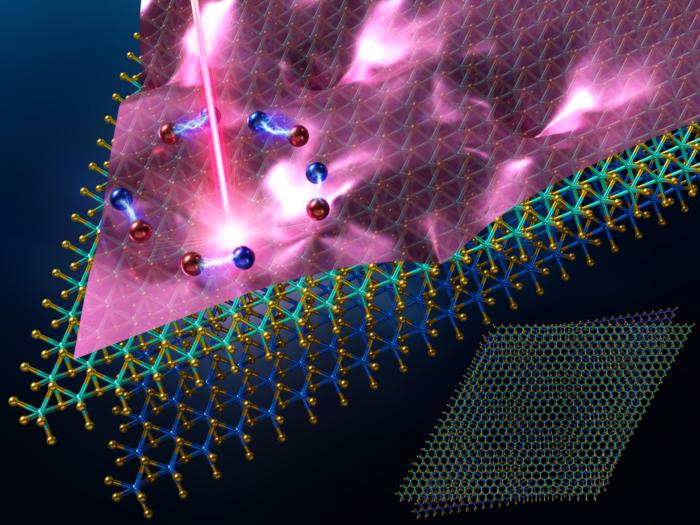
Researchers at MANA have introduced a theoretical framework that extracts hidden disorder from complex photoluminescence spectra in twisted MoSe2/WSe2 moiré heterostructures, bypassing unreliable peak-by-peak analysis. By tracking how simple descriptors like peak and average energy vary spatially, the work reveals a hierarchy of disorder, from micrometer-scale background variations to localized exciton-trapping defects.






