California Institute of Technology

Physicists use advanced quantum technologies to test decades-old theory predictions
When different materials transition from one phase to another, such as water coming to a boil or a magnet losing its ability to attract metals, something remarkable can happen: They begin to behave identically, following the same mathematical rules. "Physicists call this trait universality—the messy, microscopic details wash out and only a few essential features survive," explains Jason Alicea, William K. Davis Professor of Theoretical Physics. The math underlying these universal traits is commonly described by a theoretical framework called conformal field theory.
Reporting in the journal Nature, a collaboration between the experimental group of Caltech's Manuel Endres, professor of physics, and Alicea's theory group, together with theorists at Université Paris-Saclay and the Technical University of Munich, performed first-of-their-kind experiments on two different conformal field theories using quantum simulators, which are simplified versions of quantum computers tailored for specific tasks.
Using new technology developed for these quantum simulators, the team reports the first direct measurement of energy levels in synthetic quantum matter as predicted by the Ising and tricritical Ising conformal field theories. (Ising refers to Ernst Ising, a physicist who, in the 1920s, solved an early model of magnetism.) Both theories describe universal behavior that emerges when a quantum system—exhibiting exotic traits such as entanglement and superposition—is placed at a tipping point between two states, one of which is more ordered than the other.
Unlike transitions familiar from everyday life such as water turning into steam, this one is driven not by temperature but by quantum effects alone that happen to take place at temperatures near absolute zero. Once at that tipping point, the system can be excited by lasers to reach a series of specific energies, like the rungs of a ladder. "The energy levels predicted by these theories are important because they encode profound information about the theories themselves," Alicea says.
For four decades, researchers used conformal field theories to calculate the spacings between those rungs, which come in precise ratios, but nobody had measured them in an experiment until now.
"Our new tools borrow from quantum computing platforms," says Xiangkai Sun, a co-lead author of the new study and a graduate student working in the Endres lab. "Over the past 10 years, people have been learning to control these systems, and now we are at the point where we can use them to do fundamental physics research."
The quantum system in the study is based on platforms the Endres lab uses to build quantum computers: arrays of neutral atoms trapped by lasers called optical tweezers. A related neutral-atom platform in the lab recently set a milestone by trapping 6,100 atoms in a single array. Though the tweezer technology behind these arrays was developed largely with quantum computing in mind, in the new study, the team turned it toward a question in fundamental physics.
For the experiment, the researchers used optical tweezers to trap strontium atoms in a line. They used other lasers to excite the atoms into high-energy states called Rydberg states, which makes neighboring atoms interact strongly. The chain of atoms then behaved as a single entity rather than as independent particles. Next, the researchers tuned the lasers in a way that placed the chain at the tipping point.
To read out the energy ladder, the team applied a new tool developed for these studies, called many-body modulation spectroscopy. In this approach, the researchers gently shook the entire chain by modulating the lasers at a chosen frequency, then measured how strongly the atoms responded. By sweeping through frequencies and noting where the response spiked, the team was able to map out the rungs of the ladder. The method is similar to running a wet finger around the rim of a wine glass: At the right speed the glass resonates with sound, and at the wrong speed nothing happens.
"We repeated the experiment on chains of up to 35 atoms, and the rungs came out as predicted by the Ising conformal field theory: the spectra collapsed onto a single universal curve once rescaled for size," Sun says. "We then tuned to the tricritical point and measured the lowest levels of its distinct spectrum, which came out in the different ratios theory predicts."
Because every atom in the array can be addressed individually, the team could also do things that are far harder using traditional materials. They sorted the excitations according to their symmetry, revealing a second family of rungs hidden from the first measurement. And by adjusting the atoms at the two ends of the chain, they changed how the ladder was arranged—each setting produced a different pattern that the tricritical Ising theory predicts.
"Even though we believed these theories to be true, it's important to have an experimental realization, something you can poke and prod," Alicea says. "To see those predictions borne out is a beautiful thing."
In the future, the team plans to use an even larger quantum system to study conformal field theories using not just atoms in a line but atoms in a grid. "In two dimensions, the conformal field theories are not as well understood, so this is an exciting opportunity," Sun says.
"What excites me is that the technique doesn't require knowing the answer in advance. Here we could check our measurements against exact predictions," Endres says. "The next step is to point this at systems where nobody knows the response of the system quantitatively—including regimes that classical computers can't reach."
Reference
Observation of conformal field theory spectra in a quantum simulator
Xiangkai Sun, Yuan Le, Stephen Naus, Richard Bing-Shiun Tsai, Lewis R. B. Picard, Sara Murciano, Michael Knap, Jason Alicea, and Manuel Endres
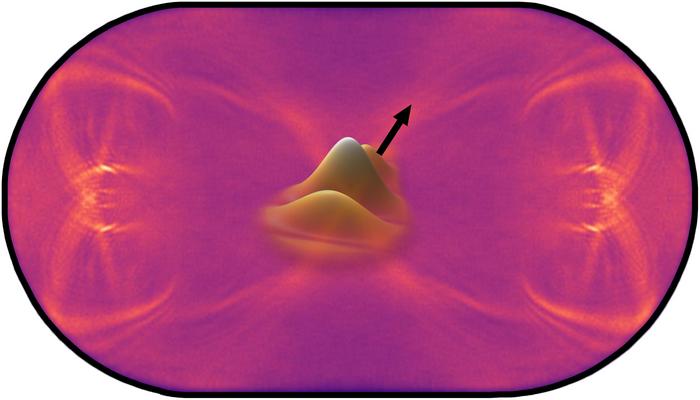
A quantum "wave packet" (in the middle) launched from the same kind of starting point behaves differently. Even after bouncing around for a very long time, faint filament-like patterns (bright glow) are still visible, a tattoo tracing back to its early history. This lingering imprint is the "quantum birthmark" described in the study. Credit: Joonas Keski-Rahkonen, Tampere University Even the most chaotic quantum systems keep a permanent mark of their own past – a "quantum birthmark" – that...
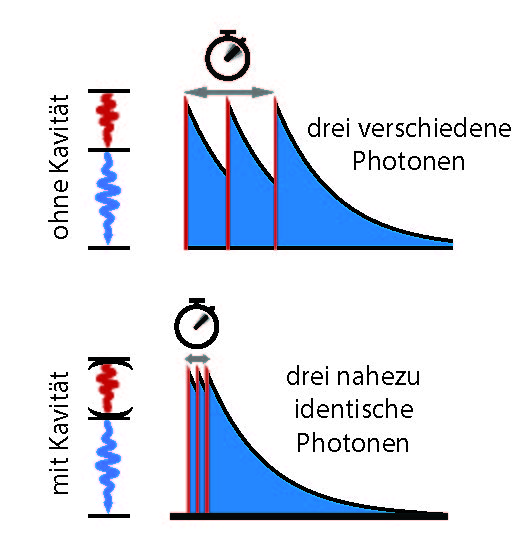
Illustration (University of Basel, Timon Baltisberger): Biexziton decay can generate photons of very high quality if the system is specifically controlled using an optical cavity. Under these conditions, 90 per cent of the photons are indistinguishable. Working in close collaboration, researchers from Paderborn University, the University of Basel and Ruhr University Bochum have made a significant breakthrough in the field of quantum communication. In their recently published paper in the...
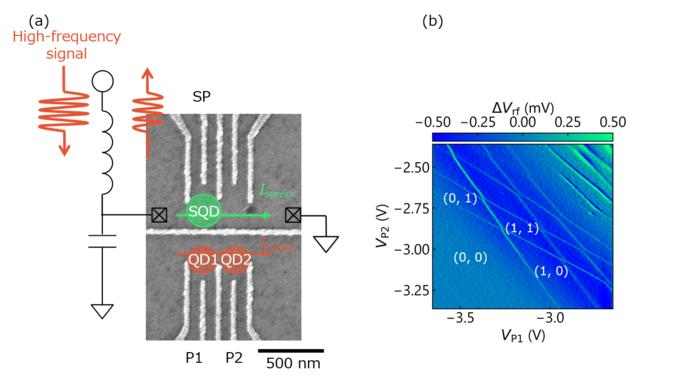
(a) The structure of the gate electrodes on the ZnO device used in the experiment in this paper. (b) The charge stability diagram indicating the formation of ZnO double quantum dot in few-electron regime. Researchers at Tohoku University, in collaboration with the National Institute for Materials Science (NIMS) and the University of Tokyo, have taken an important step toward semiconductor quantum computing using zinc oxide (ZnO). The team successfully demonstrated charge sensing,...