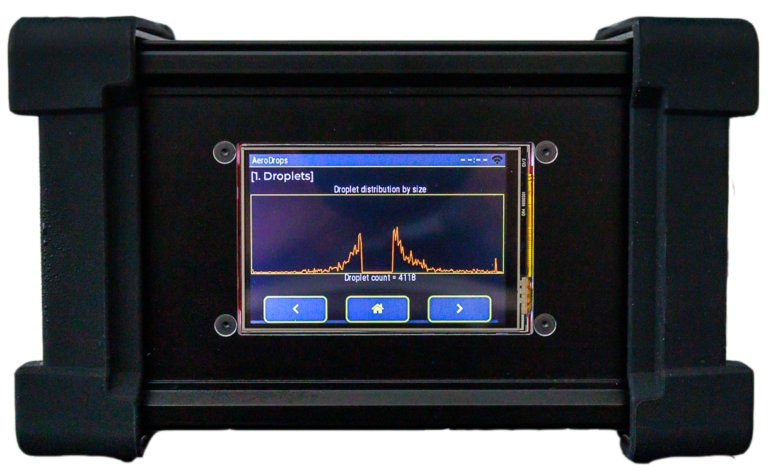
By AeroDrops
AeroDrops is the first device capable of selectively detecting respiratory droplets in ambient air. Unlike conventional air-quality sensors, it distinguishes respiratory droplets from solid airborne particles, ensuring accurate and reliable measurements unaffected by other air pollutants. By enabling real-time, data-driven ventilation control, AeroDrops supports energy-efficient operation while signaling the need for timely infection-prevention measures in hospitals, schools, gyms, and other public spaces. Technology: The core principle of RD detection is based on a change in sensor capacitance that occurs when an aerosol particle enters the sensor’s electric field. Air is drawn into the device at a flow rate of 1 L/min through a narrow nozzle with a diameter of 0.4 mm, accelerating the aerosols to approximately 130 m/s and directing them toward the sensor. When a particle, either solid or liquid, enters the electric field, it displaces an equivalent volume of air. Because the particle’s dielectric constant differs from that of air, the sensor’s capacitance changes accordingly. This change in capacitance (∆C) is converted by a charge-sensitive amplifier into a corresponding voltage pulse (∆V). Detection is selective for droplets because their high dielectric constant produces a strong and resolvable signal. The primary component of RDs is water, which has a dielectric constant of approximately 78.2. In contrast, typical indoor solid pollutants, such as carbon-based combustion particles, have dielectric constants below 15. The substantial dielectric contrast between a droplet and air generates a detectable capacitance shift. Conversely, particles or substances with dielectric constants similar to that of air produce capacitance changes that are indistinguishable from electronic noise and therefore are not resolved as discrete signals. More detailed information is available in the original study: https://doi.org/10.1021/acssensors.5c02057
