By BE Semiconductor Industries N.V.
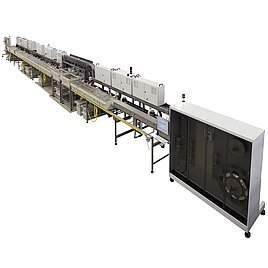
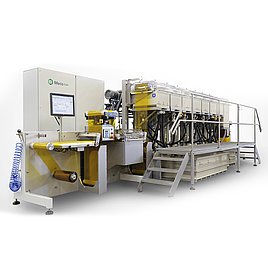
To electroplate the absorber (precursor) layers of a flexible CIS or CIGS thin film solar cell, Meco offers Reel-to-Reel (R2R) plating equipment. Based on our reel-to-reel continuous selective plating technology, Meco designs and builds custom-made reel-to-reel plating solutions for the production of CIS and CIGS cells. A sub-micron layer of Indium on Copper is plated or plating of Gallium Copper and Indium can be done onto a substrate with the highest uniformity possible. Also here it is key to achieve the highest efficiency and selectivity. Traditionally the deposition of the metal layers on thin film solar cells is done by means of vacuum deposition. As opposed to the Meco system, these systems require extensive vacuum systems and depending on configuration take a large amount of factory space. The Meco R2R Solar Line is developed to plate the precursor layer on the seed layer of flexible substrates such as steel, PET or kapton. Since there is no standard substrate dimension in the thin film solar industry every project will be tailored to customer specific requirements. Specifications - Substrate: Copper, Stainless steel, PET, Kapton - Substrate width: 25 to 1,000 mm - Substrate thickness: 23 to 150 um - Metal options: Cu, In and Ga - Plating thickness uniformity: < 5% - Seed layer: Mo/Cu - Production capacity: 15 - 20 MW
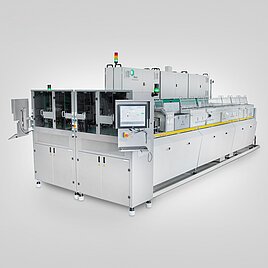
Meco - Advancing Flux Cleaning to the Next Level Meco is the industry leader in leadframe solder plating and flux cleaning solutions. With over 400 installations of our computer-controlled EDF/EPL systems, we set the standard in the industry. Now, we are taking flux cleaning to new heights with our latest innovation, the Meco FXL System. Experience the next level of flux cleaning with Meco's FXL System. Trust our expertise, innovative technology, and commitment to delivering high-quality solutions. Contact us today to learn more about how our cutting-edge systems can enhance your production process and maximize your success. Key features Innovative Loading System: Handling Leadframes with Care Our FXL System introduces a sophisticated loading mechanism that handles leadframes with utmost care, eliminating any damage or sagging of wires even for leadframes with exposed die. The patented Meco carrier belt reduces drag and allows for cleaning on both sides of the leadframe in a single pass. Automatic and Efficient: Slotted Magazine and Clip Device Featuring a slotted magazine and a specially designed clip device, our FXL System ensures automatic loading and unloading of leadframes onto the continuous carrier belt. The system enables products to be loaded closely together, with a gap of only 2-3 mm between each item. Product Flexibility and Quick Change-Over Time One of the significant advantages of the FXL System is its high product flexibility and fast change-over time. With just a few product-related parts, change-overs can be accomplished in less than 5 minutes by a single operator. This flexibility allows you to handle various frame sizes, ranging from 150 mm to 300 mm in length and 25 mm to 100 mm in width. Easy Control with Electro Plating Control Software (EPCS) To facilitate easy control and monitoring of the FXL cleaning line, we provide the Electro Plating Control Software (EPCS). With a user-friendly interface based on the Windows operating system, the EPCS offers a clear view of the system's status. It allows users to control machine operations, check process parameters, modify setpoints, and store different recipes for quick change-overs. Security and User Access Control At Meco, we prioritize security and user access control. Each user has their own authorization level, ensuring that tasks are limited to the appropriate level of access. The EPCS guarantees that all process parameters are within specification values before production begins, preventing errors and optimizing performance. Cost Savings and Efficiency The FXL System not only delivers superior performance but also offers cost-saving benefits. With its low water usage, high production yields, and minimal running costs, the system ensures efficient and economical operations. Experience the Next Level of Flux Cleaning Experience the next level of flux cleaning with Meco's FXL System. Trust our expertise, innovative technology, and commitment to delivering high-quality solutions. Contact us today to learn more about how our cutting-edge systems can enhance your production process and maximize your success. Downloads FXL 2022.pdf
CATEGORY
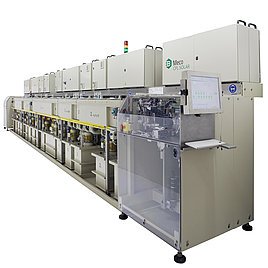
Meco CPL: More Power Out of Your Cell at a Lower Cost! The Meco CPL is based on the robust and proven concept of the Meco EPL which has, with more than 350 machines installed worldwide, built a reputation in the semiconductor world for leadframe plating applications. Key Features - Vertical product handling - Low drag-out of plating chemicals - Compact machine design/easy to maintain - Inline plating process/high up time - Efficiency improvement: 0.3 - 0.5 % (abs.) with seed-and-plate - Proven machine concept ( 350 machines in semiconductor industry) - Ideal platform for plating of Interdigitated Back Contact (IBC) cells where a thick Cu-Sn layer is plated on the rearside electrode - Ideal platform for plating of HIT cells as Cu plating drastically reduces the high metallization costs associated with heterojunction cells - Plating on frontside and backside at the same time for metallization (plating) of bi-facial cells such as HIT cells - Plating of n-type cells - Process start-up by Meco Details A vast majority of Si cells is produced by screen printing silver paste onto the front side of the wafer. To form electrical contact with the cell emitter a firing step is done afterwards. This is a well established production method within the PV industry although there are areas for further improvement. Typically screen printed contact fingers are printed 90-100 micron wide to obtain sufficient electrical conductance. To further increase the cell efficiency the contact finger width can be reduced as the active area of the cell increases (less shading). However, cell efficiency improvement is limited as the poor aspect ratio of screen printed contact fingers leads to an increase of the contact finger resistance value at the same time. Meco offers a real solution for cell efficiency improvement: the process starts on a narrow and thin seed layer of Ag paste where the electrical conductance of the contact finger is further enhanced by electroplating either Ag or Ni-Cu-Sn onto it. This gives a narrow contact finger while the resistance value is also improved at the same time. With the CPL, an overall absolute cell efficiency improvement of 0.3 - 0.5% can be obtained and also expensive Ag paste can be saved as only a narrow and thin seed layer is required. Therefore with the CPL an RoI of < 1 year can be achieved! The total CPL throughput is 1,500 to 3,000 cells/hour. Specifications - Cell size: 5 x 5", 6 x 6" - Cell type: mono-c, multi-c - Cell technology: p-type, n-type, bifacial, MWT, Back Contact (IBC), HIT cells - Metal options: Ag, Ni-Cu-Sn, Cu-Sn (for IBC) - Plating thickness (typical) Ag: 5-7 um, Ni: 1 um, Cu: 8 um, Sn: 2-3 um - Throughput: 1,500 - 3,000 UPH (pilot line: 100 - 500 UPH) - Production capacity 50 - 100 MW/year
CATEGORY
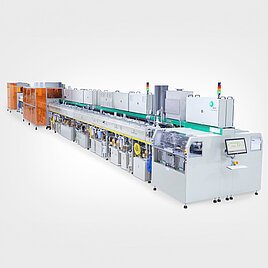
Meco Advanced Cut-strip Plating System (ACP): Meco's solution for accurate silverspot plating where mechanical masking becomes impossible! - New model available for wider and longer leadframes! Meco's Solution for Accurate Silverspot Plating Where Mechanical Masking Becomes Impossible! In general, spot tolerances of ± 125 micron in x and y direction can be reached by mechanical masking systems like Meco's patented spot tool technique. The disadvantage of mechanical masking is that you often get bleed-out of silver on the cutted edges of the leads as shown. Undesirable metal coating on these functional areas may result in poor adhesion of the mould compounds, while any silver extending beyond the package after molding may cause short circuiting among the leads as result of silver migration. Looking at the trends in leadframe design, ongoing attempts towards further miniaturization are observed. These developments result in a high lead density, thinner leadframes and packages. Such complicated and fragile leadframes are not stamped in reel to reel form, but more frequently in etched cut strips. It also requires a higher accuracy of silver spot position (±50 micron) like for QFN leadframes. Therefore Meco developed the ACP technology using photo masking techniques in combination with electro depositable photo-resist. Main Advantages of the ACP Technology Are: - High spot accuracy (<25 micron) - No side bleed on "cut edge" of leads - Mild physical mask contact (photomask) - Continuous silver plating process - High yield (98%) - Able to handle cut strip and reel to reel frames The principle of the Meco ACP technology for selective silver plating of leadframes is based on a lithographic process with a negative-working, cataphoretic photo resist. In this process an electrically insulating photo resist layer is applied to the leadframe by electrophoretic depostion, also efficienlty covering the sharp cut edges of the products. Subsequently, the photo resist is exposed to UV-light by means of a photo-mask, leaving the to be plated parts unexposed. All being operated at a continuous line speed of 3m/min! During developing, the unexposed photo resist is removed, followed by silver electroplating of the functional areas. Finally, the remaining resist is stripped away from the leadframe. It is preferred to apply a negative-working photo resist in order to achieve efficient and accurate UV-exposure and a cataphoretic process (depostion at the cathode) to avoid any metal contamination of the resist solution from the leadframe.
CATEGORY
Meco Flex Antenna Plating System (FAP): a unique cost-effective additive process for RFID antenna manufacturing, Flexible PCB and Copper Clad Laminate (CCL). Low Cost RFID Antenna Production Antenna inlays for RFID passive tags are currently made of etch copper or aluminum. In other cases the antennas are printed using costly conductive ink. Neither production method is meeting the low cost production requirements of high reliability RFID tags. Additive Copper Process Meco has developed an additive copper process for plating low cost antennas or other components onto flexible substrate. The required pattern should be printed onto the substrate material and then copper is plated on top of it. Contrary to etching processes, copper is only plated where it is actually needed while with etching a lot of copper is subtracted (etched) which leads to waste and a higher cost. Conductive Ink for Seed Layer Printing For printing the seed layer pattern a conductive ink (e.g a low-cost non-silver ink) is used. Alternatively the seed layer could also be made using an electroless Nickel-Copper process. The seed layer is only used as a starting layer for the copper plating process. The conductivity is therefore achieved with the plated copper layer. High Product Flexibility/No Change-Over Time The FAP system can handle a wide range of antenna designs (HF and UHF) or other device structures, without any product related parts resulting in zero downtime when changing over from one design to the other. Depending on the type of antenna, for UHF typically a copper thickness of 2-3 micron is needed while for HF antennas 10-12 micron copper thickness leads to optimum antenna performance. Specifications FAP 330 Ecoline | FAP 430 | FAP 650 Substrate width: 330 mm | 430 mm | 650 mm Number of plating drums: 4 | 4 / 8 / 12 / 16 | 4 / 8 / 12 / 16 Web speed: 0.5 - 2 m/min | 0.5 - 12 m/min | 0.5 - 12 m/min Antenna design: HF / UHF | HF / UHF | HF / UHF General Input Requirements - Substrate material: PET, Polyimide, PVC or coated paper - Substrate thickness: 23 - 150 micron - Copper plating thickness: 1 - 20 micron - Surface resistance of seed layer: < 300 mOhm/square Options - Strap plating option for HF antenna. This option allows plating on both sides of the substrate in one pass - For FAP 330 Ecoline: close loop rinsing option. This makes waste water treatment no longer necessary
CATEGORY
