POLYMER-TO-CERAMIC™ TECHNOLOGY Put more than 10 years of specialization in organo-silane chemistry to your use. Through our extensive research on carbosilanes, carbosiloxanes, and related compounds we have developed a broad range of silane compounds as CVD precursors to form thin films of silicon carbide and high purity intermediates for the synthesis of pharmaceuticals, Organic Light Emitting Diodes (OLED's), catalysts, cross linking or coupling agents for silicones and other fine chemical synthesis. In particular, Starfire has created a highly efficient synthesis route for the manufacture of heterocyclic silanes encompassing silacyclobutanes, pentanes and hexanes. Following is a partial listing; additional compounds and more advanced intermediates based on this chemistry can be produced on a custom basis. Allyldimethylsilane [3937-30-2] Diallyldimethylsilane [1113-12-8] Allyltrimethylsilane [762-72-1] Diallyldiphenylsilane [10519-88-7] Alloxytrimethylsilane [18146-00-4] 1,3-Diallyltetramethyldisiloxane [17955-81-6] Benzyldimethylsilane [1613-70-5] 1,1-Dichloro-1-silacyclobutane [2351-33-9] Benzyltrimethylsilane [770-09-2] 1,1-Dichloro-1-silacyclopentane [2406-33-9] Bis(chloromethyl)tetramethyl-1,3-disiloxane [2362-10-9] 1,1-Dichloro-1-silacyclohexane [2406-34-0] 1,4-Bis(dimethylsilyl)benzene [2488-01-9] 1,3-Diethoxy-1,3-dimethyl-1,3-1,4-Bis(trimethylsilyl)benzene [13183-70-5] disilacyclobutane [1967-90-4] Bis(trimethylsilyl)methane [2117-28-4] 1,3-Dimethyl-1,3-diphenyl-1,3-t-Butyldimethylchlorosilane [18162-48-6] disilacyclobutane [1628-03-1] t-Butyldimethylsilane [29681-57-0] 1,1-Dimethyl-1-silacyclobutane [2295-12-7] t-Butylmethyldichlorosilane [18147-18-7] 1,1-Dimethyl-1-silacyclopentane [1072-54-4] Chloromethyldimethylchlorosilane [1719-57-9] 1,1-Dimethyl-1-silacyclohexane [4040-74-8] Chloromethyldimethylethoxysilane [13508-53-7] 1,1-Dimethoxy-1-silacyclobutane [33446-84-3] Chlromethyldimethylmethoxysilane [18143-33-4] Dimethylisopropylsilane [18209-61-5] Chloromethyldimethylisopropoxysilane [18171-11-4] Diethylmethylsilane [760-32-7] Chloromethyldimethylsilane [3144-74-9] Diphenylsilane [775-12-2] Chloromethyldimethylphenylsilane [1833-51-8] 1-Methyl-1-silacyclobutane [765-33-3] 1-Chloro-1-methyl-1-silacyclobutane [2351-34-0] 1-Methyl-1-silacyclohexane [765-62-8] 1-Chloro-1-methyl-1-silacyclopentane [2406-31-7] 1-Methyl-1-silacyclopentane [765-41-3] 1-Chloro-1-methyl-1-silacyclohexane [18148-37-3] 1-Methyl-1-vinyl-1-silacyclobutane [3514-67-8] Chloromethylmethyldichlorosilane [1558-33-4] 1-Methyl-1-vinyl-1-silacyclohexane [19495-14-6] Chloromethyl(methyl)dimethoxysilane [2212-11-5] 1-Methyl-1-vinyl-1-silacyclopentane [3944-18-1] Chloromethylmethyldiethoxysilane [2212-10-4] Phenyldimethylsilane [766-77-8] Chloromethylmethyldiisopropoxysilane [2212-08-0] Phenylsilane [694-53-1] Chloromethyltrichlorosilane [1558-25-4] Phenyltrimethylsilane 768-32-1] Chloromethyltrimethoxysilane [5926-26-1] 1-Silacyclopentane [288-06-2] Chloromethyltriethoxysilane [15267-95-5] 1-Silacyclohexane [6576-79-0] Chloromethyltriisopropoxysilane [18162-82-8] 1,1,3,3-tetrachloro-1,3-disilacyclobutane [2146-97-6] Chloromethyltrimethylsilane [2344-80-1] 1,1,3,3-tetraethoxy-1,3-disilacyclobutane [63238-93-7] Chlorodiisopropylsilane [2227-29-4] 1,1,3,3-tetramethyl-1,3-disilacyclobutane [1627-98-1] Diallylmethylsilane [2043-08-5] 2-(Trimethylsilyl)ethanol [2916-68-9] (Dichloromethyl)methyldichlorosilane [1558-31-2] Vinyltrimethylsilane [754-05-2]
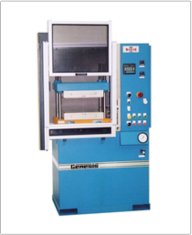
In order to press cure Starfire polymer systems, heated hydraulic presses are used. A single platen press with caul plates or a multiple-platen press can be used to fabricate multiple laminates simultaneously, or heated compression mold tooled presses can be used. Typical pressures required to press 2-D laminate structures are 250 psi (+/-50), and 650-1,000 psi (+/-100) for compression molding. Typical temperatures required for cure are 300°C (maximum) or less depending on the catalyst and resin selection, with ramp rates of as high as 5°C/min for heating, and 10°C/min for cooling. For compression molding operations, a press which has capability to "push" and "pull" is advantageous, but not required. Better than 0.001" out of flatness is suggested for high quality composites and thickness variation better than 0.002" is suggested for any platen press. (http://www.wabashmpi.com/index.htm)
CATEGORY
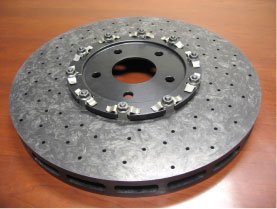
Pyrolysis of Starfire polymer is accomplished in standard ceramic kilns capable of flowing inert gas, such as Nitrogen or Argon, at atmospheric pressure. Programmable heating ramp rates must be 1-3°C/min with a maximum suggested temperature capability of 1,200°C. A high temperature internal can, or retort, is required to maintain inert gas environment, and must have a temperature capability of 1,250°C. Stainless Steel can be used if temperatures 1,000°C (maximum) are to be achieved, and inexpensive high nickel steels such as 309, or 310 are also suitable to achieve 1,200°C maximum pyrolyzing temperatures. A standard kiln volume of 10 ft3 is standard choice for pyrolysis of small volume programs. L&L Kilns supplies all kilns used by Starfire Systems. (http://www.hotkilns.com/index.html)
CATEGORY
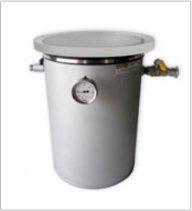
Vacuum infiltration of blanks is conducted in vacuum vessels rated to <0.5 torr. A vacuum pump capable to pump at up to 15cfm for a volume 5.5 ft 3 is required to maintain vacuum. Each vessel must have a valved tube inlet to introduce polymer, a valved tube exhaust to connect to the pump, and a pressure gage to verify vacuum levels have been achieved. It is also helpful for large vessels to have a valved drain to support polymer removal. (http://www.lacotech.com/)
CATEGORY
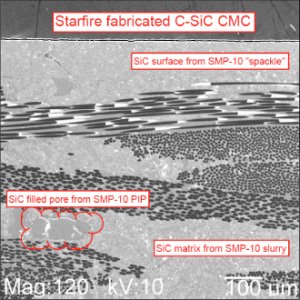
These proprietary Starfire® Systems polymers are our original technology and yield near stoichiometric SiC ceramics when converted. They are our highest strength polymers, thermally stable to 2500°C +, and available in new, hot melt versions. Starfire's advanced technology offers a polymer route to near stoichiometric silicon carbides, delivering the benefits of SiC ceramic composites without the sintering and machining challenges. Our polymers form a high-strength green part with cure temperatures as low as 200°C and then form SiCs with nanoscale grain sizes as low as 800°C. Highlights: - Ability to mold complex, near net-shaped ceramic composite components - Features a low temperature green cure - Ceramic is formed using low cost furnaces - Nanoscale ceramic grain yields tough parts - Products are flexible – they feature low viscosity for infiltration or hot melt for layups - Materials are lightweight, corrosion resistant, and temperature resistant - Materials increase friction while reducing wear Applications: - SiC ceramic matrix composite components - Infiltrate low cost preform for enhanced performance - Suitable for a variety of structural, thermal, or friction uses
CATEGORY
