User Interface - Unicode tabbed-document application: compatible with 32- and 64-bit Windows - monolithic, streamlined architecture: minimal installation footprint and portable design bypasses the Windows registry - multiple instances: control multiple instruments by simply duplicating the program - customizable toolbar: quick access to your most frequently used commands - complete, intuitive environment: run experiments, analyze data, and generate plots all in the same window - status bar: technique, file status, and command prompt - WYSIWYG graphics - comprehensive context-sensitive help File Management - Unicode support: international file and folder names - open data files: read directly from binary or plain-text files - save data file: binary, plain-text formats for exporting data (e.g., to spreadsheet) - list data file - convert to text files: for exporting multiple data files - text file format - print present data - print multiple data files - print setup Experimental Setup - technique: a large repertoire of electrochemical techniques - experimental parameters: extremely wide dynamic range - system setup: line frequency, potential/current axis polarities - hardware test: digital and analog circuitry diagnostic test Instrument Control - run experiment: real time data display in most cases - pause/resume during run - stop running experiment - reverse CV scan direction during run - repetitive runs: automatic data save, signal averaging, delay or prompt between runs, up to 999 runs - run status: stir, purge, iR compensation, smooth after run, RDE and SMDE control status - macro commands: edit, save, read, and execute a series of commands - open circuit potential measurement - iR compensation: automatic and manual compensation, solution resistance, double layer capacitance and stability test - analog filter setting: automatic or manual setting of potential, i/V converter, and signal filters - cell control: purge, stir, cell on, SMDE drop collection, and pre-run drop knock - step functions: initial and two step potentials, duration of steps and number of steps, particularly useful for electrode treatment - working electrode conditioning before running experiment: programmable 3 steps - rotating disk electrode: rotation speed, on/off control during deposition, quiescent time, run, and between runs - stripping mode: enable/disable, deposition potential and time, stir and purge conditions Graphical Display - present data plot - 3D plotting (NEW): interactive visualization of impedance and SECM data (select models); Laplacian smoothing, Delaunay triangulation, stereoscopic 3D anaglyph imaging - overlay plots: several sets of data overlaid for comparison - add data to overlay: adding data files to overlay plot - parallel plots: several sets of data plotted side by side - add data to parallel: adding data files to parallel plot - zoom in/out: visually selected zoom area - manual results: visually selected baseline - peak definition: shape, width, and report options - Special Plots: x-y, ip-v, ip-v 1/2, Ep-log v, semilog plots, linear polarization resistance plot - graph options: video or printer options, axis, parameters, baseline, results, grids, axis inversion, axis freeze, axis titles, data sets, XY scales, current density option, reference electrode, header, and notes - color and legend: background, axis, grid, curves, legend size, thickness, and display intervals - font: font, style, size and color for axis labels, axis titles, header, parameters, and results - copy to clipboard: for pasting the data plot to word processors Data Processing - smoothing: 5-49 point least square and Fourier transform - derivatives: 1st - 5th order, 5-49 point least square - integration - convolution: semi-derivative and semi-integral - interpolation: 2x - 64x data interpolation - baseline correction: visually selected baseline, slope and dc level compensation - baseline fitting and subtraction: selectable fitting function, polynomial order and potential range for best fitting and baseline subtraction; particularly useful for trace analysis - data point removal - data point modifying: visual data point modification - background subtraction: difference of two sets of data - signal averaging - mathematical operations: both X and Y data array - Fourier spectrum Analysis - calibration curve: calculation and plot - standard addition: calculation and plot - data file report: analytical report from existing data files - time dependence report - corrosion rate calculation CV Simulation and Fitting - fast implicit finite difference algorithm - reaction mechanisms: 10 predefined mechanisms; in select models, any combination involving electron transfer, first- and second-order chemical reactions - system: diffusive or adsorptive - maximum equations: 12 - maximum species: 9 - simulation parameters: standard redox potentials, rate of electron transfer, transfer coefficient, concentration, diffusion coefficient, forward and reverse chemical reaction rate constants, temperature, electrode area, and experimental parameters - simultaneous display of voltammogram and concentration profiles - automatic detection and determination of over-determined equilibrium constants - dimensionless current - equilibrium data AC Impedance Simulation and Fitting - visually equivalent circuit input - automatic equivalent circuit parameters fitting View - data information: date, time, filename, data source, instrument model, data processing performed, header and notes - data listing: data information and numerical data array - equations: convenient compilation of general and technique-specific equations - SECM probe status: probe position and current display - clock - toolbar - status bar Help - comprehensive context-sensitive HTML help - on-the-fly switching between HTML help and legacy WinHelp - using help - about the application System requirements - operating system: Windows 98 / NT / Me / 2000 / XP / Vista / 7 / 8 - USB port or serial communication port
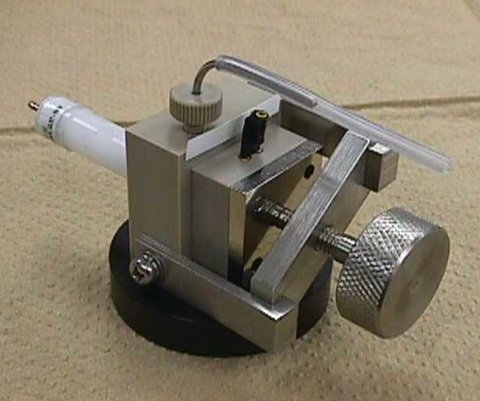
Non-Aqueous Ag/Ag+ Reference Electrode w/ porous Teflon Tip. For the CHI112, Ag+ solution (typically 10 mM) should be prepared with the supporting electrolyte and AgNO3 (not included). This solution is then filled into the reference electrode compartment using a syringe (not included). The instructions will come with the components.
CATEGORY
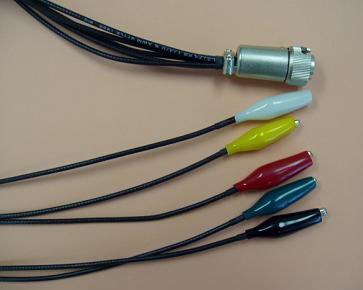
Electrode leads for model number xxx (where xxx = 600, 710B, etc.)
CATEGORY
Electrode Polishing Kit. The CHI120 electrode polishing kit contains 1 bottle of 1.0 micron Alpha alumina powder, 1 bottle of 0.3 micron Alpha alumina powder, 3 bottles of 0.05 micron Gamma alumina powder, 2 glass plates for polishing pads, 5 pieces of 73 mm diameter 1200 grit Carbimet disks (grey in color), 5 pieces of 73 mm diameter Mastertex polishing pads (white in color), and 10 pieces of 73 mm diameter Microcloth polishing pads (brown in color).
CATEGORY