The HumiPyc(model 1 and model2 ) is a fully automatic, versatile, precise, and cost effective volumetric analyzer capable of carrying out density measurements of different samples at ambient temperature. With ancillary equipment, it can be used for filter integrity testing, moisture analysis, permeation of gases through membranes, and calibration of RH sensors using saturated salt solutions. Opposite to On/Off valves used in other pycnometers for pressurization / depressurization of sample chamber, the HumiPyc uses proportional valves to ensure continuous flow of gas in and out of the sample chamber, from vacuum to 345 kPa. Thus, elutriation of fine powder is avoided. Addition of RH probe to the sample chamber allows for density determination at known conditions of RH, temperature, and pressure. A unique design of the sample chamber closure enables variety of applications. New analytical capabilities and convenience of operation are materialized thanks to migration from classical keypad operated pycnometers to PC environment for software design and control. A unique design of software allows the user to design experiment as a sequence of preprogrammed steps (macros), and save the created template for future use. A new experiment can be executed with just a click. All experimental data are recorded and can be transferred to a spreadsheet. In addition to the Auto mode, a Manual mode is also available, mainly for troubleshooting and carrying out specific R&D testing of samples. User-friendly software for execution of different RH steps, diagnostics, calibration, graphing, reporting, and RH calculations has been designed. The user can conveniently define an experiment as a “sequence of steps” using the template form and save it for future use. A single step can be a complete measurement cycle, a sample treatment, or some special functionality. Predefined routines containing user modifiable parameters are assigned a tag number, which can be introduced to the sequence of the experiment steps. Automation of templates design, flexibility in experiment modification during run, running multiple samples using the same template, and ability to switch between Auto and Manual operation are very useful in any research work. Volume measurements from under 1cc to over 100 cc (true density) of solids (fine powder, foams), optionally at precise RH conditions. Model 1 - built-in temperature control, from sub-ambient temperatures to 50 ˚C Model 2 – ambient temperature Operational mode: Fully automatic operation via PC control (Windows ® based software from 95 to Windows 7 is included) and Manual Mode via front panel controls. Sample chamber: Typical chamber volume is over 130 cc, larger volumes available, several adapters for reducing volume are supplied. Sample containers: Several containers of different sizes are supplied, no special containers are required. Commonly available containers that can fit inside can be used. Sample treatment: Sample treatment to specified criteria; programmable and continuous pressurization/depressurization cycles or vacuum. Optional true purge with gas flowing through the sample, (not around a sample container like in other pycnometers), is available. Volume calibration Using certified metal spheres, Calibration Kit is included (Set of Large spheres (0.5” -2”), Set of micro spheres (1 – 6mm), handling tools) Volume resolution: Better than 0.0001 cc Typical Reproducibility: Better than ± 0.01% Resolution of data acquisition: 24 bit Displayed pressure resolution: 0.0001kPa Pressure range: (transducer dependent), typically from 0 (vacuum) to 344.7 kPa (50 psia), Transducer selection: Absolute, Gauge, Barometric, (common ranges) Transducer accuracy: (transducer dependent), typically ±0.11%FS, ±0.073%FS optional Temperature probe (RTD) accuracy: ±0.1 ˚C RH probe range: 0 to 100 % Gas Type: Helium, Nitrogen, Argon, air, etc Gas Inlet Port: 1/8” tube compression tubing (Swagelok ®type bulkhead) Vacuum port: 1/4”NPT Female (standard), flexible vacuum hose from the instrument to a vacuum pump (e.g. small rotary vane) with KF16 flange can be supplied. Auxiliary hardware: Specific to an optional technique or customized version. Communication link with a PC: Serial port (RS232) or USB Dimensions: (W x H x D) (22 x 28 x 43cm) (8.7” x 11.4” x 19”) Model 1 Instrument Weight (w/o accessories): 14kg (30lb) M1 Typical power requirements: 110-240 VAC universal input, 50/60 Hz, 75VA A wide range of application: - True density measurements at precise condition of RH, P, and ambient T without elutriation (fine powders) - Determination of volume (density) vs. pressure value (open-, closed-cell foam) - Filter integrity testing (Bubble Point & Pressure Decay method) - Permeation of gases & vapors through membranes (optional equipment needed) - Calibration of RH sensors using saturated salt solutions - Moisture analysis, desorption, headspace extraction, sample treatment - Fast and easy to use for quality control Optional techniques: RH analysis; Headspace extraction; Sample treatment; RH sensor calibration; Study of RH of slurries; Permeation of gases and vapors through membranes
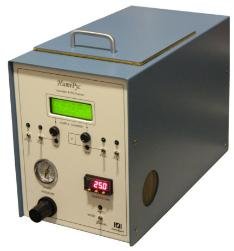
Applications: - True density measurements of solids (e.g. fine powders, foams, etc). - Determination of density at precise relative humidity and temperature values (with RH probe) - Filter integrity tester - bubble point and pressure decay tests (with ancillary hardware) - RH sensor calibrator (with saturated salt solutions) - Determination of RH atmosphere over different mixtures, solutions - Outgassing of samples using vacuum to a specified RH value or other conditions - Remote control from PC for working with dangerous samples (under the hood) Design highlights: - Manual and Automatic operation (Windows based software) - Progressive gas pressurization and depressurization (nano-powders, no-elutriation) - Dual reference chamber for the largest range of volume measurements - Relative humidity and temperature measurements inside the sample chamber - 24-bit data acquisition, high accuracy and excellent repeatability - Pressure regulator and gauge (at the back panel of the instrument) - Superior for foam density measurements (ASTM D6226-05) - Variety of ancillary hardware for other applications, e.g. for filter integrity testing (largest pore sizes), RH probe calibrations, - Small size and mass, portable - Designed for easy customization to fulfill application specific requirements - Sophisticated and interactive software for experiment design and control (our software is compatible with 64-bit Windows operating system) - All experimental data are recorded and transferable (macro) to Excel. - Volumetric density measurements using pressure range from vacuum to 50 psi (345 kPa) and temperature range from sub ambient to 50C, with parallel relative humidity (RH) data (0-100%) - RH analysis in the pressure and temperature range, sorption and kinetic data from multiple headspace extraction - Designed especially for true density measurements of fine powders and foams - Bubble Point and Pressure Decay Methods for characterization of filters /membranes The most versatile gas (helium) pycnometers available; with many options, software compatible with 64-bit Windows operating system, and for every budget. Design highlights: - Integration of automatic and manually operated pycnometer into one system - Integrated temperature control - Continuous flow of gas in and out of sample chamber - Relative Humidity (RH) and temperature measurements inside the sample chamber - Vacuum port (standard in all models) - 24-bit data acquisition, high accuracy pressure transducer - Independent precision pressure regulation - Auto Mode (Windows operating system) and Manual mode of operation - Sophisticated and interactive software for experiment design and control - Macro transferring data to Excel for additional analysis - All experimental data recorded and available to the user Advantages: - Many capabilities in one instrument, high accuracy, and precision - Volume and density data obtained at precisely defined temperature, pressure, and RH conditions - Dual reference chamber for the largest range of volume measurements - No sample elutriation during treatment and analysis, designed for fine powders - Any sample holder up to about 2" (52mm) O.D., and 2" (52mm) Height - Elimination of shortcomings of other pycnometers that use only On/Off valves - Ability of incorporating of additional sensors - Multiple headspace extraction capabilities - Determination of RH atmosphere caused by solids, liquids, or slurries - Availability of equilibration profiles vs. time data for kinetic and sorption studies - Foam density measurements (open cell content, other characterizations) - Very low cost - Small size, (8.7" x 11.4" x 19") 22cm x 29cm x 43cm - Determination of foam density (open-cell, closed-cell percentage) using the HumiPyc ™ - density analyzer. Profile of density vs. pressurization pressure instead of a single number. - Combining the Enhanced Bubble Point and Pressure Decay methods in characterization of micro-filtration products using the HumiPyc. To find out more about HumiPyc capabilities as filter integrity tester, please read this application note. - Determination of actual performance of gas pycnometer vs. quoted specifications... review
CATEGORY
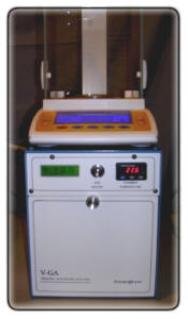
High capacity (typically 100/220g or 120g) Sartorius semi-microbalance eg. CPA 225D - Electromagnetic force compensation - Thermal compensation - Adaptable to noisy environments - Integrated calibration weight - Overload protection - Readability (model dependent), typically 10 or 100 micrograms - Superior accuracy and stability V-GA isothermal chamber - Temperature control of sample chamber from sub-ambient to 95C with stability +- 0.1C - Temperature of experiment from sub-ambient to 60 C at full range of RH (standard model) - Sample chamber size (5.2cm x 5.2cm x 12.8cm), different sizes optional - High temperature digital RH probe (RH and T data) (in the vicinity of the sample) - Additional temperature sensor (RTD) (in the vicinity of the sample) - Proprietary design of vapors exhaust system and anti-condensation protection - Uniform RH distribution (special diffuser) - Dual gas/vapor entry ports - Large area sample holders with fine mesh bottoms - USB/Serial communication port for transfer of RH and temperature data to PC - Small size of instrument (w/o balance): 23cm x 27cm x 38cm The main components of the modular V-GA flow system: Selection of one of the two RH generators: (Each of the RH generators can be used separately for other applications and the operational software is provided.) Typical Applications - Monitoring the sample mass uptake or loss as a function of time by varying relative humidity or temperature (or both). - Study of permeability of different vapors through membranes, fabrics in controlled RH and temperature environment using special cells. - Possible expansion to density and surface tension measurements. Advantages - More representative sample can be used - No limit on dynamic range (compare to 500mg or +-200mg of other microbalances) - Large selection of balances and weighing modules to satisfy any application - Easy installation by the user, virtually maintenance free - Independent modules, each with its own software - Robust, easy to service and operate - Perfect for R&D and industrial QC environment - Economical to use (air can be supplied from a compressor) - Special applications can be easily addressed - Independent use of modules for other purposes, e.g. RH Generator - Ability to measure water vapor transport rates, WVTR, using special cells - Capability of determining of organic vapors permeability through membranes - Ability to determine deliquescence points - Low cost Windows® based operational software for the combined modules - Intuitive design of experiment protocols and saving them for reuse - Isothermal profiles - Iso-humidity profiles - Isobars - Fast run - Up to 1000 steps per run - Ability to select and combine several equilibrium criteria - Calculation utility for solving variety of "RH problems" - Graphing, generating reports, viewing previous data - Ability to modify experiment parameters at any time - USB/Serial communication with a PC - Automated installation
CATEGORY
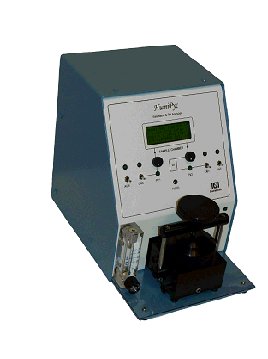
Complete solution for measurements of foams volume (density) Software compatible with 64-bit Windows® operating systems To reduce errors in determination of physical volume measurements of a foam sample, additional hardware for cutting exact shapes can be provided. The first volume measurement of the whole foam sample using a gas pycnometer yields the uncorrected volume which is only accurate for predominantly open-cell structures. To obtain correction for closed cells that were cut during the foam sample preparation, the original specimen is cut into pieces to expose additional closed cells (proportional to surface area) and the foam pieces are measured again. From the geometric volume, and the first and second pycnometric runs, parameters like porosity, percentages of closed and opened cells can be calculated. The foam calculator available in newer software versions facilitates these easy calculations. The gas pycnometer also allows foam volume (density) measurements at programmable pressure levels and the results can serve for further characterization of foams (e.g. compressibility, recovery from compression). For flat foam samples primarily designed for filtering, bubble point pressure (largest pore(s)) can be determined using additional hardware. Design features: - Fully automated operation via PC - Novel software approach for experiment design and convenience of operation - Ability to set low pressures to avoid foam distortion and carry out accurate measurements using 24-bit resolution - True gas purge using a separate exhaust (similar design as in the cement density and fineness (specific surface area determination technique (Permeametry) - The foam sample can be purged to specific relative humidity value using optional RH probe. - Specific (optional) hardware for other analytical capabilities Measurement of true density, porosity, percentages of open-cell / closed-cell of foams plays important role in development and quality control of various properties of the cellular materials. Characterization of foams presents its own challenges and the highest performance gas pycnometers and dedicated accessories need to be used. The enhanced and optimized HumiPyc Gas (Helium) Pycnometers with dedicated hardware are superior tools for foams characterizations. Standard test methods for foam open cell content, like ASTM D6226 or ISO 4590 stipulate specific shapes and sizes of foam samples. To optimize the foam volume determinations results, volume reducing adapters accepting cubes or cylindrical shapes can be provided.
CATEGORY
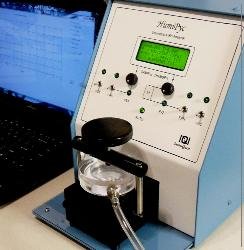
Adding Enhanced Bubble Point (active pore size determination) and Pressure Decay methods to the true density and moisture analysis capabilities of the HumiPyc The unique design of the HumiPyc - gas (helium nitrogen, air) pycnometer and its closure of the sample chamber allow for additional usage for testing of packed beds and filter integrity (bubble point, pressure decay methods). One of the assemblies depicted on the photo below (with a paper filter inside) has transparent upper part for visual observation of the bubbles. The outlet from the chamber can be connected to a flow meter to implement additional capabilities (forward flow method, capillary porometer). Please contact us at support@instruquest.com regarding inquiries for any application-specific requirements of the Bubble Point and Pressure Decay analyzer. - Pore diameter range from micrometers to millimeters - Enhanced bubble point method - Pressure decay (pressure drop) method - Integration of density, pore analysis, and gas transport properties - Programmable pressure rate increase - High performance R&D tool for product testing and development - Open-design for easy customization to address specific requirements - Excellent resolution for large pore sizes - Temperature measurements of the externally located sample holder - Minimal added cost compared to purchasing of a separate bubble point or pressure decay tester Addition of the Bubble Point and Pressure Decay tests capabilities to the HumiPyc requires only optional hardware for the sample holding as the progressive gas dosing, all hardware, and the high resolution (24-bit) data acquisition are already a part of the gas pycnometer. The sample can be measured inside the temperature-controlled compartment of the HumiPyc or it can be measured external to the instrument. The external location of the sample holding hardware allows for larger spectrum of samples to be measured and facilitates visual determination of the onset of bubbles formation. The increase in gas pressure can be done manually or automatically and the experimental data are graphed and recorded. Considering the vast diversity of samples, their affinity towards the wetting liquid, and the pressure spectrum employed, it is recommended to combine the visual observations and the automatically obtained data for the most reliable results of the bubble point method.
CATEGORY
