By Solaronix SA
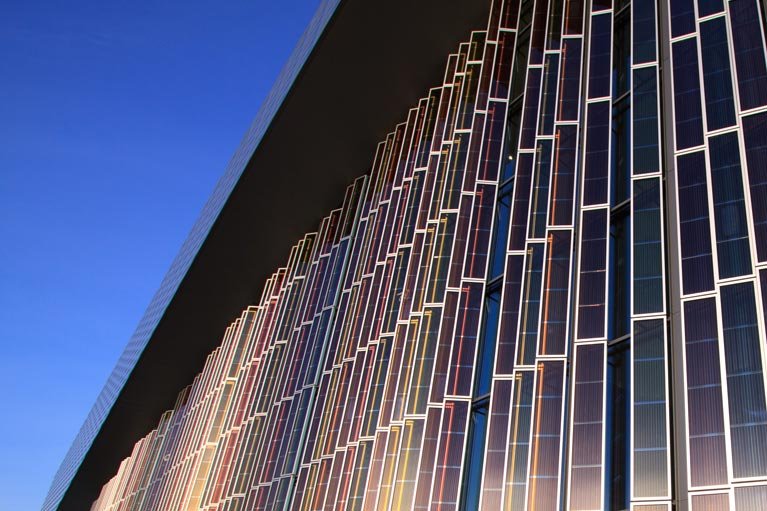
Solaronix is developing a new generation of photovoltaic panels based on Dye Solar Cell technology. Our models offer unprecedented possibilities in terms of customization and integration. The main goal of Solaronix has always been to bring innovative solutions to solar energy in the form of new applications, reduced costs, or easier fabrication. In that quest our efforts are directed towards the development of easy-to-manufacture photovoltaic solar cells using ubiquitous industrial equipment and readily available components. Solaronix has been a pioneer of Dye Solar Cell technology since its inception. We believe this type of solar cell demonstrates unmatched features that open solar technology to a host of innovative applications. Thanks to in-house production and supply of the specialty chemicals and components of Hybrid and Dye Solar Cell, we pioneered the fabrication processes for Dye Solar Cell photovoltaic panels. Solar Cells, a Step Ahead. The result is Solaronix' palette of Dye Solar Cell flavors. Our models come in a variety of colors and transparencies, offering unprecedented design flexibility for device or building integration. Their low light sensitivity makes them attractive for diffuse light conditions, including indoor applications. Because our goal is to use industrially proven and omnipresent machines and processes, while keeping manufacturing energy needs minimal, the energy payback time of our solar cells is reduced to a few months instead of several years. Features: Environmental Friendliness - Most of the material in our solar cells is glass. Indeed, the layer absorbing light is extremely thin, which keeps materials usage to a minimum. They don't use toxic heavy metals they are free of cadmium, tellurium, selenium, indium, and gadolinium, elements often found in other solar cells. The ruthenium pigment that is present in extremely small quantities has been show not to be mutagenic. Equally important, feedstocks of the materials employed in our solar cells are abundant. After glass and sealant, the most used ingredient is titanium dioxide, a compound that's commonly found in other industries such as paints or cosmetics. The amounts of precious metals we use (eg. ruthenium and platinum) are so tiny that they would only represent a small fraction of their mined sources. Short Energy Payback Time - Photovoltaic panels are made to transform sunlight energy into electrical energy, but it takes some conventional energy to make them as well. The energy payback time is the duration it takes for a solar panel to produce as much energy as it took to make it, preferably as short as possible. The electricity produced afterward is then truly renewable. Because the materials used are low cost, and the manufacturing processes are not as energy intensive, the anticipated energy payback time for dye cell products is significantly truncated to several months instead of several years. Accessible Manufacturing - The production of our solar cells was meant to be as simple as possible. That's why our pilot production line employs ubiquitous fabrication equipment that require significantly lower capital expenditure compared with other photovoltaic technologies. Manufacturing installations are viable at a smaller scale, which in turn allows for customized products and for production sites closer to their integration, reducing transportation costs. Tunable Aesthetics - A unique selling point: our solar cells come in different colors and have adjustable shapes and transparencies. This unprecedented set of features opens the way to new and innovative solutions where photovoltaic panels become an aesthetic item as well. Building integration can be facilitated by a clever use of incoming light for both energy conversion and passive lighting. Real World Ready - The characteristics of photovoltaic panels are given for standardized ideal conditions at 25°C under full sun illumination. We all know that reality is very different more often than not. Cloudy or hazy days, partial shading, sunrise and sunset, higher latitudes, all conditions when sunlight is not as strong. On the other hand, clear skies will elevate panels' temperature much higher than 25°C. Our solar cells are able to harness diffuse light more efficiently. They exhibit superior performance on cloudy or hazy days, and they generate power longer throughout the day. What's more, their performance is not degraded by rising panel temperature, unlike other photovoltaic technologies. Fits Almost Anywhere - It's no surprise that solar panels must be facing the sun to be most effective. In practice, photovoltaic panels cannot always be installed at the best orientation because of roof inclination or cardinal orientation. However, our solar panels demonstrate a lower angular dependence, which makes them eligible for facades or similar places where the angle towards sunlight is not optimal. For the same reason our solar panels provide smooth energy production from sunrise to sunset, and over the year as the sun's path changes. Indoors Too - Not only do our panels work well in diffuse light, there spectral response also widely overlaps with those of light sources found in homes and offices. They produce a very good power output in low light applications. One can imagine numerous indoor applications of our solar cells: chargers, sensors, standby power, etc.
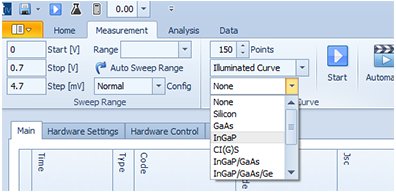
To ensure a correct powerful control of the equipment, the user-friendly Tracer IV-Curve software is required for each I-V Measurement system. The numerous functions range from doing basic I-V curve measuremens to most advanced analysis. Tracer is the all-in-one solution for the measurement and elaboration of IV-curves for solar cells and modules. Tracer is the core application that will help you to characterize your solar cells and modules. Many institutes and laboratories all over the world work hard on the development of new materials and technologies for photovoltaic applications. One of the main techniques to characterize these devices is to measure its IV curve. An IV curve can be taken from a solar cell by changing the voltage while measuring the light generated current. It seems logical for this measurement to use a standard power supply, because a power supply is normally used to provide a variable voltage and current. Unfortunately this would not work for solar cells. A solar cell generates current, so you will need to have a power supply that sinks this generated current instead of providing it. This can be done with a so called bi-polar power supply (or electronic load). This is a power supply that can sink and source current at both positive and negative voltages. There are many instruments on the market that can be used as a bi-polar power supply. Some of them are just bi-polar power supplies while others integrate measurement and control capabilities as well. Tracer will let you define and setup a system based on different instruments to measure your IV curves. You can add multiplexers to automatically measure multiple cells by using one single measurement system, implement contact checking and measure monitoring solar cells. Some examples of the supported hardware: - Keithley 2400 series - Keithley 2600 series - HACKL Electronic Loads - Kepco BOB - B&K Electronic Loads - Toellner loads info - EKO MP-180 Curve Tracer - National Instruments Data Acquisition - MODBUS / Ethernet controlled instruments Naturally Tracer natively supports the control of all Keithley 2400 and 2600 series source meters. These instruments have proven their strength over time for the measurement of solar cells. They range from 0.1fA – 20 Amperes. Tracer is developed with the latest Microsoft.NET Technology, which resulted in a modern ‘Microsoft Office' look and feel. A stable operation on the Microsoft Windows platform is guaranteed. Before you start working with Tracer, you will have to configure your system. This is done by the Tracer Configurator. A tool that completely defines the setup you want to use. Tracer intends to support most instruments available on the market to use as an IV-curve measurement system. You can use for example a Kepco Bop bipolar power supply, add 2 Agilent 34410A DMMs to measure voltage and current, use a National Instruments DAQ card to control the Kepco Bob and get that unused Keithley 2000 DMM to measure a pt100 sensor for the solar cell temperature. This can all easily be deined in the configurator.
CATEGORY
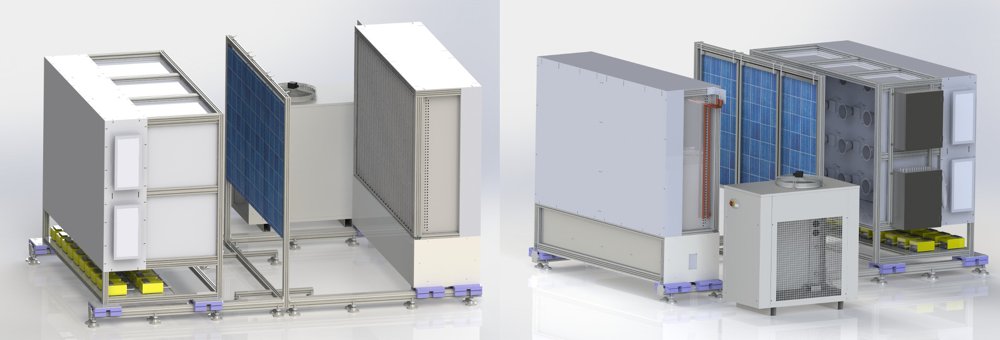
UV-Rad-1525 series is e complete environement UV Preconditionning test, the execellence of our ageing equipment under UV light combined with a userfriendly professional electronic load. The electronic load is piloted through an IV Tracer software that offer a complete turnkey solution for the most exigent user. The UV-Rad units are designed for UV precondioning test. They rely on thorough thermal engineering to maintain the samples at 60°C ±5°C to meet the standard testing conditions required by IEC 61215-2:2015 and IEC 61646:2008 norms. These equipments are designed to provide accelerated test under UV light. The UV-Rad unit are the worldwide cheaper maintenance cost equipment for PV industry. You have the complete mastery of operating and maintenance costs thanks to our long life time of bulbs (up to 40'000 hours) UV-Rad product is compliant with the tests list describe below - UV Preconditioning test test according to IEC 61215-2:2015 and IEC 61646:2008 norms This UV-Rad-1525 unit was designed to realize solar simulation on a 250 x 150 cm area. The system relies on 20 Lumixo light engines to obtain UV spectrum, uniformity (±1%), and stability (STI<0.5% and LTI<2%). UV-Rad-1525 Specifications Sample type: Mono and polycrystalline silicon PV panels Sample area: 2.5 x 1.5 m illuminated area Light intensity: 125 to 200 W/m2 in the wavelength range 280nm and 385nm. Total UV irradiation of 15kWh/m2, with at least 7.5 kWh/m2 in the wavelength band between 280nm and 320nm according IEC 61215-2:2015 and IEC 61646:2008. Light source: 20 Lumixo light engines Lamps lifetime: 20000 hours, serviceable Illumination non-uniformity: ±5% over 250 x 150 cm (Class A) Irradiance stability: <2% (Class A as per IEC 60904-9) UV light measurement: The system is equiped with a UV light sensor for the wavelength band 280-320nm and the band 320-385nm. Light engine cooling: Forced air ventilation Software: Lamp control and monitoring, sample holder temperature, light intensity Dimensions: 330 x 270 x 210 cm (sample holder closed) Mass: ~1500 kg without refrigerated circulator Structure: Anodized aluminum Electromagnetic compatibility: 2.45 GHz ISM Group 2, Class B Device (CISPR 11) RoHS conformity: Yes CE conformity: Yes, the components and the entire system conform with the CE regulations, the system is intended for industrial or laboratory use Safety: The system shutdown automatically the UV light sources to prevent any damage if a door is open during operation. Information - 2 x UVB sensors (range 280 - 320 nm and 320 - 385 nm) are included with UV-Rad series. Available options - Silicon Reference cell (open or shunted version) - GaAs Referenc cell - Solar cell IV-Converter (dedicated readout unit for reference cells).
CATEGORY
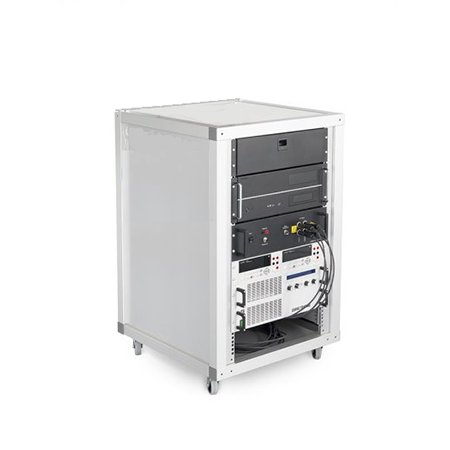
Coupling our solar simulator to a performant electronic load results in high quality measurements which most demanding users require nowadays. I-V measurement equipments is a professional system. Professional measurement system Our IV-System Pro is built around the well-known Kepco Bob bi-polar power supply and 3 Agilent DMMs to realize high quality data acquisition on current, voltage and reference cell. These proven instruments have all it takes to measure IV-curves (both dark and illuminated) on solar cells and modules. The current range is ±4A, where the voltage range is ±100V. Other ranges are available on request. When measuring solar cells it is very important to use a thermostated sample holder. By using thermostated sample holder to prevents heating up of the solar cell material. Another important parameter for solar cell metrology is the temperature. A high precision, class A Pt100 temperature sensor including computer interface (USB) is included with this Profesionnal IV System. Multiplexing of measurement can be made, this option add up to 60 two wires channels or 30 fours wires channels. The multiplexer is piloted across the I-V Tracer software for automatich measurements.
CATEGORY
Coupling our solar simulator to a performant electronic load results in high quality measurements which most demanding users require nowadays. I-V measurement equipments is a professional system. Our IV-System Pro is built around the well-known Kepco Bob bi-polar power supply and 3 Agilent DMMs to realize high quality data acquisition on current, voltage and reference cell. These proven instruments have all it takes to measure IV-curves (both dark and illuminated) on solar cells and modules. The current range is ±4A, where the voltage range is ±100V. Other ranges are available on request. When measuring solar cells it is very important to use a thermostated sample holder. Sample holders prevents heating up of the solar cell material. Another important parameter for solar cell metrology is the temperature. A high precision, class A Pt100 temperature sensor including computer interface (USB) is included with this Profesionnal IV System. Multiplexing of measurement can be made, this option add up to 60 two wires channels or 30 fours wires channels. The multiplexer is piloted across the I-V Tracer software for automatich measurements.
CATEGORY
