By Draper
Underlying these offerings is Draper’s ability to design and deliver heterogeneous system-in-package (HSiPs) that combine logic, memory, RF, analog, and sensor components into a single secure package. These highly integrated solutions leverage chiplets manufactured at different process nodes and from different material systems. Interconnectivity is achieved through advanced RDLs, through-silicon vias, and interposer-less bonding approaches, while Draper also integrates anti-tamper and physically unclonable function (PUF) features into these packages to ensure mission assurance. Applications include secure AI accelerators for autonomy and ISR, radiation-hardened processors for space systems, and multi-domain command-and-control processors that meet extreme size, weight, and power efficiency requirements.
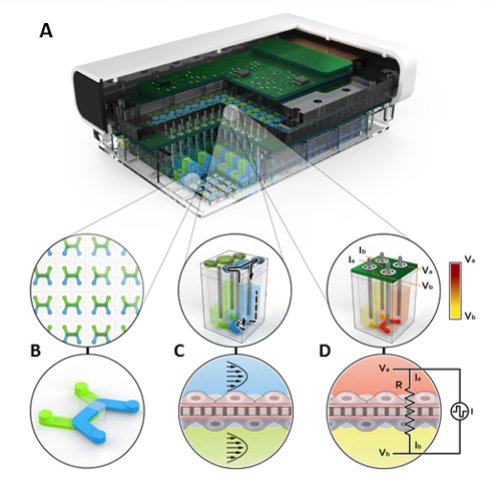
High-throughput platform. The PREDICT96 system is composed of a microfluidic culture plate with 96 individual bi-layer microchannel-based tissue culture units. Each unit is comprised of an apical and basal channel separated by a Transwell®-like membrane, in a standard 96-well plate format (Figure 1 B). The platform conforms to the SBS standard microplate footprint, enabling compatibility with high-throughput screening imaging modalities and other industry-standard equipment. Dynamic flow control. A recirculating pneumatic perfusion system driven by 192 microfluidic pumps in the lid enables independent operation in the apical and basal chambers of each of the 96 tissue units, providing physiological levels of fluid shear stress (Figure 1 C), as well as enabling accumulation of important signaling molecules and metabolites. Real-time sensing. Functionalized, stainless steel pump sippers facilitate fluid movement in the system and concurrently serve as integrated electrodes for near real-time sensing (TEER, O2). The system can be controlled remotely outside of an incubator using proprietary software (Figure 1 D). These real-time sensors reduce operator contact and intervention with the systems, increasing safety and mitigating potential sources of cross-contamination. Designed for seamless integration into standard laboratory equipment and drug evaluation pipelines, our technologies maximize flexibility and throughput. With parallel, integrated sensors, our platforms deliver far more high-quality data than other preclinical models, making preclinical testing for drug development more predictive and enabling novel drug discovery avenues.
CATEGORY
Similar to accelerometers, we developed gyroscopes which are critical components in various applications, from aerospace and defense to robotics and consumer electronics for improved guidance and navigation. Our gyroscopes, such as the radiation-hardened Interferometric Fiber Optic Gyroscope (RH-IFOG), are engineered with precision to assist in stabilizing and orienting vehicles, missiles, and spacecraft, ensuring accurate navigation. Gyroscopes played a pivotal role and contributed to the success of Submarine Inertial Navigation System (SINS), Peacekeeper, Trident I and Trident II programs.
CATEGORY
As the need for enhanced guidance and navigation systems continued to evolve, we developed highly precise accelerometers. These advanced sensors take specific force measurements while self-contained in a local inertial frame and require no physical or electromagnetic contact with external references. Our base accelerometers, the Pulse Integrating Pendulous Accelerometer (PIPA) and Pendulous Integrating Gyroscopic Accelerometer (PIGA), have been used in various guidance systems contributing to the success of Air Force and Navy weapon systems.
CATEGORY
We develop, build, and test state-of-the-art Inertial Measurement Units (IMUs), providing cutting-edge technology in ballistic missile guidance and navigation. Our IMUs have played crucial roles in supporting a range of systems and missions such as the Agena/CORONA systems, Peacekeeper, Polaris, Poseidon, Trident I, Trident II, the Space Shuttle, and various precision guided munitions and weapons.
CATEGORY
