LabOne®provides users with platform-independent instrument control including proven measurement methodologies. Today's leading instrumentation manufacturers invest on integration to increase the impact of their products and to differentiate them from the competition's. As researchers build ever more advanced experimental setups, the goal of Zurich Instruments is to help them reduce that complexity thanks to integrated test and measurement solutions. This is why Zurich Instruments developed LabOne®, the first-of-its-kind comprehensive user interface for leading scientists and engineers worldwide. Invest Smart Instrument purchases that are part of strategic long-term plans We believe in instrumentation that grows with our customers' needs. Our software updates are free, and configurable options can be added according to your changing requirements. The countless features we provide offer the flexibility you require for shorter- and longer-term research objectives. Save Time Experimental setups that work from day one Researchers should be able to rely on stable user interfaces for multiple simultaneous measurements. We offer a software infrastructure that accelerates your signal acquisition, and a variety of time- and frequency-domain analysis tools that speed up your data interpretation. Aim High Instruments that integrate the experience of opinion leaders The measurement approaches we pursue are validated with some of the world's leading laboratories and fine-tuned with some of the most prominent opinion makers in their respective fields. Our analysis tools provide inherent methodologies to achieve, check, and repeat measurements reliably. Browser Operation LabOne® users are free to operate, control, and monitor an instrument from their preferred device running their web browser of choice. The same instrument can be accessed from several work stations simultaneously – even remotely from a smartphone. Remote Measurement Freedom of operation is also reflected in the possibility of performing measurements remotely. Practical use cases include: - Run a measurement and display the data on a tablet. - Leave a noisy laboratory environment and control the instrument from an office. - Access the same instrument from several work stations simultaneously. - Monitor measurements remotely from a smartphone. API Compatibility Across Instruments The LabOne APIs allow users to run their programs with every instrument configuration on every instrument series. In this way, it is possible to transfer software seamlessly across different instruments. Choice of APIs Software Architecture The LabOne® software architecture is organized in multiple layers.All communications between users and instruments take place through the LabOne Data Server. This enables: - A multi-client configuration, where multiple interfaces (even from different computers on the network) can access the settings and data associated with an instrument. Settings are synchronized across all interfaces by the Data Server. - A multi-instrument setup, where any of the Data Server's clients can access multiple instruments simultaneously. Available APIs Native structures LabOne provides APIs that are based on native data structures for an efficient interface between the instrument and the programming environment. This produces transfer rates up to 100 times faster than traditional ASCII interfaces. Core library A library of elements called the LabOne Core Library allows customers to program their own user interfaces for quick integration of complex function groups (e.g., the Sweeper or Spectrum Analyzer tools). Minimal effort is required to switch from UI to API programming. Bidirectional APIs APIs allow users to store and reload data. Saved data can also be reloaded and analyzed offline with the same tools used for data acquisition. LabOne supports Python, C, MATLAB®, LabVIEW™ and.NET, and its APIs are compatible across instruments.
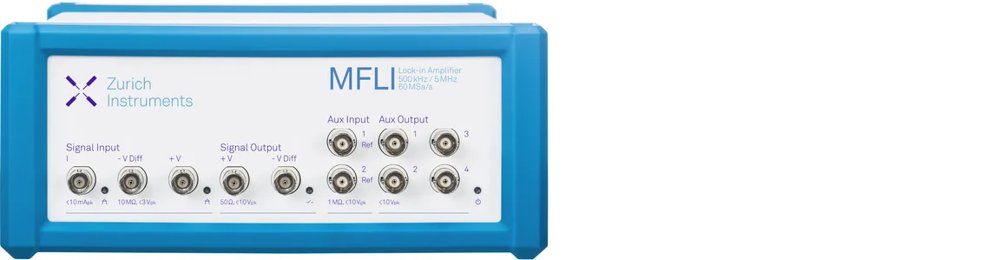
Zurich instruments’ lock-in amplifiers are ideal instruments for measuring the amplitude and phase of periodic signals from a large variety of optical experiments, covering the range from elementary to cutting-edge experimental designs. Thanks to their low input noise and large dynamic reserve, they can detect minute signals and achieve large signal-to-noise ratios (SNRs) quickly and reliably. Each instrument is equipped with a set of advanced measurement tools, such as an oscilloscope, a parametric sweeper, a spectrum analyzer, and more,allowing you to characterize your optical signals more comprehensively. Additionally, if an analog interface to other instruments is needed — for example, a control voltage for laser cavities or delay lines — internal measurement results or other customizable signals can easily be routed out from the instruments via the auxiliary output connectors. This toolset, together with several field upgradeable options, expand the functionality of the instruments well beyond lock-in amplification,making them a perfect fit for the demanding requirements of many applications. Each of these functionalities can be controlled through LabOne®,a proprietary software of Zurich Instruments.This platform-independent instrument control tool provides users with a powerful and intuitive user interface, together with support for the most popular programming languages. These features make Zurich Instruments' lock-in amplifiers extremely versatile, allowing them to be tailored to any experimental setup, reducing experiment complexity and decreasing the time to publication. Explore higher frequency domains of your optical experiment with high noise rejection and faster measurements: with signal inputs up to 8.5 GHz, Zurich Instruments’ lock-in amplifiers cover a wide range of modulation techniques and applications. Carry out multiple tasks in parallel with one instrument: for example, you can simultaneously perform lock-in detection and boxcar averaging on the signal from the photodetector while running a PID/PLL control loop to stabilize your laser cavity. The parallelization of several experimental aspects allows you to achieve results more efficiently and quickly. Ease of integration: thanks to our APIs (LabVIEW, MATLAB, Python,.NET, C), swiftly connect your lock-in amplifier with all the elements, e.g., delay lines and/or modulators, in your experimental setup.
CATEGORY
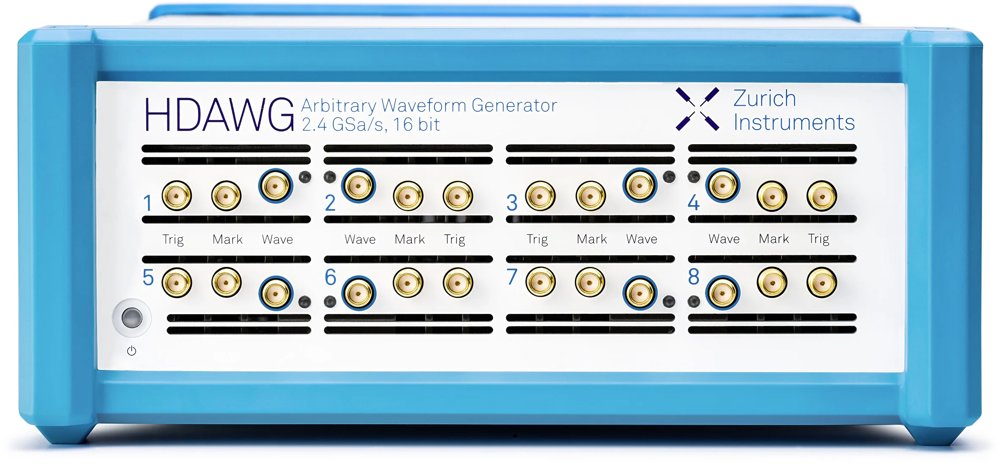
The HDAWG multi-channel Arbitrary Waveform Generator generates the fast pulses for the metallic gates which are used to control the QD energy levels and couplings and to drive the two-qubit gates. To counteract the effect of cross-coupling, additional pulses are applied to multiple gates. The HDAWG is able to modulate the microwave source in order to produce single-qubit gates. Different qubits can be addressed with frequency multiplexing. A single-sideband modulation scheme, in conjunction with the internal oscillators, suppresses unwanted images and facilitates a clean spectrum. Experience accurate spin control and enhanced fidelity, also for fast qubits, thanks to the fast and low-noise HDAWG outputs.
CATEGORY
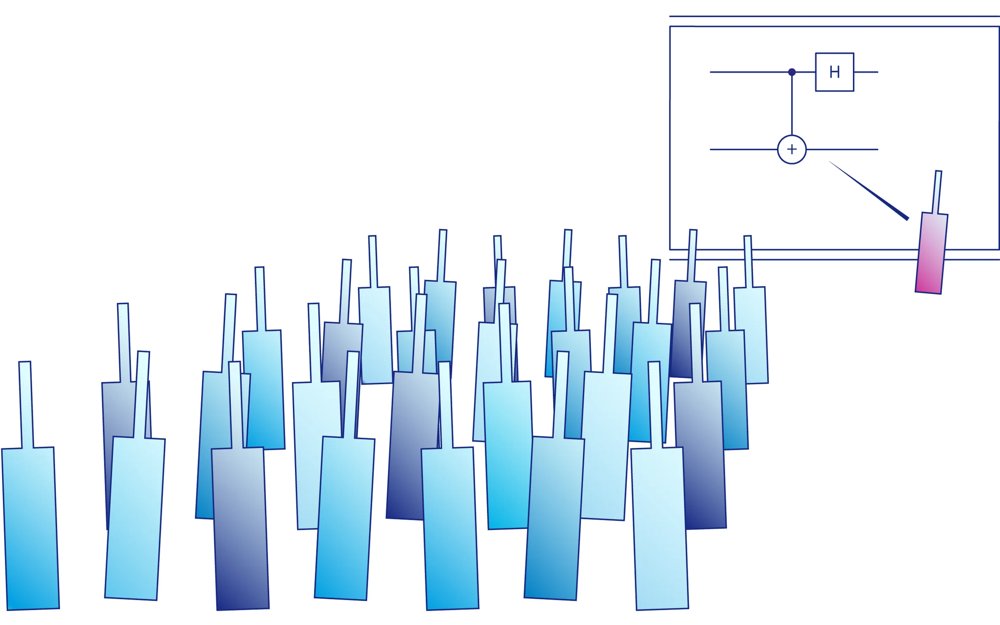
Operation from DC to 8.5 GHz 1 GHz bandwidth free from mixer calibration High output power for short qubit gates
CATEGORY