By Swiss Nanoscience Institute
One of the products is a DC block — a small device that provides clean and controlled grounding, thereby eliminating unwanted electrical currents that could distort measurement results or interfere with sensitive qubits.
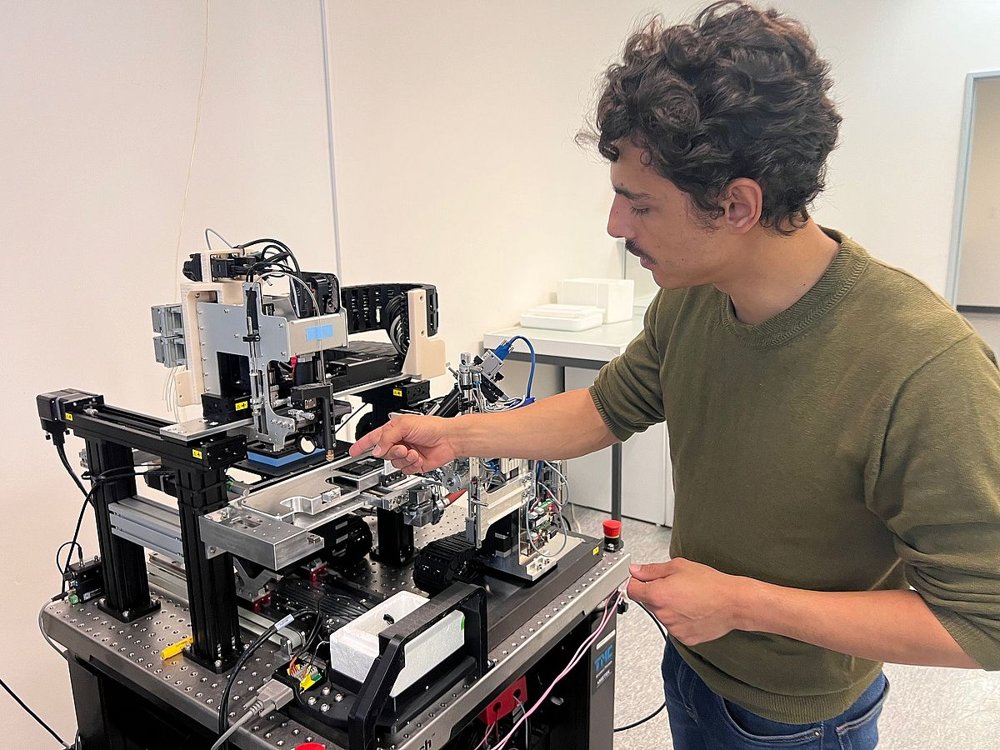
The Basel-based start-up is launching an automated system that can be used to prepare tiny sample quantities for cryo-electron microscopy with no loss of material. The aim of this fledgling company is to provide new avenues for efficient and reproducible sample preparation in the form of an automated, modular system for use with cryo-EM technology. For example, the processing of biological samples begins with selecting a cell from a cell culture, breaking the cell up and extracting the cellular contents, which are written onto the grid. The cryoWrite system can also include an effective and automated purification step that isolates a specific protein. Just two nanoliters of the sample material are enough to be written onto a grid as a thin layer for examination by electron microscopy. Once the material has been applied, the grid is quickly dipped into liquid ethane to vitrify the sample, and the automation process also includes the transfer of the grid to a cooled storage system for transport. “Our concept has a modular structure,” explains Engel. “We’re constantly working to develop extension modules that further broaden the system’s applications. For example, as part of the Nano-Argovia project FuncEM, we’re developing a module that aims to image ‘live’ samples under an optical microscope just before the freezing process. This would allow researchers to obtain relevant information on the functionality of the analyzed structures.” The aim is to sell 10 devices over the next few years, each of them costing around half a million Swiss francs.
CATEGORY
Qnami, a start-up led by Dr. Mathieu Munsch and the Georg H. Endress Professor Patrick Maletinsky, has moved in opposite the SNI’s general manager, Claudia Wirth. In this portrait, we introduce the young company, which manufactures quantum sensors and supports customers with all aspects of their use. Qnami’s business model is to use diamonds as precise and sensitive quantum sensors and to supply these sensors as probes for analyses using atomic force microscopes. The tiny diamonds used for this have defects in their crystal lattice, where a carbon atom has been swapped for a nitrogen atom and there is a vacant site immediately alongside. These defects are known as nitrogen-vacancy centers (NV centers) and can also occur in natural diamonds, where they impart a reddish color to the precious stones. At Qnami, the team produces these defects in their diamonds deliberately, taking advantage of the fact that the NV centers host individual electrons that can be excited and manipulated. The intrinsic angular momentum (spin) of these electrons, and their electric dipole, are extremely sensitive to tiny magnetic and electric fields. If the diamond sensor is exposed to a magnetic or electric field, this results in a measurable change in the NV center luminescence, which can be detected using a standard optical device. Each Qnami diamond is just a few micrometers long and contains a single quantum sensor of this kind. The diamonds are attached to a tiny cantilever probe and incorporated into an atomic force microscope, allowing images to be generated with nanometer resolution. Furthermore, since the sensors operate just as well at room temperature as they do at temperatures close to absolute zero, they can be used to analyze a wide range of materials and create precise images of electric or magnetic fields. As diamonds do not interact with the examined material, they are also suitable for analyzing biological samples. Inside a tiny diamond, electrons in nitrogen-vacancy centers are excited so that they emit a light signal. Qnami uses this optical signal to generate high-resolution images of electric and magnetic fields. He is currently manufacturing the first sensors for existing partners and customers – a technique that begins with the production, testing, and characterization of a whole series of these tiny diamonds. Every single diamond tip must then be manipulated in a process that takes about a day per tip.
CATEGORY
Filters of this kind are necessary because quantum bits (qubits) — the tiny, extremely sensitive units of a quantum computer — must be protected against interference from the environment. The filter developed by YQuantum ensures that interference in the form of electromagnetic noise, thermal effects or individual photons is attenuated and that the qubits retain their quantum states. It is also significantly smaller than existing filters, which will be a key factor when it comes to realizing a greater number of qubits in the future.
CATEGORY
The other product offered by YQuantum is a bias tee, which can, for example, be used to supply a component with electricity while simultaneously controlling it via high-frequency signals without the two signals interfering with one another. “This component ensures that communication between two qubits achieves a higher quality factor,” says Jünger. “It also allows us to improve quantum computing, although we often have to do a bit of educating — because some users aren’t aware of the imperfections of their current solutions.”
CATEGORY
