By Spectradyne Particle Analysis
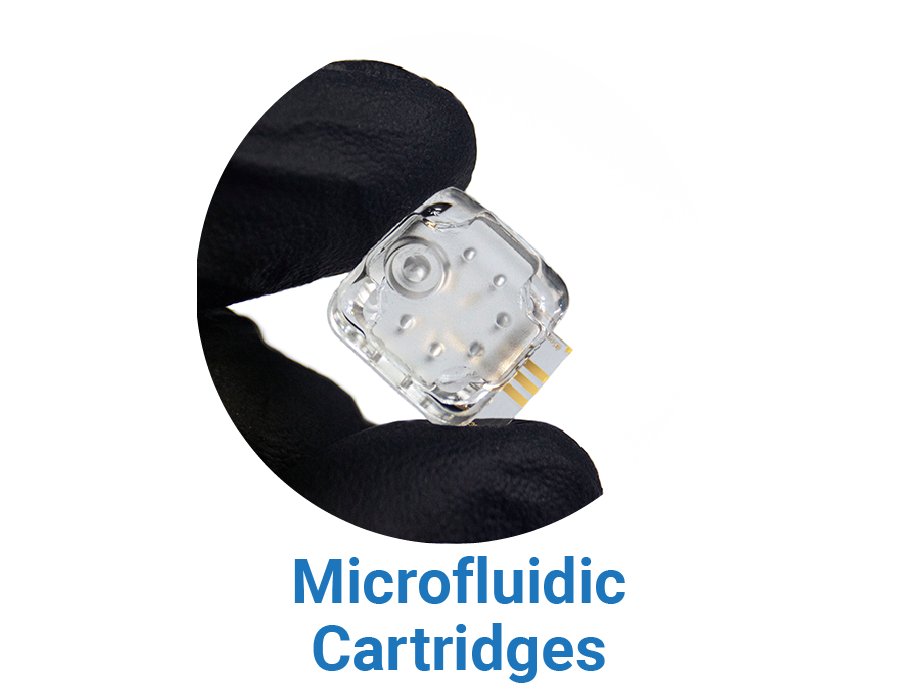
Spectradyne's single-use microfluidic cartridges are the foundation of MRPS. Leveraging advances in semiconductor processing, they bring Resistive Pulse Sensing to the nanoscale — making it fast, accurate, and practical for real-world samples. Available Cartridge Sizes Each cartridge class defines a particle size measurement subrange. Choose the cartridge that matches your expected particle size — multiple cartridge types can be used on the same sample to cover wider ranges. Cartridge subranges overlap to ensure every sample can be fully characterized. Contact our applications team if you are unsure which cartridge is right for your sample. The same cartridges. Two measurement platforms.
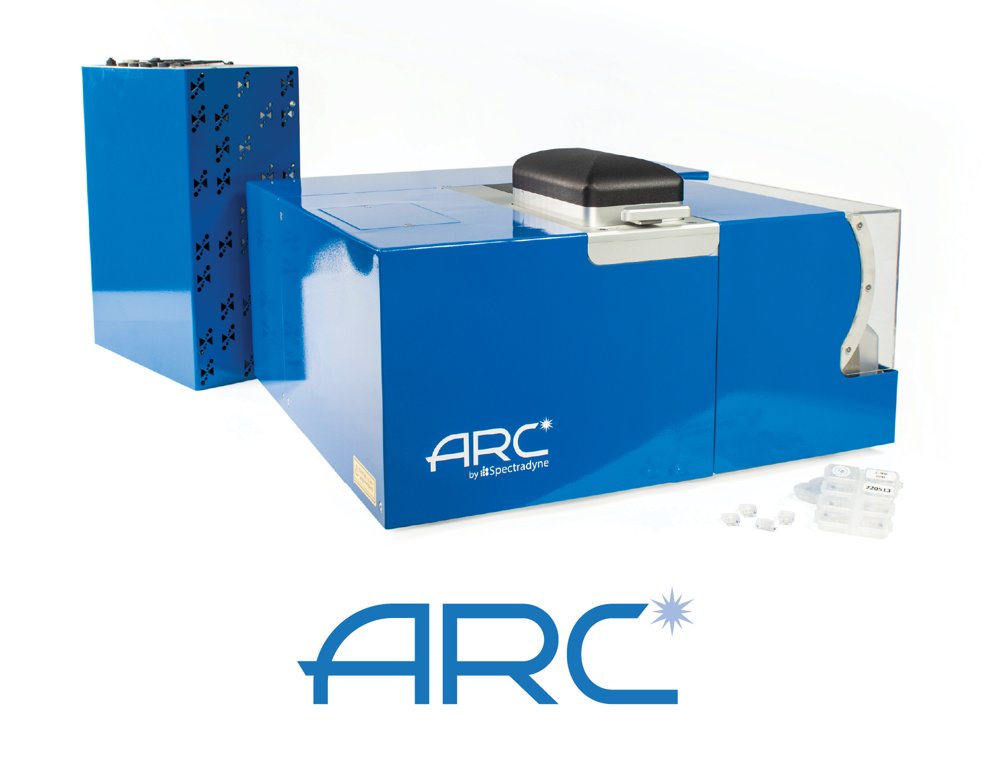
Three instruments in one Particle Sizing & Concentration MRPS electrical sensing delivers accurate size distributions and absolute particle concentration for every sample — regardless of optical properties, refractive index, or fluorescence. Measures 50 nm to 10 µm in a single 3 µL run. Single-Particle Fluorescence F-MRPS adds up to four simultaneous excitation wavelengths and four optical collection channels, correlated particle-by-particle with electrical sizing. Directly identify payload-loaded LNPs, fluorescently labeled EVs, and viral vectors without secondary assays. GMP/GAMP Ready ARC is GMP/GAMP and 21 CFR compliant, supporting pharmaceutical manufacturing and quality control workflows. Microfluidic cartridges are single-use — no cross-contamination risk, no calibration between runs, and results in under five minutes. F-MRPS Technology Fluorescence correlated, particle by particle The ARC combines MRPS electrical sensing with simultaneous single-particle fluorescence detection — up to four excitation wavelengths and four optical collection channels, operating in parallel. Every fluorescence signal is correlated with a simultaneous electrical size measurement for the same particle, in the same 3 µL run. Channel configuration Excitation: 405 nm, 488 nm, 561 nm, 637 nm Collection: Blue, Green, Yellow, Red Electrical: MRPS — always on All four excitation and collection channels operate simultaneously alongside MRPS electrical sensing. LNP Payload Efficiency Directly measure encapsulation of fluorescently labeled nucleic acid cargo. No indirect Ribogreen assay required. EV Surface Phenotyping Quantify CD63, CD9, CD81, or any fluorescent antibody label alongside accurate EV size and concentration. EV Membrane Staining Characterise EV populations with membrane-permeant and -impermeant dyes. Validated with Biotium ExoBrite stains. Viral Vector Loading Distinguish full, partial, and empty AAV or lentiviral capsids by correlating fluorescent staining with electrical size. True orthogonality: Because MRPS measures size electrically — not optically — fluorescence detection does not interfere with sizing accuracy. The ARC simultaneously reports accurate size and absolute concentration for the total particle population, each fluorescent subpopulation, and non-fluorescent particles. Applications Built for the samples that matter most The ARC measures particle types that conventional light-scattering instruments struggle with — low optical contrast, polydisperse, and precious biological samples. Lipid Nanoparticles Measure payload encapsulation efficiency, ligand density, and size distribution simultaneously. Replace indirect Ribogreen assays with direct single-particle fluorescence. GMP/GAMP ready for quality control. Extracellular Vesicles Accurately count and size EVs down to 50 nm using electrical sensing — not light scattering. Combine with multi-channel fluorescent surface marker phenotyping on the same 3 µL sample. Virus & Gene Therapy Count viral particles and distinguish genome-loaded from empty capsids in minutes. Quantify AAV, lentivirus, and non-viral vectors with high resolution from just 3 µL — no live biological assay required.
CATEGORY
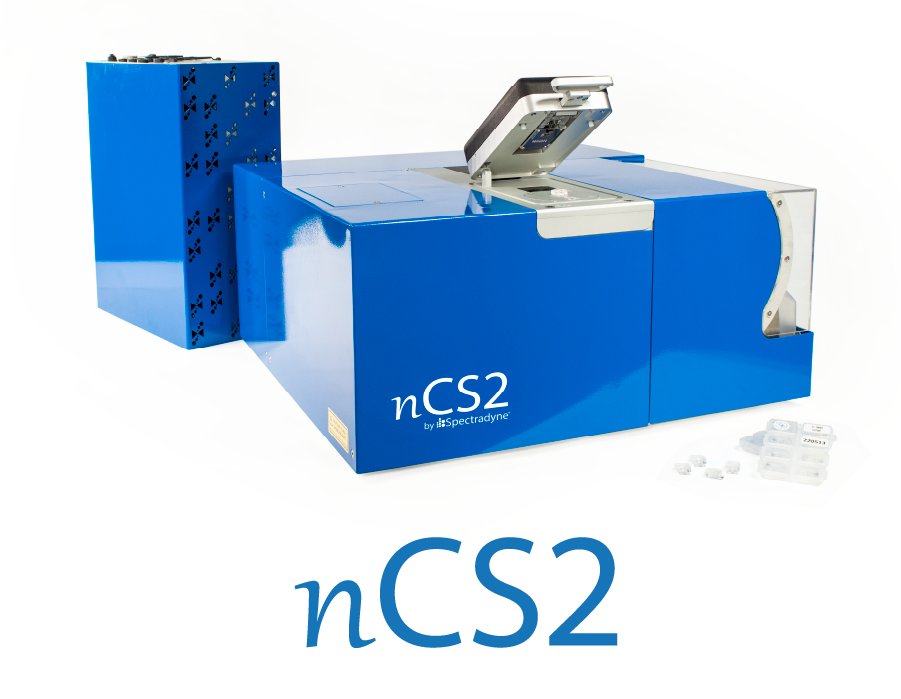
Fast, accurate nanoparticle size and absolute concentration using MRPS electrical sensing — from a single 3 µL sample. Measures any particle type regardless of optical properties, from 50 nm to 10 µm, with results in minutes. Accurate sizing for any sample, in minutes Upgrade path to the ARC: The nCS2 and ARC share the same chassis and platform. When your research expands into single-particle fluorescence — payload quantification, EV phenotyping, or viral vector loading — the nCS2 upgrades directly to a full ARC without replacing your instrument. MRPS vs. Light Scattering — Where DLS and NTA fall short: DLS and NTA measure bulk optical properties and cannot reliably resolve polydisperse samples. MRPS measures each particle individually by electrical displacement, delivering accurate size distributions and absolute concentration even in complex, multi-population samples. Validated against CryoTEM: MRPS sizing has been independently validated against cryogenic transmission electron microscopy — the accepted gold standard for nanoparticle sizing. Read the application note for head-to-head data. Built for the samples that matter most: The nCS2 measures particle types that conventional light-scattering instruments struggle with — low optical contrast, polydisperse, and precious biological samples requiring minimal volume.
CATEGORY

Choose the right instrument for your lab. Spectradyne’s MRPS and F-MRPS technology measures the size, concentration, and fluorescent phenotype of every nanoparticle in your sample — in minutes, not days. 3 µL Sample volume. <5 min Per run. 50–10000 nm Detection range.
CATEGORY
Spectradyne LLC has recently released a novel nanoparticle characterization instrument, the nCS1, which is capable of measuring the size distribution of nanoparticles with diameters ranging from 30 nm up to a few microns, over a wide range of nanoparticle concentrations, from 10 7 to 10 12 particles/ml. The instrument can report accurate size distributions of a wide variety of nanoparticles in a range of suspension media, and reports the data in absolute nanoparticle concentration units. The basis for this new instrument is the well-established resistive pulse sensing technique, implemented by Spectradyne in a miniaturized and disposable microfluidic cartridge. The basic concept involves passing a weakly conducting analyte carrying the nanoparticles or microparticles of interest through a small constriction having a diameter of a few hundred nanometers to a few microns. A bias voltage is applied across the constriction, and the electrical resistance of the current path through the analyte and the constriction is monitored. When a nanoparticle passes through the constriction, it blocks some of the electrical sensing current, increasing the electrical resistance of the constriction by an amount proportional to the nanoparticle volume. Monitoring the electrical resistance as a function of time thus yields a number of short pulses, each corresponding to the passage of one nanoparticle, with the pulse amplitude yielding the nanoparticle volume, and the duration corresponding to the particle dwell time, and thus the particle velocity. As the particles are entrained in the suspending fluid, the pulse duration yields the volumetric flow rate. One can thus obtain the concentration of nanoparticles as a function of nanoparticle size, directly from the time trace of the electrical resistance. For the instrument to work properly, the aqueous solution must have a conductivity that falls roughly in the range of 0.1 to 1 S/m, typically achieved by dissolving 0.01 to 1 M of salt in water. Phosphate-buffered saline (PBS), for example, serves well, and blood serum and urine have the appropriate levels of conductivity. In Spectradyne’s implementation of the resistive pulse sensing technique, particles are detected in a disposable microfluidic cartridge that forms the core of the nCS1. The sample to be analyzed is pipetted into a reservoir in the cartridge (just 3 microliters of analyte are required), and the cartridge is loaded into the instrument for measurement. The analyte is prevented from contacting any other instrument components prior to analysis, removing any possibility of cross-contamination. After engaging the cartridge with the instrument, automated software controls the microfluidics and data acquisition, and complete data sets can be generated within a minute or so. Following data acquisition, software-based analysis of the data produces the basic output of the instrument, which comprise particle histograms as a function of particle size. The particle concentration is reported in the form of a concentration spectral density (CSD TM ), which corresponds to the number of particles per ml of analyte solution per nm of particle diameter. The disposable microfluidic cartridge affords a number of powerful advantages over other competing techniques. First and foremost, the maximum sample volume used in an analysis is only 3 microliters, set by the size of the analyte reservoir in the disposable cartridge. This is highly appealing for situations in which the test formulation is expensive or difficult to produce, and provides a significant and welcome reduction in volume from what is needed in, eg, DLS-based analyses. Secondly, the very high count rates afforded by Spectradyne’s instrumentation means that statistically significant data sets can be acquired in just a few tens of seconds of data acquisition. Thirdly, the wide range of concentrations that can be reliably measured, from 10 7 to 10 12 particles per ml, means that many formulations can be measured as is, often without the potentially problematic need for dilution or concentration. Finally, the low cost of the disposable microfluidic technology means that tests can be repeated multiple times without incurring significant expense, allowing the close observation of an on-going process, or monitoring the stability of a formulation following production.
CATEGORY
