By Aquamarijn
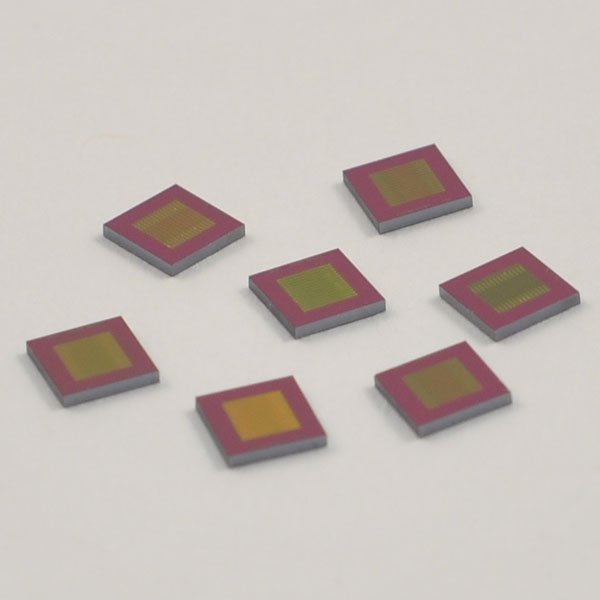
Low-porosity microsieves are typically used in microsieve filtration applications or as a nanostencil during shadow mask deposition. Sieves can be mounted in POM mounting discs (13mm or 25mm) for dead-end filtration units or in Stainless steel discmounts (29mm) for a crossflow filtration unit. Specifications table for low-porosity microsieves (chip size: 5×5 mm 2, chip thickness: 0.4mm) For chip size: 10×10 mm 2, contact us for a quote. Pore size (µm) / Pore pitch (µm) / Porosity (%) / Pores 2 / 8 / 5.7 / 113,666 3 / 12 / 5.7 / 50,518 4 / 16 / 5.7 / 28,416 5 / 14 / 11.6 / 32,984 6 / 24 / 5.7 / 12,630 7 / 28 / 5.7 / 9,279 8 / 32 / 5.7 / 7,104 9 / 36 / 5.7 / 5,613 10 / 40 / 5.7 / 4,547
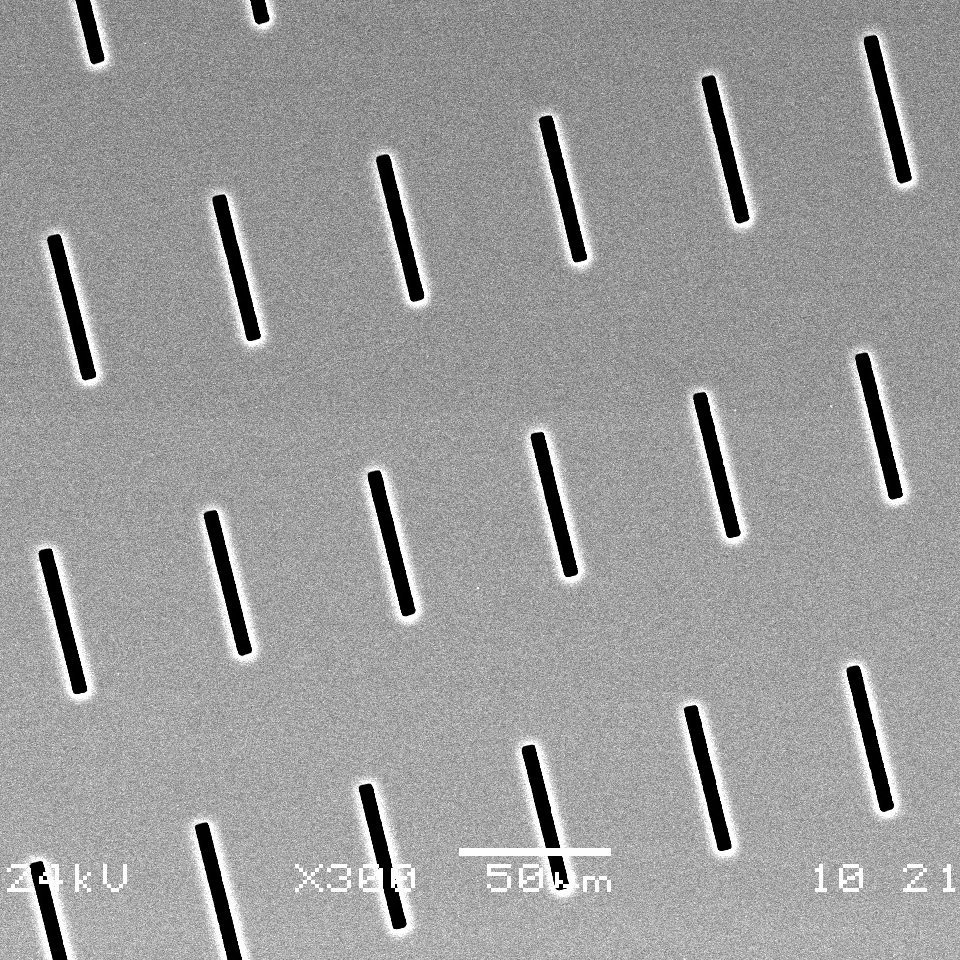
Aquamarijn offers microsieves optimized for emulsification with hydrophobic or hydrophilic coatings for making WATER in OIL or OIL in WATER emulsions respectively. A cross-flow module made of stainless steel is available. For emulsification with strong solvents, we offer perfluoro elastomer (FFKM) O-rings. Solvent-resistant glue will be used to mount the chip onto a disc mount. Altogether, this makes the module fully solvent-compatible. Different designs & materials and a start-up kit & scaled-up module are available upon request. The microsieve membrane emulsification process generates monodisperse droplets by dispersing one fluid into a second, immiscible fluid through a precise microsieve. Thanks to the homogeneity of pore size, every droplet generated by the microsieve membrane is the same. In addition, hydrophobic or hydrophilic coatings for making WATER in OIL or OIL in WATER emulsions respectively, advances and stabilizes the process of emulsification. Altogether this results in highly uniform, reproducible and size-controlled droplets. The droplets can be transformed into particles after an appropriate solidification step. In principle, the size of the droplet will be about 4 times larger than the width of the slit chip. It means: - Slit chip 2×20 ⇒ ~ 8µm droplets - Slit chip 3×30 ⇒ ~12µm droplets - Slit chip 5×50 ⇒ ~25µm droplets Additionally, membrane emulsification also can be performed with a low porosity membrane. In this case, the droplet size will be determined by the flow rate of the continuous flow. Microsieves Specification: - 2x20: Shape Slit, Outer diameter /length 20 µm, Width 2 µm, Nozzles per chip 9504 - 3x30: Shape Slit, Outer diameter /length 30 µm, Width 3 µm, Nozzles per chip 4224 - 5x50: Shape Slit, Outer diameter /length 50 µm, Width 5 µm, Nozzles per chip 1456 Type: Slit 2x20; Length: 20µm; Width: 2µm; Nozzles per chip: 9540 Coating: none, hydrophobic (w/o) CHF 27.00, hydrophilic (o/w) CHF 50.00 Disc-mount: Non-Solvents use CHF 25.00, Solvents use CHF 50.00 Holder: none, Non-solvent use CHF 462.00, Solvents use CHF 530.00
CATEGORY
We introduced a revolutionary micro filtration membrane: microsieves, micro-engineered membranes produced using silicon micromachining. The most important features of the microsieve membrane technology are the precision-etched pores (depending on your application, 0.1-50 µm) and a thin membrane (with a thickness of 0.5 to 2 µm) with a surface roughness down to a few nm. Special properties of the microsieve®are: Well defined pore shape; Uniform pore size distribution (standard deviation less than 1%); Available with customer specific inorganic or organic coatings; Optically flat; this allows fast microscope scanning without adjusting focus; Smooth pores showing minimal cell rupture (f.i. hemolysis or blood platelet activation); Integration with Micro Total Analysis Systems (µTAS); Isolation of vulnerable cells when using a microsieve®which is thinner than the pore size. The flow rate of the Aquamarijn microsieve® is the highest yet available due to the uniform pore size, the high pore density and the small thickness of the membrane layer. The clear water flux is at least one order of magnitude larger than the best conventional filters and approaches nearly the theoretical maximum throughout the whole pore size range. In a cross-flow configuration fouling is easily prevented at relatively low cross-flow pressures due to the excellent overall flatness of the membrane layer. Microsieve properties: Membrane Size 1 to 150 mm, Circular or Rectangular; Membrane Thickness 0.1 to 2 µm; Pore Size 0.1 to 100 µm; Membrane Material Ceramic, Si3N4 or SiO2; Support Silicon or Other; Support Thickness 0 to 500 µm; Membrane Coating Ceramic, metallic, monolayer or polymeric; Temperature Resistance -50 to 800°C; Chemical Inertness Inert to (in-)organic solvents; Surface Roughness 1 to 100nm rms; Protein Adsorption antifouling coatings possible; Refractive Index 1 to 2.1; Optical Flatness Yes; Operating Pressure 0 to 0.5 MPa; Cleaning Cross-Flow/Back Pulsing/Aggressive Solvent/Oxygen Plasma; Sterilisation Yes; Clear Water Flux See Graph.
CATEGORY
In this test method, the liquid sample is quickly filtered through the microsieve disc. The microsieve membrane surface retains most of the content of the sample, and is scanned by microscope directly. The inertness of the membrane allows for immediate staining, directly at the membrane surface for use with fluorescence microscopy. As the membrane material has no autofluorescence, this yields clear images. Because the total surface area of the microsieve is small in comparison to the collected sample, it is easy to count individual micro-organisms. Furthermore, with the microsieve test method it is possible to differentiate with selective staining agents between dead and living cells, something that is difficult with ‘plate count’ (living cells only), ATP (living cells only) and PCR (dead plus living cells) methods. The microsieve test disc for microbiological analysis may be used in applications other than beer screening. For example, the test disc are also suitable for the quality control of drinking water on the presence of Cryptosporidium, Legionella and E-Coli. Properties - Rapid detection of micro-organisms and particles present in liquid - Ultra low detection limit (1 micro-organism / ml) - Fast results (typically less than 1 hour). - No auto-fluorescence allows for use of living/dead staining kits. - Automation possible with image recognition software.
CATEGORY
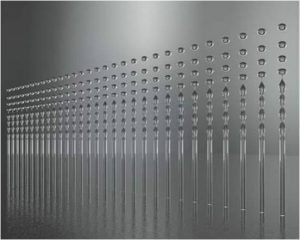
Medspray uses established micro & nano technology processes to manufacture the spray nozzles. The orifices of our spray nozzles are tiny (1 to 30 micrometer, for reference: a human hair is 70 microns thick). Spray nozzles are created batch-wise, with several thousand nozzles from a single silicon wafer. Our spray nozzle units are based on plain orifice nozzles, creating Rayleigh jets. A 2 micron hole creates a jet, breaking up in mono-disperse 4 micron droplet trains. The diameter of the droplets is twice the size of the orifice. The hole size can be engineered to meet the specific requirements of the device. Spray nozzle chips do not have electronic functions, it is purely a mechanical structure, made with technologies generally used to make computer chips. Pressing water through the Medspray nozzle results in a jet which will automatically break up in droplets (Rayleigh principle). This is mono-disperse, all droplets have the same size. The droplets are twice the size of the jet. By changing the hole diameter of the spray nozzle, the droplet size can be engineered for optimal performance.
CATEGORY
