Consumer Packaged Goods (CPG) companies, and those that sell into them, have been adopting AI as part of their product development process, and with good reason – it works! 2 of the top 10 Personal Care companies use the Citrine Platform in their product development processes and we are now in a position to illustrate not only that it works technically, but how our customers are getting return on investment. When optimizing formulations the Citrine Platform is able to simultaneously optimize technical properties such as viscosity, sensory properties such as liking, and business considerations such as cost or number of ingredients. The Citrine Platform not only predicts the outcome of the experiment, but also the accuracy of its prediction. Researchers can therefore choose experiments with a high likelihood of success. Fewer experiments are therefore needed to hit targets, speeding up development time significantly. The Citrine Platform is designed to encourage domain knowledge integration. Once datasets are set up with proper documentation of experimental conditions and AI models are created with embedded scientific equations etc., the models, data and search spaces are shareable assets that new team members can review and reuse, gaining the hard-won knowledge of your expert formulators. The Citrine Platform is not a black box. In fact one of our users described it as a flashlight. Whether and how an input e.g., % of emollient in a cream, or in AI parlance “Feature” is thought to be related to an output e.g., viscosity, is listed in the Citrine Platform Feature Importance section. Here a domain expert can sense check the model and reassure themselves that the model is taking into account features that they think are important, but it also enables researchers to see factors that they have perhaps not considered before, or to rule out the importance of a feature, so that future experiments varying that input are not needed. As well as accelerating product development by reducing the number of experiments needed, the Citrine Platform helps researchers to confidently use completely new ingredients. The Citrine Platform enables the development team to tag ingredients and enter their properties. It is then able to predict which new ingredients are going to best fit a formulation. The Citrine Platform is currently being used on such projects. The Citrine Platform can be used in two ways to guard against this risk. The first is to use the platform to find ingredients from different suppliers that perform in an equivalent way in formulations. The second is to pivot quickly when issues occur. The platform captures data in a way that it can be used by future researchers, with proper, standardized documentation of experimental conditions etc.
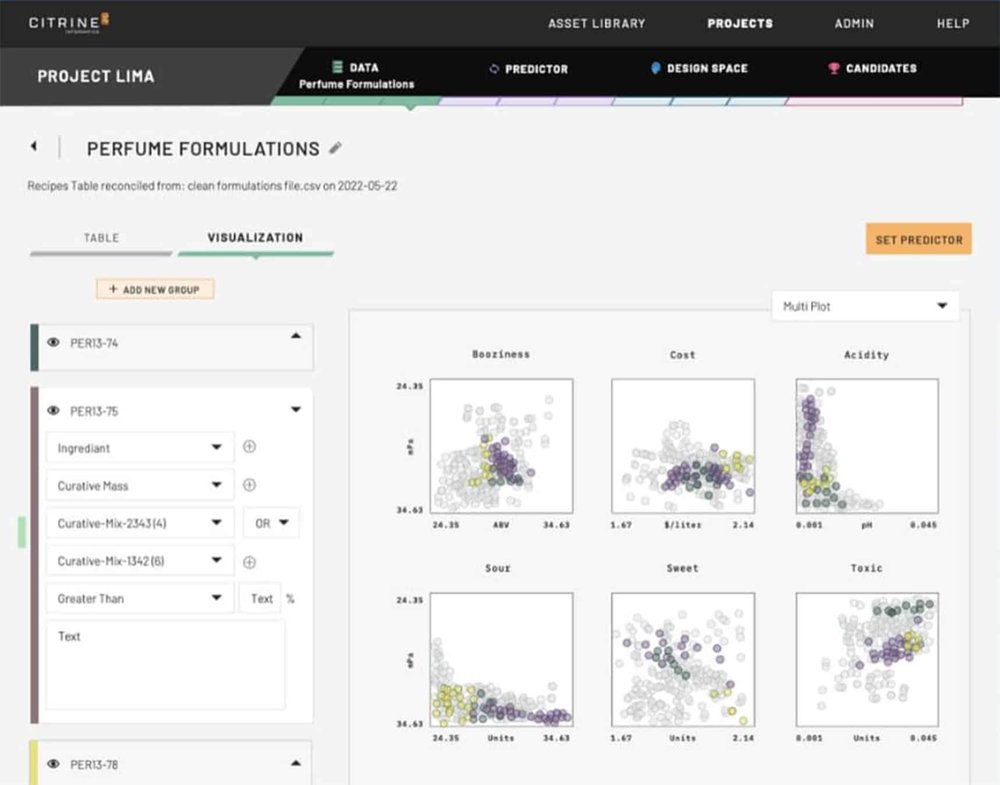
Scalable data management for chemicals, materials, ingredients and products. What it is: The Citrine DataManager (CDM) enables you to unify and leverage data across your enterprise. It is a chemistry-aware software toolkit to capture, enhance, analyze, visualize and communicate your data in a structured but flexible way. The starting point of your AI journey and the first way that you get value from the Citrine Platform. How this benefits our customers: Increased Productivity - Structure your data so that it can power AI - Reduce repeated experiments by making data findable, comparable and reusable across your business units - Enable knowledge transfer through visualizations Improved Customer Responsiveness - Quickly find the product closest to your customer’s requirements - Visualize how your product compares to those of your competitors - Streamline inventories and work around supply issues How it is different from other options: Unlike legacy data management solutions, Citrine Data Manager (CDM) was specifically designed for product experts wanting to use AI on complex products where materials, chemicals or ingredients are a key part of their competitive advantage. Product experts need - An easy way to digitize data and check its quality - A data structure that grows as they learn more about their project, or they want to join datasets along a value chain - A common vocabulary, so that teams can speak different languages and use different units, but still work with each other’s data - The ability to systematically specify all steps in a material’s processing history, including processing conditions and batch measurements. - Intuitive visualizations to communicate their work, learn from others, and assess data quality - A secure way to store and share data - A place where experimental parameters, formulations and end product measured properties come together to power AI How it works: Get data into the Citrine Platform easily: Data can be ingested quickly via CSV, Excel or directly using our API. Omni – the universal data harmonizer – can extract data from Technical Data Sheets, harmonize it with data already on board and then present it for your validation. CDM also includes a flexible Python interface to automate data ingestion. CDM streamlines importing data from common instrument files, e.g. HPLC. Citrine Professional Services can help you get almost any data AI-ready. Our team of experts uses a combination of manual and programmatic techniques to clean and structure your data. Increase and improve data automatically: CDM’s descriptor libraries convert information like chemical formulas and SMILES to relevant features automatically enhancing the dataset that can be used in AI. Check data quality through visualizations: Researchers can inspect the data using visualizations to spot any outliers so they can clean and correct data if needed. Data model that doesn’t turn data away: Our open-source materials data model (Graphical Expression of Materials Data, or GEMD) is at the core of CDM. It enables customers to add and remove properties, relationships and related data sets with ease. This means that unlike, standard relational database it never turns away data. The platform ensures that data is comparable across a team. While each team member can use the name and units they are used to, a template can join comparable data together and convert units so that all the data can be easily analyzed and visualized and used to power AI. This is particularly useful for companies with business units in different countries. Data model that fully captures the context: Each step from procurement to final product is visualized in the material history and made available to AI models. Product experts can learn from these diagrams and can click to uncover details. In this example, each stage is recorded, including, both the specified processing parameters (e.g., 200°C) and the actual measured parameter in that run (e.g., 199°C). The color-coded graphical user interface is easy to use, and users can also use the Python client to add, review, and revise data. This rich data model enables AI access to all aspects of a material’s history that will affect its final properties. Visualization and reporting: Finally, data can tell a story. Visualization tools and custom reports, enable teams to communicate their progress to managers and customers. Information Security: The data is secure in the platform and access to team data and specific projects is controlled by an authorization system.
CATEGORY
From product goal to AI-guided experimental decisions in minutes Catalyst helps materials and chemicals teams use natural language to move faster from questions, goals, and data to better experimental decisions. Built into the Citrine Platform, Catalyst helps scientists query knowledge, analyze candidate experiments, create AI workflows, and improve models with their own domain expertise. What it is: It lets product development teams use natural language to move through work that normally takes time, training, and manual setup. With Catalyst, users can: - Query data, uploaded reports, and peer-reviewed scientific papers - Analyze suggested experiments and predicted materials - Turn product goals into AI workflows - Edit AI models with domain knowledge Catalyst is built into the product development workflow, where Citrine data, models, search spaces, and candidate experiments already live. What can Catalyst help product experts do? Gain knowledge and insight Catalyst helps users query their data, uploaded reports, and curated peer-reviewed scientific papers using natural language. Teams can find relevant materials, compare options, summarize reports, and reuse prior knowledge faster. Example prompt: Which materials have a high viscosity, low cost, and use plant-based surfactants? Catalyst helps users identify relevant results and inspect the source information behind the answer. Analyze suggested experiments and predicted materials Catalyst helps users understand which AI-suggested experiments or predicted materials are most promising. Users can ask Catalyst to compare candidates, explain tradeoffs, and recommend what to test next based on target properties and customer requirements. This helps teams move from a long list of possibilities to a focused experimental plan. Go from product goal to full AI workflow Catalyst can turn a product development goal into a Citrine project in minutes. A user can describe a goal in ordinary language, such as: Find a lower-cost formulation that maintains tensile strength and improves flexibility. Catalyst can help create the first version of the workflow, including: - Dataset - AI models - Search space - Target properties - Candidate experiments The user can then review, edit, and guide the workflow before acting. Edit AI models using domain knowledge Catalyst helps product experts add their knowledge directly to AI models using natural language. For example, a user might write: Hardness affects texture liking. Catalyst can suggest model edits that reflect that relationship. The user reviews and approves changes before they are applied. This helps teams capture expertise, improve model relevance, and make AI workflows more aligned with real product development experience. How does Catalyst help our customers? It reduces the time from question to action Catalyst helps users move faster from product questions to usable next steps. Instead of manually searching documents, configuring workflows, or analyzing candidates in separate steps, users can prompt Catalyst and work through the process in the platform. It lowers the barrier to broader AI adoption Catalyst makes it easier for more scientists to start using AI. Users can begin with the outcome they want, not with a blank project setup. Catalyst creates a starting point they can inspect and refine. This reduces training burden and helps teams adopt AI more consistently. It helps Product Experts choose the next experiment Catalyst helps scientists understand what has been recommended and why. Product experts can compare candidates, evaluate tradeoffs, and decide which experiments are most likely to move the project toward its goal. It supports cross-team learning Catalyst helps teams reuse knowledge from prior data, uploaded documents, reports, and scientific literature. It also helps capture domain knowledge in models, making expertise easier to share across teams and projects. How is Catalyst different from a generic AI assistant? It is built into the product development workflow Catalyst works inside the platform, connected to the data, models, search spaces, and candidate experiments that teams already use. It is designed for product development workflows, not general-purpose chat. It supports action, not just answers Catalyst can help users ask questions, analyze data, create workflows, evaluate candidate experiments, and edit models. That means it supports the work before, during, and after AI-guided candidate generation. It shows the reasoning Catalyst is designed for scientific decision-making. Users can inspect source information, rationale, tradeoffs, and recommendations before deciding what to do next. Scientific sensibilities Catalyst is designed for scientific work. - It supports expert judgment rather than replacing it - It provides references where source material is used - It helps users inspect reasoning and recommendations - It allows scientists to review, refine, and guide workflows - It keeps product experts in control of the final decision Private and secure Our security standards apply to your Catalyst queries, just like any other data you trust us with. Citrine does not train LLMs using your data or conversations. How it works: Catalyst is integrated with the rest of the Citrine platform, so you can interact with it as you think of questions or ideas. Knowledge and insight Use natural language to query Citrine data, uploaded reports, and peer-reviewed scientific papers. Experiment analysis Ask Catalyst to compare candidates, explain tradeoffs, and recommend which experiments to consider next. AI workflow creation Describe a product development goal. Catalyst helps create a project with data, models, search space, target properties, and candidate experiments. Model editing Tell Catalyst what domain knowledge matters. Catalyst can suggest model edits for the user to review and apply.
CATEGORY
Citrine| VirtualLab A powerful AI system that lets your researchers find better results more quickly, by conducting virtual experiments before they go into the lab What it is: Citrine VirtualLab (CVL) refers to a set of generative AI tools that allow companies to rapidly identify chemical formulations and materials that are likely to match a set of pre-defined specifications. Why this matters to our customers: We have designed Citrine VirtualLab to apply cutting-edge machine learning techniques to the materials and chemicals domain. With the Citrine Platform, you are always in control. Our approach to AI is to make it as easy as possible to develop and review proposed solutions, so your teams can focus on finding results that work for your business. Working with Small Data Sets The Citrine Platform was designed from the outset to work well on the small, sparse data that materials companies usually have. We’ve tackled projects with fewer than 30 initial data points. Using Your Experts’ Domain Knowledge A graphical model enables researchers to see how components fit together and facilitates the integration of expert domain knowledge. The machine learning models fill in gaps in knowledge, not in relearning the basics. Reusable Components Once built, each component can be used as part of other AI and machine learning projects in your company, contributing to a library of codified domain knowledge that researchers across the team can use. Sequential Learning Workflows The Citrine Platform powers the next generation of experiment design. Using iterative, proprietary calculations that factor in uncertainty, you can efficiently and systematically see how each of your desired parameters might perform. What it replaces: Typically, chemists and product engineers have relied on intuition and lengthy physical experimentation to create new features. CVL uses artificial intelligence to virtually combine thousands of possible combinations of ingredients and processes to identify promising combinations with the features that your customers want. CVL enables you to capture the greatest value from your own intellectual property. How it works: At the simplest level, you create a new AI model with checkboxes to choose the inputs you’ll consider, and a drop-down box to choose the property you want the model to predict. You can also use our graphical AI model builder to add expressions, processors, and even configurable features on chemical formula data (featurizers). You can use sliders to select upper and lower bounds for ingredient and processing parameters. The CVL AI engine rapidly synthesizes hundreds or thousands of experiments based on your inputs, and presents you with easy-to-use visualizations to quickly review your results and generate value more quickly. With our graphical AI Model builder, for example, the team can see how pieces of the model fit together. Detailed feature impact plots help you to unpick the effects of different raw materials, process parameters, and molecular features on your target properties. This helps companies supplying raw materials highlight the impact of their products, and helps Product Experts understand their domain in more detail. CVL shows you results with visualizations that are easy to understand and assess. Candidate materials can be filtered, color-coded, labeled, and compared. Clear charts show how candidates compare to targets and to existing materials. Researchers can use these charts to communicate progress and collaborate within a team and across your company. The Citrine Platform includes a Python API as you roll out AI for materials and chemicals across your organization. The API lets Python users structure, reuse, automate and share interaction pathways, enabling efficient deployment of AI at scale.
CATEGORY
Bring new supplier materials into your formulation workflow in minutes — not days. Omni eliminates manual data entry by automatically extracting and harmonizing data directly from your TDS documents. From PDF to Model-Ready in Minutes Upload any Technical Data Sheet (TDS) as a PDF and the Citrine Platform handles the rest — no copy-paste errors, no mismatched units, no duplicate hunting. A clean validation interface keeps a human in the loop, ensuring data quality while dramatically cutting onboarding effort. After validation, the new raw material is immediately available for the entire team. What OMNI Does For You Scans & Extracts Reads property data directly from PDFs — no templates required Deduplicates Checks whether extracted properties already exist in your dataset Harmonizes Normalizes units and property names automatically for consistency Validates Presents clean data for scientist review before ingestion Ingests Adds the new raw material directly into your existing dataset Omni is Available in the Citrine Platform Today Available Now Omni is the first step in the Universal Data Harmonizer roadmap — live and ready to use. More Coming Soon Additional automated ingestion capabilities are on the roadmap and coming soon. Get Started Ready to eliminate manual data entry? Reach out to your Citrine team today.
CATEGORY
