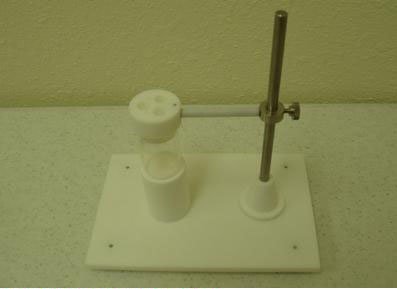
The scanning electrochemical microscope (SECM) was introduced in 1989 as an instrument that could examine chemistry at high resolution near interfaces. By detecting reactions that occur at a small electrode (the tip) as it is scanned in close proximity to a surface, the SECM can be employed to obtain chemical reactivity images of surfaces and quantitative measurements of reaction rates. Numerous studies with the SECM have now been reported from a number of laboratories all over the world, and the instrument has been used for a wide range of applications, including studies of corrosion, biological systems (e.g., enzymes, skin, leaves), membranes, and liquid/liquid interfaces. Trapping and electrochemical detection of single molecules with the SECM has also been reported. The CHI920C Scanning Electrochemical Microscope consists of a digital function generator, a bipotentiostat, high resolution data acquisition circuitry, a three dimensional nanopositioner, and a sample and cell holder. Diagrams for the SECM and cell/sample holder are shown below. The three dimensional nanopositioner has a spatial resolution down to nanometers but it allows a maximum traveling distance of 50 millimeters. The potential control range of the bipotentiostat is ± 10 V and the current range is ± 250 mA. The instrument is capable of measuring current down to sub-picoamperes. In addition to SECM imaging, three other modes of operation are available for scanning probe applications: Surface Patterned Conditioning, Probe Scan Curve, and Probe Approach Curve. Surface Patterned Conditioning allows user to edit a pattern for surface conditioning by controlling the tip at two different potentials and durations. The Probe Scan Curve mode allows the probe to move in the X, Y, or Z direction while the probe and substrate potentials are controlled and currents are measured. The probe can be stopped when the current reaches a specified level. This is particularly useful in searching for an object on the surface and determining approach curves. The Probe Approach Curve mode allows the probe to approach the surface of the substrate. It is also very useful in distinguishing the surface process, using PID control. The step size is automatically adjusted to allow fast surface approach, without letting the probe touching the surface. The CHI920C is designed for scanning electrochemical microscopy, but many conventional electrochemical techniques are also integrated for convenience, such as CV, LSV, CA, CC, DPV, NPV, SWV, ACV, SHACV, i-t, DPA, DDPA, TPA, SSF, STEP, IMP, IMPE, IMPT, and CP. When it is used as a bipotentiostat, the second channel can be controlled at an independent constant potential, to scan or step at the same potential as the first channel, or to scan with a constant potential difference with the first channel. The second channel works with CV, LSV, CA, DPV, NPV, DNPV, SWV, and i-t. The CHI920C SECM is an upgrade from the CHI900B/CHI910B SECM. The stepper motor positioner now has a resolution of 4 nanometers with 50 mm travel distance. CHI920C will be the stepper motor positioner with a combination of closed loop 3-dimensional piezo positioner. The closed-loop piezo control allows improved linearity and reduced hysteresis of the piezo devices. The other improvements for the CHI920C over the CHI900B/910B include faster data acquisition (1M Hz 16-bit), higher current (250mA), faster CV (1000V/s at 0.1 mV potential increment), and ac impedance measurements. CHI900C SECM Specifications: Nanopositioner: X, Y, Z resolution: 1.6 nm with Piezo positioner; 4 nm with stepper motor positioner; X, Y, Z total distance: 5 cm. Bipotentiostat: Probe Potential: ± 10 V; Substrate Potential: ± 10 V; Compliance Voltage: ± 12 V; 3- or 4-electrode configuration; Reference electrode input impedance: 1e12 ohm; Current Sensitivity: 10 -12 A/V to 10 -1 A/V; Maximum Current: ± 250 mA; External signal recording channel; ADC Resolution: 16-bit @ 1 M Hz. Galvanostat: Current range: ± 250 mA. Experimental Parameters: CV and LSV scan rate: 0.000001 to 10,000 V/s; Potential increment during scan: 0.1 mV @1000 V/s; CC and CA pulse width: 0.0001 to 1000 sec; True integrator for CC; DPV and NPV pulse width: 0.001 to 10 sec; SWV frequency: 1 to 100 kHz; ACV frequency: 0.1 to 10 kHz; SHACV frequency: 0.1 to 5 kHz; IMP frequency: 0.00001 to 100 kHz (extend to 1M Hz if impedance is 10-1000 ohm); Automatic potential and current zeroing; Automatic and manual iR compensation; Current low-pass filters, covering 8-decade frequency range, Automatic and manual setting; RDE control output: 0-10 V (corresponding to 0-10000 rpm); Flash memory for quick software update; Serial port or USB port selectable for data communication. Techniques: Scanning Probe Techniques - SECM Imaging (SECM): constant height, constant current, potentiometric and impedance modes; Probe Approach Curves (PAC); Probe Scan Curve (PSC): amperometric, constant current, potentiometric and impedance modes; Surface Patterned Conditioning (SPC); Surface Interrogation SECM (SISECM). Sweep Techniques - Cyclic Voltammetry (CV); Linear Sweep Voltammetry (LSV); Tafel Plot (TAFEL). Step and Pulse Techniques - Staircase Voltammetry (SCV); Chronoamperometry (CA); Chronocoulometry (CC); Differential Pulse Voltammetry (DPV); Normal Pulse Voltammetry (NPV); Differential Normal Pulse Voltammetry (DNPV); Square Wave Voltammetry (SWV). AC Techniques - AC Voltammetry (ACV); Second Harmonic AC Voltammetry (SHACV); AC Impedance (IMP); Impedance versus Potential (IMPE); Impedance versus Time (IMPT). Galvanostatic Techniques - Chronopotentiometry (CP); Chronopotentiometry with Current Ramp (CPCR); Multi-Current Steps (ISTEP); Potentiometric Stripping Analysis (PSA). Other Features: Real Time Absolute and Relative Distance Display; Real Time Probe and Substrate Current Display; Dual channel measurements for CV, LSV, CA, DPV, NPV, SWV, i-t; Cell control: purge, stir, knock; Automatic potential and current zeroing; Current low-pass filters, covering 8-decade frequency range, Automatic and manual setting; RDE control output: 0-10 V (corresponding to 0-10000 rpm); Flash memory for quick software update; Serial port or USB port selectable for data communication; Digital CV simulator, user defined mechanisms; Impedance simulator and fitting program. Other Techniques - Amperometric i-t Curve (i-t); Differential Pulse Amperometry (DPA); Double Differential Pulse Amperometry (DDPA); Triple Pulse Amperometry (TPA); Integrated Pulse Amperometric Detection (IPAD); Bulk Electrolysis with Coulometry (BE); Hydrodynamic Modulation Voltammetry (HMV); Sweep-Step Functions (SSF); Multi-Potential Steps (STEP); Electrochemical Noise Measurements (ECN); Open Circuit Potential - Time (OCPT); Various Stripping Voltammetry; Potentiometry. Applications: Electrode surface studies; Corrosion; Biological samples; Solid dissolution; Liquid/liquid interfaces; Membranes.
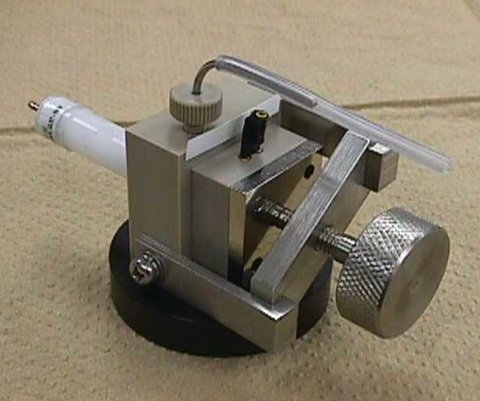
Non-Aqueous Ag/Ag+ Reference Electrode w/ porous Teflon Tip. For the CHI112, Ag+ solution (typically 10 mM) should be prepared with the supporting electrolyte and AgNO3 (not included). This solution is then filled into the reference electrode compartment using a syringe (not included). The instructions will come with the components.
CATEGORY
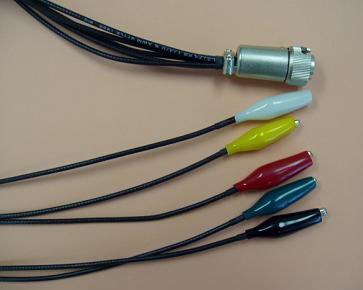
Electrode leads for model number xxx (where xxx = 600, 710B, etc.)
CATEGORY
Electrode Polishing Kit. The CHI120 electrode polishing kit contains 1 bottle of 1.0 micron Alpha alumina powder, 1 bottle of 0.3 micron Alpha alumina powder, 3 bottles of 0.05 micron Gamma alumina powder, 2 glass plates for polishing pads, 5 pieces of 73 mm diameter 1200 grit Carbimet disks (grey in color), 5 pieces of 73 mm diameter Mastertex polishing pads (white in color), and 10 pieces of 73 mm diameter Microcloth polishing pads (brown in color).
CATEGORY