SmartTip has recognised the growing demand for chemically activated probes for Chemical Force Microscopy (CFM) and has recently added chemical probes to its probe portfolio. CFM probe types CFM probes are prepared from commercially available AFM probes which are modified with specific functional groups using self-assembled monolayer’s of thiols on gold. Thiol-Au chemistry offers several advantages over alternative modification protocols: - Well-defined chemistry - Very organized and stable SAMs - Highly reproducible functionalization (robust production process) - Extremely versatile (many different chemical functionalities) Custom modifications and/or functionalization of probes provided by clients are often possible. Please do not hesitate to contact us with specific requests and/or questions. Benefits: - Off-the-shelf availability - SmartPack ensures high quality chemical probes - Variety of different chemical probes available - Custom modifications are possible - Excellent technical support and high customer service Applications Most CFM applications can be grouped into two main categories: - Surface analysis and characterization - Binding – unbinding events CFM measurement conditions can be tuned in terms of solvent, temperature and pH. Biological samples can be measured under physiological conditions. Types of applications: - Measurement hydrophilic/hydrophobic interactions - Intermolecular force measurements - Chemical sensing and detection - Local mapping of functional group distributions or receptors - Local mapping of surface properties (e.g. modulus) Application examples in different areas: - Polymers (determination composites/blends/phase separation/microstructure) - Biomaterials (implants, bio-sensors, dental enamel structure) - Tribology (friction, wear) - Cosmetics (hair, development shampoos/conditioners, skin, contact lenses) - Pharmaceutical industry (study of membrane proteins for development of new drugs)
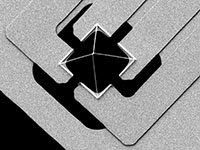
This probe features an AFM-type cantilever with a sharp pyramidal tip composed of four freestanding silicon nitride nanowires coated by conductive material. The nanowires form an electrical cross junction at the apex of the tip, addressable through the electrodes integrated on the cantilever. The cross junction on the tip apex can be utilized to produce heat and detect local temperature changes or to serve as a miniaturized Hall magnetometer enabling, in principle, thermal and magnetic imaging by scanning the probe tip over a surface.
CATEGORY
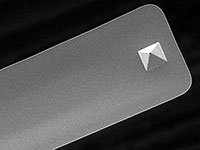
Scanning microscopy probes with a fluidic microchannel directly incorporated into an AFM-type cantilever allow controllable, local dispensing and aspiration of liquid through a submicron aperture at the probe tip. Our microfluidic probe can be used for various applications ranging from nanopatterning, ion conductance microscopy, patch clamp measurements, direct cell injection, cell staining and cell adhesion.
CATEGORY
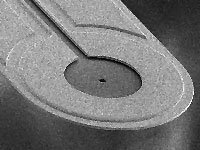
A drastic reduction of friction (superlubricity) on a scanning probe tip can be achieved by electrostatic force modulation. A novel AFM probe with an electrostatic circular membrane actuator monolithically integrated at the end of the cantilever allow an improved control of force excitation and consequently a more stable small-amplitude oscillation, which is essential for reduced friction.
CATEGORY
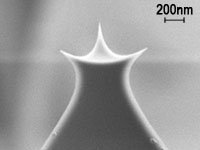
Scanning rates of the atomic force microscope (AFM) could be significantly increased by integrating the force sensing probe with microelectromechanical systems (MEMS). We present a micromachining method for batch fabrication of in-plane AFM probes that consist of an ultra-sharp silicon nitride tip on a single crystal silicon cantilever.
CATEGORY
