By Delta Optical Thin Film A/S
A simple way to extend the blocking range of a tunable bandpass filter is to slide in a small, fixed (homogeneous) wide-band bandpass filter as illustrated on Figure 6. The bandpass filter (BP) transmits almost 100% in the tuning range and blocks typically OD5-6 outside the tuning range. For a practical implementation, it is therefore beneficial to use a range of blocking filters that we use one at a time dependent on the center wavelength of the tunable filter. The transmission ranges of the different blocking filters overlap to enable both narrow and wide bandwidths.
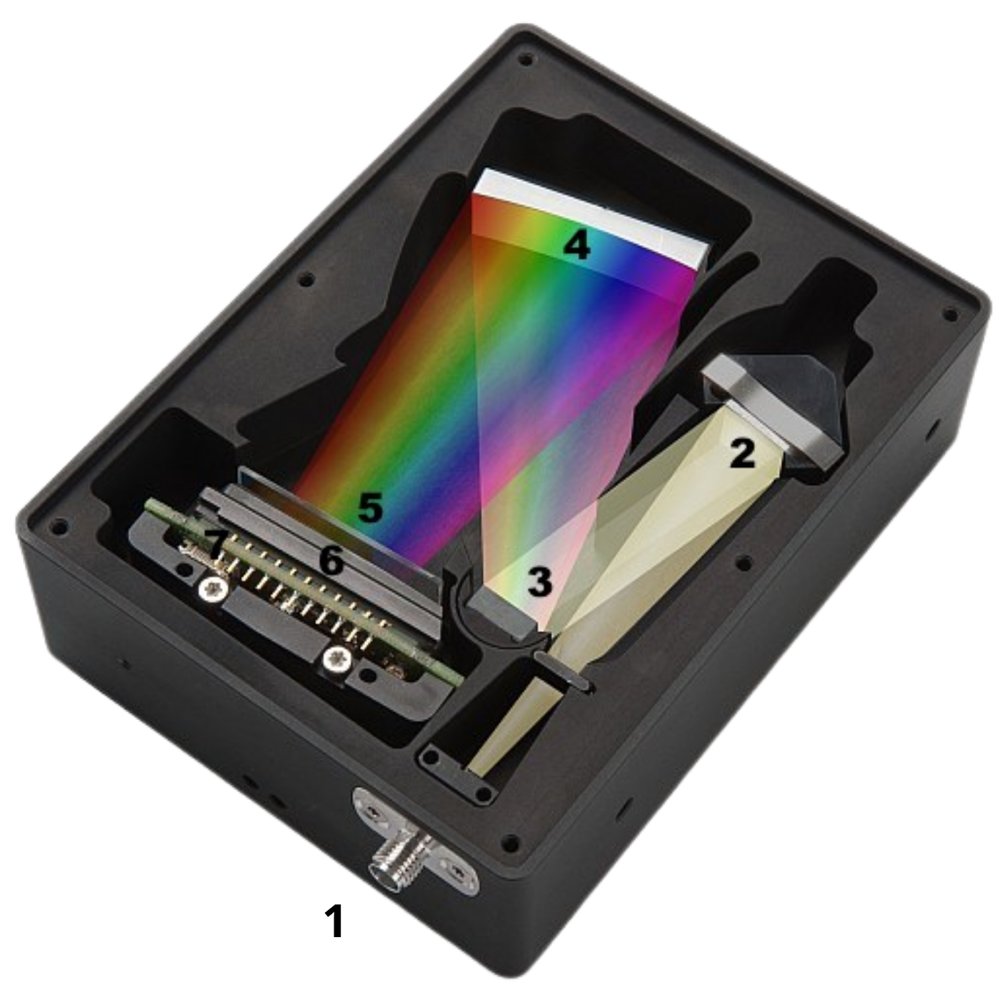
Linear Variable Order Sorting Filters deliver optimal higher‑order suppression for spectrometers, backed by Delta Optical Thin Film’s decades of high‑volume, high‑quality manufacturing. One of the key applications of our Continuously Variable Edge Filters is as Linear Variable Order Sorting Filters (LVOSF) in diffraction grating-based mini-spectrometers. The wavelength dispersive element in most mini-spectrometers is a diffraction grating which separates different wavelengths into different angle. In general, the grating diffracts light at each wavelength λ into multiple angles – called orders. The diffraction angle of the 1st order of λ coincides with the 2nd order of λ/2, the third order of λ/3 and so on. Normally, only the 1st order is used, and the higher orders need to be removed or ‘sorted out’ before they reach the detector. Linear Variable Order Sorting Filters provide the following benefits over fixed edge wavelength filters: - Continuous order suppression across the entire wavelength range - Simple set-up with one filter covering the entire UV-VIS-NIR - Reduced spectral artefacts around the blocking edge compared to hard‑edged fixed filters. A Linear Variable Order Sorting Filter is essentially a Long-Wave Pass Edge Filter, where the filter edge changes continuously along the length of the filter. When placed in front of the diode-array detector in a mini-spectrometer, the LVOSF blocks higher diffraction orders from the grating while letting the first order pass. Compared to discrete order sorting filters with a fixed cut-on wavelength, Linear Variable Order Sorting Filters provides - Continuous order suppression matching the 1st order dispersion of the spectrometer across the entire wavelength range - A simple set-up with only one filter covering the entire UV-VIS-NIR - Reduced spectral artefacts around the blocking edge compared to hard‑edged fixed filters - Reduced stray light The cut‑on wavelength changes almost linearly with position along the length of the filter substrate, although it is not perfectly linear. For this reason, we sometimes refer to our filters as continuously variable. In spectrometer applications, the small deviation from linearity has no practical significance. In many cases, we can customize a filter by cutting a specific section from a longer substrate. Delta Optical Thin Film also offers fully custom designs, including tailored wavelength ranges, gradients, substrate sizes, and blocking performance. Each filter can be optimized to match the requirements of your optical system. Delta Optical Thin Film’s filters are optimized for high‑volume manufacturing with consistently high quality and performance. Delta Optical Thin Film’s LVOSF are coated on UV grade fused silica substrates and can be supplied with different dispersions matched to a specific detector and in different sizes. They can be manufactured either with a coating that covers the whole length of the filter or with a section that allows UV light to pass. The key application of our Linear Variable Order Sorting Filters is in diffraction grating-based mini-spectrometers – especially when the spectrometer wavelength range spans more than one octave.A typical spectrometer for example that ranges from 190 nm to 1100 nm needs three different order sorting filters.No matter if these three different filters are mechanically assembled or directly coated onto one substrate there will always be a transition region where the detector will collect meaningless signals. Delta Optical Thin Film’s Linear Variable Order Sorting Filters (LVOSFs) remedy this situation because the coating is continuous and the cut-on wavelength changes continuously along the filter.Furthermore, a CVOSF suppresses maximum amount of stray light because the cut-on wavelength moves together with the dispersion of the grating.
CATEGORY
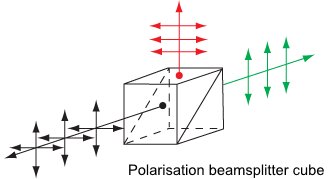
Besides flat Dichroic and Polarisation Beamsplitters Delta Optical Thin Film also manufactures Beamsplitter Cubes. Their size can vary between (5 mm)³ and (15 mm)³. Beam splitter cubes are used with collimated light with only a small Cone Half Angle (CHA) – typically laser light. The biggest advantage of cubes over flats is that beam offset and ghosting that are introduced by flat beam splitters can totally be avoided with cubes. In general, one differentiates between Polarisation and Dichroic Beamsplitters. The first type splits the incident light beam depending on its polarisation state irrespective of its wavelength (colour). The latter type splits the incident light beam depending on its wavelength (colour) irrespective of its polarisation state. Polarisation (also called polarising) Beamsplitters: A Polarisation Beamsplitter is used when incident light needs to be separated into different polarisations – typically s- and p-polarisation. It depends on the design, which of the two polarisations is transmitted and which is reflected. Dichroic (also called colour or non-polarising) Beamsplitters: A Dichroic Beamsplitter is used when incident light needs to be separated by its wavelength. Both short wave pass and long wave pass Dichroic Beamsplitters are available. Intensity Beamsplitters: An Intensity Beamsplitter is used when incident light needs to be separated into two beam of equal or different intensity irrespective of both wavelength and polarisation state. Delta Optical Thin Film’s Multifunctional SMART™ Coatings: Delta Optical Thin Film has developed proprietary coatings that can combine different functionalities. An example of a smart component could be one that acts as a Polarisation Beamsplitter in two spectrally separated wavelength ranges. In this way a Polarisation Beamsplitter can be constructed that covers multiple laser wavelengths over a much wider range than a conventionally designed beamsplitter. Another example of a smart component could be one that acts as a Polarization Beamsplitter in one wavelength range, as a laser mirror in another range and as a bandpass filter in a third wavelength range. If you need further information please, contact us. All our beamsplitter cubes are customised products. We can also develop your custom specific beamsplitter.
CATEGORY
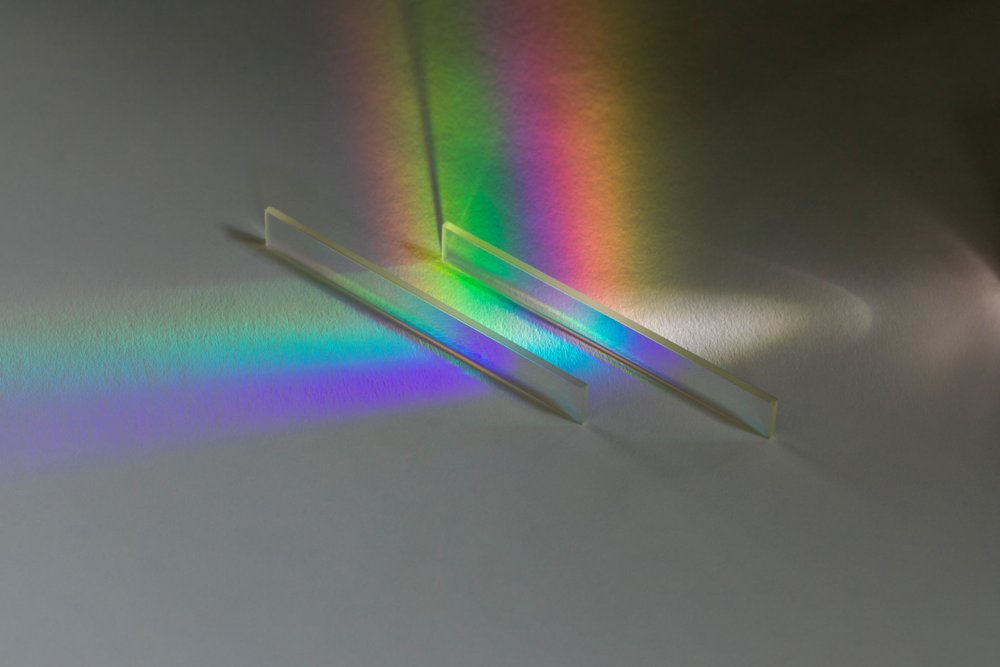
Linear Variable Beamsplitters – also called LV Dichroics – allow you to build fully tunable epi‑fluorescence systems with far fewer components. These continuously variable beamsplitters are typically long‑wave‑pass designs optimized for 45 degrees Angles of Incidence (AOI). By translating the filter along its length, you can select the exact cutoff wavelength needed for your excitation and emission separation. LV Dichroics provide a nearly linear shift of the edge along the substrate. Both types integrate seamlessly with our Linear Variable Bandpass Filters and Linear Variable Edge Filters to form a complete, fully tunable epi‑fluorescence filter set. Benefits of Linear Variable Beamsplitters: - Enable completely tunable epi‑fluorescence setups using a single beamsplitter - Replace multiple fixed dichroics with one compact, continuously variable component - Fast, wavelength selection by translation - Smaller and simpler systems compared to filter wheels - High transmission and stable optical performance Continuous Variable Dichroics – also known as Linear Variable Dichroics – are essentially linear‑variable edge filters optimized for a 45‑degree angle of incidence. Wavelengths shorter than the edge are reflected, while wavelengths longer than the edge are transmitted. As the filter is translated through the beam, the cutoff position shifts accordingly, changing the division between reflected and transmitted wavelengths. The spectral variation is often close to linear with respect to position. Specifications (LV Dichroic, LF102227): Edge/center 320 - 760 nm; Transmission T 90%; Max size 60 mm x 23 mm x 1 mm. Product example: LV Dichroic (LF102227) This filter is a Continuously Variable Long Wave Pass filter with a nominal Angle of Incidence (AOI) of 45 o that can be used as a beam splitter - The 50 % edge wavelength travels from ≤ 320 nm to ≥ 760 nm within ≤ 58 mm - Broadband transmittance is ≥ 81 % for λ 50% in the 320-420 nm range and ≥ 87 % in the 420-760 nm range - Averagne broad-band blocking is ≤0.05%for λ 50% in the 320-420 nm range and≤0.1% in the 420-760 nm range
CATEGORY
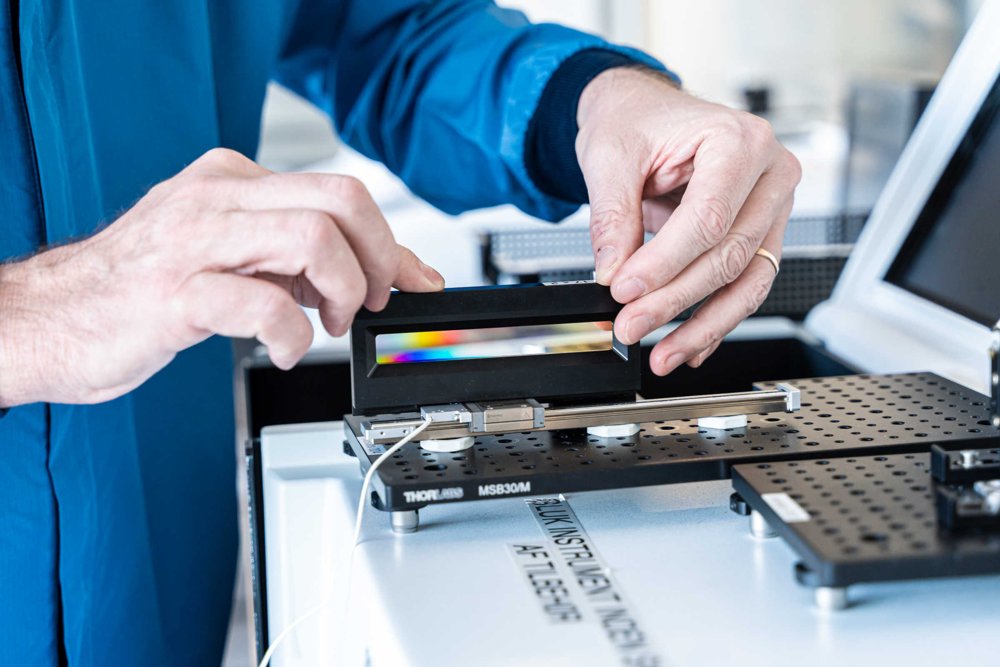
High‑performance Linear Variable Bandpass filters built on decades of optical innovation, enabling you to reduce system complexity. Linear Variable Bandpass Filters (LVBF) deliver precise spectral control in a compact, tunable format. - Fast, wavelength selection by translation - Smaller and simpler systems compared to filter wheels - High transmission and stable optical performance - Easy integration into hyperspectral and sensing applications Continuously Variable Bandpass Filters – also known as Linear Variable Bandpass Filters – are optical filters where the centre wavelength of the band varies continuously at various positions on the filters. Linear Variable Bandpass Filters vary their centre wavelength along a linear axis, typically along the longest dimension of the filter substrate. The variation itself might be close to linear to the position but can also follow other functions (e.g. exponential). An LVBP filter is a thin‑film optical filter whose center wavelength changes linearly along one dimension. By moving the filter or scanning the light spot across its surface, you can select different passbands without mechanical filter wheels or multiple discrete filters. LVBP filters provide continuous wavelength tunability, compact system design, and high spectral stability. They replace large filter sets, simplify instrument architecture, and enable fast, flexible wavelength selection in compact spectrometers, imaging systems, and hyperspectral setups. Yes. Delta Optical Thin Film offers custom wavelength ranges, gradients, substrate sizes, and blocking performance. Filters can be optimized depending on your system requirements. LVBP filters are widely used in compact spectrometers, hyperspectral imaging, fluorescence detection, environmental sensing, semiconductor inspection, and OEM analytical instruments—anywhere tunable, space‑efficient spectral selection is needed.
CATEGORY
