- Design variant detection probes optimized to hybridize Small Nucleotide Variations (SNVs) in a target genome. - Design multiple probes per target. - Include nucleotide modifications in primer/probe design.
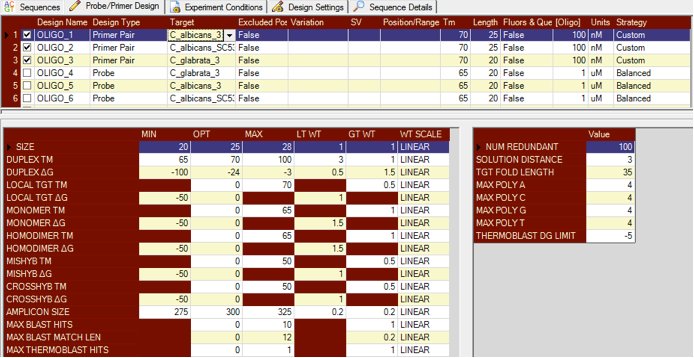
PCR Primer Design Tool. Visual OMP uses a dynamic programming algorithm to calculate the energy of all possible structures by using our thermodynamic database. The optimal and nearby suboptimal structures are predicted to be the most populated at equilibrium. Types of Design with Visual OMP: - PCR Primer - Multiplex PCR Primer - Existing PCR Assays - Taqman - Molecular Beacon - Microarray - Polymorphism - RNA Target Selection PCR Primer Design: Poor primer PCR design is the one major cause of all failures or false positives or negatives in single and multiplex PCR. Primers may fail for many different reasons and the major factors that affect PCR primer designs are: 1. Assay temperature which affects the equilibrium constant of oligo binding, hence the amount of primer that binds its target. 2. Cation concentration (K+, Na+, Mg2+, NH4+) which affects the stability of one oligonucleotide binding to another. 3. Buffer additives / consistencies such as denaturants or viscosity. Current buffer additives include glycerol, DMSO, formamide, TMAC and betaine, all of which will affect the thermodynamic stability of oligo hybridization. 4. Desired annealing temperatures for primers and probes, which is related to oligo length and amplicon size. 5. Secondary structure which affects any oligonucleotide and its ability to bind to another oligonucleotide or itself. Visual OMP uses a dynamic programming algorithm to calculate the energy of all possible structures by using our thermodynamic database. The optimal and nearby suboptimal structures are predicted to be the most populated at equilibrium. 6. Synthetic nucleotide modification, such as modified backbones, sugars or bases that have the ability to increase or decrease target binding. Multiplex PCR Primer Design With Visual OMP: Visual OMP (multiplex PCR primer assay design software) can design multiple primers and probes at the same time using a dynamic design algorithm that queries each oligo design against every other oligo in the system to check for intended and unintended cross- and mishybridization. The size of the plex design depends on many factors such as target number, length, complexity and secondary structure, all of which further depends on the defined experimental conditions that are used. A typical use case would involve a 20-plex of targets that are about 500 nucleotides long at standard endpoint PCR conditions. Multiplex pcr assay designs that are larger than this would require the use of OMP-Developers Edition, which is a server-based command line design and simulation application. Analyze Existing PCR: Visual OMP's simulation engine is a very powerful tool which uses multi-state coupled equilibrium to analyze the behavior of existing assays that did not perform as predicted in design due to poor thermodynamic design or the existence of prohibitive secondary structures. Once the offending primers or probes are identified, then Visual OMPs design engine can design new oligos in the presence of the existing oligos to optimize assay sensitivity and selectivity. Existing sequences can be imported into Visual OMP from a fasta file and if the file contains no nomenclature, then the sequences will be imported as Oligo1 and so on. Taqman Design: Visual OMP can design both Taqman Probes and Taqman Minor Groove Binder Probes, depending on your application while the simulation engine accounts for the thermodynamic contributions of the available fluorophore and quencher sets and the contribution of the minor groove binder. Furthermore, it is possible to exclude or selectively target various target regions during design. DNA Software's extensive fluorophore and quencher library has been experimentally validated and tested for the most accurate simulations possible. Molecular Beacon Design: Visual OMP designs both molecular beacons and allele specific molecular beacon pairs. Loop and stem size, melting temperature and free energy can be controlled to optimize selectivity and sensitivity of designed beacons. Beacon stems are designed to not mishybridize to adjacent target sequences which may quench a fluorophore report and the stem can be optimized with a terminal G/C pair stem terminal option. Probe Design and Analysis: Using Visual OMP's cross-hybridization grid a user may visually inspect all heterodimer interactions between oligos in seconds, and determine the problem probes and targets that are not functioning as predicted due to significant cross-hybridization or mishybridization. The cross-hybridization grid may be filtered so that a user may color customize the interactions of importance. In the figure below all of the intended hybridization from this microarray probe is labeled by green boxes. Polymorphism Design and Simulation: Visual OMP is also able to design allele specific primers and probes over or around single SNP sites for the binary IUPAC ambiguity codes. In this example a C. albicans sequence with a W ambiguity code (A or T) is 97.95 % differentiated by Visual OMP using two allele specific forward primers and a common reverse primer. Multiple SNP sites or ambiguity codes are not supported at this time. Target Selection: The figure below shows an RNA sequence fold in Visual OMP with its Target Accessibility plot, which shows a user the best areas, given experimental conditions, to design primers and probes. The regions where the target complexity (green) and target unfolding DG (blue) overlap on the Accessibility plot are the regions where the strongest secondary structure exists, and as such, these areas should be avoided for design. The Target Accessibility plot for the RNA sequence fold top left under experimental conditions of 55 ˚C, 50 mM NaCl and 0.5 mM MgCl2. The Target Accessibility plot for the RNA sequence fold top right under experimental conditions of 37 ˚C and 1 M NaCl.
CATEGORY
qPCR curve fitting to determine absolute copy number in every well. CopyCount™ (qpcr analysis software) turns every qPCR reaction into an absolute copy number determination. What is CopyCount? CopyCount™ analyzes the shape of qPCR fluorescence data to deduce the absolute number of copies of target DNA/RNA at cycle zero. There is no need for a standard curve, or sample dilution, or excessive replicates – instead every individual qPCR curve can be analyzed to give absolute copy number. This is useful for determining viral load, bacterial load, standardization of reference stocks, and other applications. CopyCount™ saves you time and money by reducing the need for excessive replicates and standard curves and increases the real estate on your plate that is devoted to unknowns rather than standards. Results from CopyCount™ are simple to interpret: CopyCount™ gives the number of molecules of DNA at cycle zero. No more mathematical gymnastics are needed to interpret complex Ct values. CopyCount™ uses your existing qPCR instrumentation, rather than expensive Digital PCR instrumentation. The Problem With Absolute Quantification Obtaining absolute PCR quantification currently requires the laborious preparation of standards and acquiring a standard curve, thereby wasting reagents and using valuable plate real estate. In addition, the traditional qPCR analysis method determines the “cycle threshold”, Ct or Cq, which varies for different assays, different machines, and varies from plate to plate, thereby making the Ct value hard to interpret. Solving Absolute Quantification with qPCR CopyCount DNA Software has made a breakthrough in understanding the mechanism of PCR amplification. Our new product, qPCR CopyCount™, allows for any qPCR curve to be analyzed to directly determine the absolute number of copies of DNA at cycle zero. The DNA copy count is the quantity that every biologist wants and the results provided by qPCR CopyCount™ have unprecedented relative and absolute accuracy. How can qPCR CopyCount™ benefit your research as a Digital PCR alternative? - DNA copy number results that are 3-4 X more precise than Ct method - Eliminates two common sources of user error, namely the quantification of standards and the running of standard curves - Accelerate your workflow with existing qPCR instrumentation - Cost effective alternative to Digital PCR A Novel, Validated Method for Absolute qPCR Quantification. Absolute Quantification with Existing qPCR Instruments Utilizing your current lab equipment and methods, and providing you higher sample throughput than Digital PCR, qPCR CopyCount™ provides absolute quantification with outstanding accuracy, within 5% errors. Rather than the need for expensive new equipment, qPCR CopyCount™ makes every qPCR reaction an absolute reaction. Lower Cost Per Well qPCR CopyCount™ requires no quantification standards and provides users more sample wells rather than control wells. In other words, “more real estate for your plate”. Export Formats qPCR CopyCount requires that you upload your raw qPCR fluorescence data for each cycle as a text based CSV/TSV file or Excel XLS/XLSX formats. At this time we are unable to support direct binary formats such as SDS and EDS files. Currently, we can automatically detect the following formats: - Abbott m2000rt - ABI 7500/7900 - Bio-Rad: CFX and iCycler - Fluidigm - Life Technologies: ViiA 7, Step One, OpenArray 12K Flex - Qiagen: Rotor-Gene - Roche: LC480 and Lightcycler Series - StrataGene MX - General Column-Layout CSV - General Row-Layout CSV If your data is not in one of the above formats, please contact DNA Software and we will work on adding it to the system! “DNA Software has discovered the quantum nature of qPCR” Interested in learning more about CopyCount™? CopyCount™: qPCR Analysis Software turns every qPCR reaction into an absolute copy number determination. See how CopyCount™ can benefit your organization.
CATEGORY
Scans multiple primers against collections of genomes to find all hybridizations and amplicons. ThermoSleuth™ finds all mishybridization sites, eliminates false positives in PCR Solving Primer Specificity ThermoSleuth™ automatically scans oligos against large genome databases to detect all thermodynamically stable hits. Different from BLAST, ThermoSleuth™ captures the important mishybridization hits by considering the following: - Appropriate thermodynamic scoring, as BLAST doesn’t differentiate a GC pair from an AT pair - Displays all false amplicons - Consideration for 3’ extensibility and stable mismatches - ThermoSleuth will score based on complementarity as opposed to similarity in BLAST - ThermoSleuth allows for solution conditions, salt, buffers, additives and other experimental factors The problem of false positives in PCR The most common cause of false positives in PCR is the formation of false amplicons due to primer mishybridization which is not detected by BLAST because it scores hits incorrectly using sequence similarity rather than using the proper rules for match and mismatch complementarity. Additionally, many researchers do not have access to the computational capacity or storage required of modern genomic-based assay designs. The solution to false positives in PCR ThermoSleuth solves the problem of primer and probe mishybridization by scanning against whole genome databases such as the human genome or microbiome using the speed of BLAST while applying the proper thermodynamic model to mishybridization and crosshybridization results. The cloud integration of ThermoSleuth enables all researchers with the computational power to capture 50X as many thermodynamically stable and extensible hits as BLAST. How to Eliminate False Positive in PCR Design. Pre-made and customizable genome collections ThermoSleuth contains a huge repository of curated and pre-formatted sequence databases that can further be arranged into a customized sequence playlist. Some of the most popular playlists are shown below. Customers now have the capability to build a background database as large as they need without restricting memory, storage or computational capacity which is a huge source of pain for those researchers that have limited local computational capacity. ThermoSleuth Features (PCR assay design tool) - Single Genome Scan - Multiple Genome Scan - Playlist of Genomes - Detects Extensible Hits - Detects Probe Hybrdization - Evaluates probe dyes and minor groove binders. - Specificity Checking - Sensitivity Checking - Correctly scores mismatches by identity - Detects Amplicons - Adjustable primer extensibility settings - Allows download of amplicon plus tails - Graphic overview of results - Genome view provides detailed thermodynamics - Multiplex Capability - Differentiates DNA from RNA backbones - Modified Backbones - Modified Bases - Uses Monovalent Salt - Uses Divalent Salt - Simulates at different temperatures - Simulates at different primer concentrations - Correctly scores target dangling ends - Correctly scores bulges
CATEGORY
Integrate DNAS folding algorithms into your design pipeline. The core of DNA Software’s product line is its computational environment, the Oligonucleotide Modeling Platform. The core of DNA Software’s product line is its computational environment, the Oligonucleotide Modeling Platform. OMP is a programmable predictive modeling environment, which is used to develop customer-specific applications that access the computational and storage capacity of a local server. OMP takes all of the chemical and biological knowledge and expertise developed by DNA Software, Inc. and encapsulates it into a single design and simulation PCR script software platform. Key technology features of OMP include: Fully encapsulated design and simulation platform that precisely designs and predicts oligonucleotide hybridization that will result from monomer, homodimer and heterodimer species under your specific oligo concentrations and temperature and salt conditions. A defined scripting language that allows OMP to be programmed to perform specific tasks such as batch runs or weeding through simulation data to more easily see what’s important to your application. Cutting edge peer-to-peer distributed high-performance computing architecture with an API for Perl script access to the OMP engine that can run on most any Windows, Linux or Unix machine. Customizable gadgets to help you rationalize and organize cross-hybridization and melting curve data which is particularly useful for large multiplex design and simulation. Simulation data can be visualized using Visual OMP™ and assay specificity can be evaluated using ThermoSleuth™. Improve sensitivity with modified backbones and nucleotides. The Science Behind OMP Efficiently designing high-throughput, accurate diagnostics requires the ability to predict in advance precisely how oligonucleotides behave under the conditions of a given assay. To address this challenge, DNA Software has developed the Oligonucleotide Modeling Platform (OMP), the computational environment which forms the foundation of the company’s product line. With OMP, it is possible to predict the melting temperature (Tm) of a duplex within 2 ˚C, on average; significantly more accurately than other popular commercial software packages or freeware, which simply lack the rigor and precision needed for today’s demanding, high-throughput assays. DNA Software’s CEO, Dr. John SantaLucia, has spent over 20 years developing a nearly complete database of thermodynamic parameters derived from 1000’s of empirical observations. He also developed a better model for calculating thermodynamics that produces more accurate and reproducible results. Oligonucleotide Modeling Platform The core of DNA Software’s product line is it’s computational environment, the Oligonucleotide Modeling Platform (“OMP”). OMP is a programmable predictive modeling environment, which is used to develop customer-specific applications. OMP takes all of the chemical and biological knowledge and expertise developed by DNA Software scientists and Dr. SantaLucia’s previous work, and encapsulates it into a single, simulation platform. Key technology features of OMP include: A defined scripting language, allowing OMP to be “programmed” for specific tasks necessary to users or client applications, Fully encapsulated hybridization science functions which precisely predict the DNA hybridization that will result from any specific oligo experiment under a variety different design conditions, including; Single-strand optimal and sub-optimal unimolecular structure prediction, recursive bimolecular hybridization algorithm, Customized numerical analysis code for the solution of multiple coupled hybridization equilibria, DNA secondary structure display, Display of species concentrations as a function of temperature, Interface with the sequence and annotation data in the SNP database, Interface with the Oracle, SQL and MS ACCESS database format, Rich modeling functionality, including capabilities to predict DNA microarray effectiveness, PCR and PCR multiplexed efficiency, and oligo probe and primer interactions (dimerization), A cutting edge peer-to-peer distributed computing architecture which allows OMP to run across a cluster or network of PCs, making OMP scalable and extremely fast, Cross-platform capability to run on most any commercial Windows, Linux, or Unix machine. Interested in learning more about OMP-DE™? The core of DNA Software’s product line is its computational environment, the Oligonucleotide Modeling Platform. See how OMP Developer Edition™ can benefit your organization.
CATEGORY
